
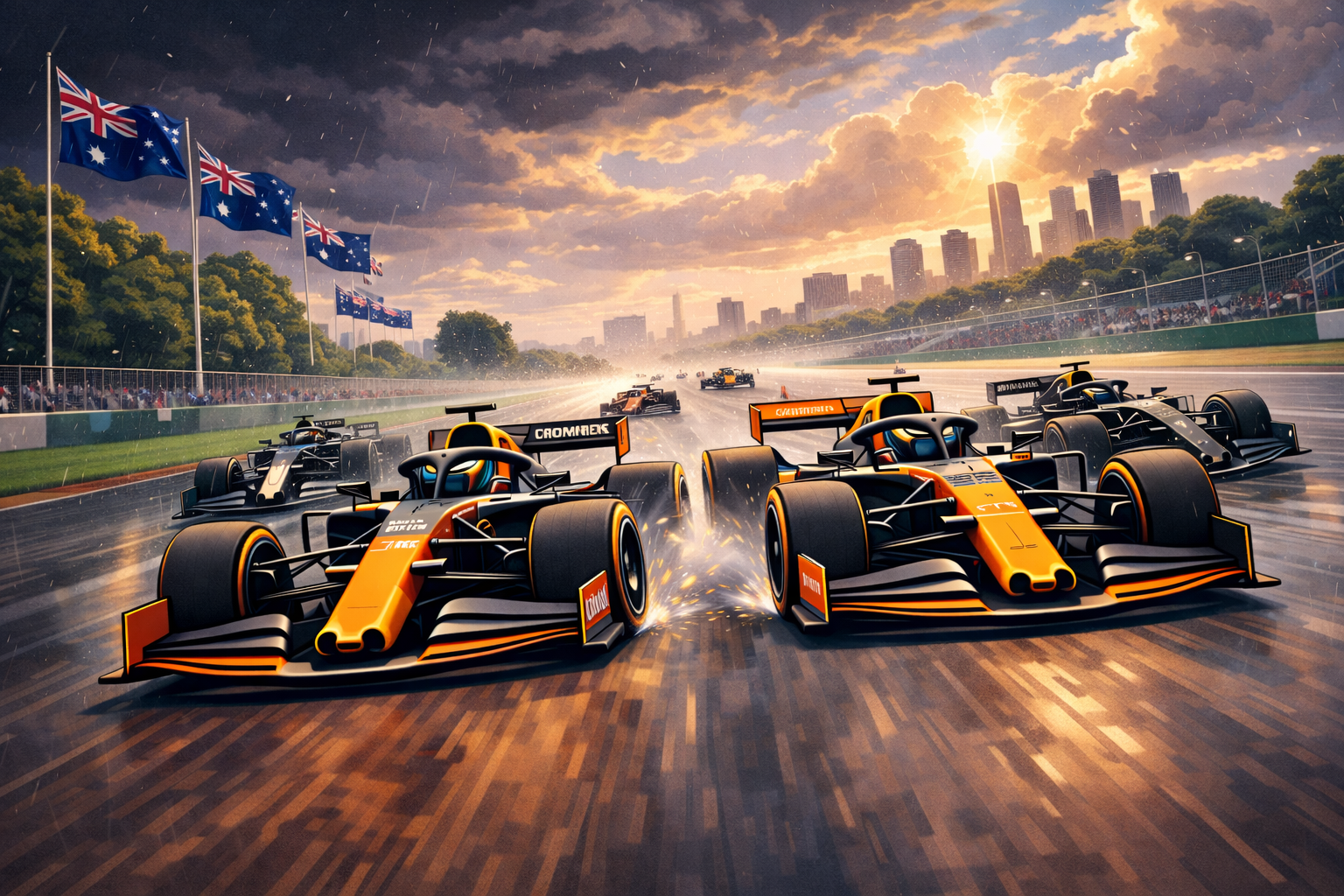

The 2025 Australian Grand Prix delivered a spectacular start to the new Formula 1 season, with Lando Norris taking a hard-fought victory for McLaren in a chaotic wet. dry race at Albert Park. From multiple Safety Cars to changing weather and standout rookie performances, Melbourne set the tone for what could be one of the most competitive seasons in recent years.
Melbourne sets the tone for 2025
As the opening round of the 2025 Formula 1 World Championship, the Australian Grand Prix always carries extra weight and this year was no exception. Fans arrived at Albert Park eager to see how the pecking order had shifted over the winter, with established contenders like Max Verstappen and Lewis Hamilton facing renewed threats from rising stars and rapidly improving teams. The race delivered on that anticipation, producing a tense battle at the front and plenty of action throughout the field.
Qualifying had already hinted at a close fight, with Lando Norris putting his McLaren on pole and Verstappen lining up close behind in the Red Bull. The likes of George Russell, Oscar Piastri and highly rated rookie Kimi Antonelli all positioned themselves to capitalise on any mistakes from the front row. With dark clouds hovering over Melbourne, strategy and tyre choices were always going to be just as important as outright pace.
Wet. dry chaos and key race conditions
The grand prix started on a damp track after earlier rain showers, forcing teams to begin on intermediate tyres and judge how quickly the racing line would dry. Grip was limited in the opening laps and those who pushed too hard were quickly punished, as several drivers slid wide or ran deep into the braking zones. The conditions rewarded smooth, precise driving and made it difficult for anyone to pull away comfortably at the front.
As the race developed, a clear dry line gradually appeared, tempting some teams to consider an early switch to slicks. Making that change at the right moment became one of the defining strategic questions of the afternoon. Pit walls had to balance the risk of losing time on the wrong tyre against the potential reward of an undercut, all while keeping an eye on the radar for the possibility of more rain later in the race.
Norris vs Verstappen: the battle at the front
From pole position, Norris executed a clean launch and settled into the lead, but Verstappen applied pressure almost immediately in the early laps. The Red Bull driver, a multiple world champion and still the benchmark for many rivals, tested Norris’s composure by staying within striking distance whenever the McLaren encountered traffic or hit a patch of lower grip. For long stretches, the gap between the two hovered at just a couple of seconds.
Once the track was ready for slick tyres, both leaders moved onto dry compounds without major drama and the duel resumed on a faster, yet still tricky surface. Norris impressed with his consistency and confidence in the high-speed sections, where the McLaren seemed to work particularly well. Verstappen, however, remained a constant threat and never allowed Norris to relax, especially around the DRS zones where the Red Bull’s straight-line efficiency came into play.
The final phase of the race brought renewed tension as the clouds returned and light rain began to fall again. Grip dropped just enough to create uncertainty, but not enough to make a switch back to intermediates an obvious choice. Norris had to manage his tyres, his battery and his nerves while Verstappen closed in, but the McLaren driver held firm and crossed the line to take a hugely significant win for himself and his team.
Mercedes shines with Russell and Antonelli
Behind the leading pair, Mercedes enjoyed one of its most encouraging weekends in recent seasons. George Russell delivered a composed and intelligent drive to secure a podium, managing the changing grip levels and staying out of trouble when incidents unfolded around him. His third place underlined that Mercedes has taken a step forward with its 2025 challenger and may be ready to fight more regularly at the sharp end.
Even more eye-catching was the performance of Mercedes rookie Kimi Antonelli. Starting further back than he would have liked, Antonelli methodically picked his way through the field, showing strong pace in both wet and dry conditions. He avoided the errors that caught out more experienced names and demonstrated excellent racecraft in wheel-to-wheel battles. A time penalty for an unsafe release briefly threatened to drop him down the order, but once it was overturned, his impressive finish near the front stood as one of the stories of the day.
For fans following Antonelli’s rise through the ranks, the Australian Grand Prix provided early confirmation that he has the talent to justify the hype. With Russell as a strong reference point inside the team, Mercedes appears to have a potent driver line-up to support its push back toward regular victories.
Ferrari’s rollercoaster afternoon
Over at Ferrari, the race was a mixture of promise and frustration. With proven race winners like Lewis Hamilton and Charles Leclerc, the team had hoped to turn solid qualifying pace into a big points haul. At times, particularly when the strategy calls looked bold, Ferrari appeared ready to challenge the leaders, but a combination of timing misjudgements and the unpredictability of the weather ultimately left them short of the podium.
One of the key moments came when Ferrari chose to keep Hamilton out on slick tyres as rain started to intensify, gambling that the shower would be brief or manageable. For a few laps, the decision looked inspired as rivals dived into the pits and Hamilton gained track position. However, as grip levels deteriorated, he was forced to pit anyway, losing the advantage he had built and dropping back into the pack. Leclerc’s race was similarly complicated by strategy swings and traffic, leaving Ferrari with fewer points than their pure pace might have justified.
Hamilton’s first race in red was always going to attract enormous attention. The move from Mercedes to Ferrari was one of the biggest stories of the off-season. Melbourne gave us a glimpse of what he can do in the car, but also a reminder that even the most decorated driver on the grid can’t overcome a poorly timed pit stop. The Tifosi will be patient, but they’ll want results soon.
Midfield heroes and costly mistakes
The midfield battle in Melbourne was as lively as ever, with drivers from Williams, Aston Martin, Haas and others taking turns in the limelight. Alexander Albon produced another strong performance for Williams, making the most of the mixed conditions to run inside the top ten for much of the race and secure crucial early-season points. His ability to keep calm when the race descended into chaos highlighted why he is so highly valued by the team.
Veteran racer Nico Hülkenberg also impressed, using his experience to stay clear of major incidents and bring home a solid result for Haas. In contrast, some drivers paid a heavy price for small mistakes. Liam Lawson and Gabriel Bortoleto both found the barriers at different stages of the race as grip levels changed, triggering Safety Cars and reshuffling the order yet again.
The home crowd had plenty to cheer for with Oscar Piastri, even if his race did not quite match the fairytale scenario many locals had hoped for. Despite some strategic compromises and time lost in traffic, Piastri showed strong pace and racecraft, fighting inside the points and reminding everyone that he will be a serious threat throughout the season, especially as McLaren continues to refine its package.
Rookies under the spotlight
The 2025 Australian Grand Prix also served as a reality check for several rookies making their way onto the grid. Isack Hadjar saw his race end before it really began after a costly mistake on the formation lap, a painful lesson in how little margin for error exists at this level. Local favourite Jack Doohan and experienced campaigner Carlos Sainz were involved in separate early incidents, adding to the drama of the opening laps.
However, while some newcomers struggled, others seized the opportunity to showcase their potential. Antonelli’s measured drive stood out, but there were also promising signs from drivers like Franco Colapinto and Arvid Lindblad, who gained valuable experience in extremely challenging conditions. Their ability to adapt quickly will be crucial as the season moves on to circuits with very different characteristics.
What this result means for the 2025 season
Norris’s win for McLaren, Verstappen’s relentless pressure for Red Bull and the double strength shown by Mercedes suggest that the 2025 championship fight could be far more open than some previous seasons. Each of these teams left Melbourne with reasons for optimism: McLaren proved it can convert qualifying pace into race wins, Red Bull showed that Verstappen will always be in contention and Mercedes demonstrated that its latest car is a step forward.
Further back, Ferrari knows it has work to do in fine-tuning strategy and execution if it wants to turn its driver line-up and raw speed into consistent podiums. Teams like Aston Martin, Williams, Alpine and Kick Sauber will look at the Australian Grand Prix as both a warning and an opportunity: on a day when so many variables are in play, staying clean and making bold but well-timed calls can transform a midfield car into a points-scoring contender.
As the championship now moves on from Melbourne, the big question is whether the Australian Grand Prix was a one-off spectacle driven by changeable weather or the first glimpse of a season-long three-way fight between McLaren, Red Bull and Mercedes. If Norris, Verstappen, Russell and the likes of Hamilton, Leclerc and Piastri continue to trade blows at this intensity, fans can look forward to a 2025 campaign packed with storylines, rivalries and unforgettable races.
How Norris is maturing as a title contender
There was a time when Norris would have been the driver making the error under pressure. Not anymore. His management of that final stint, with rain falling and Verstappen right behind him, was the kind of drive that separates genuine title contenders from fast drivers who are still learning. He kept his head, looked after the rear tyres and didn’t crack. That’s a different Lando to the one we saw even twelve months ago.
McLaren’s growth as a team mirrors his own. Their pit calls in Melbourne were sharp. Their communication looked calm. The whole operation has a confidence about it that you can feel even watching from home. If they can carry that into the flyaway races and the European summer, they’re going to be very hard to stop. Whether the rest of the grid can match that consistency is the real story of 2025. For a deeper look at how underdogs can build championship-winning operations, the story of the Brawn GP miracle is worth revisiting.
Albert Park in the wet: a circuit that punishes hesitation
Albert Park doesn’t forgive drivers who second-guess themselves. The street-style layout has walls close to the racing line, limited run-off in key braking zones and surface changes that make grip unpredictable even in dry conditions. Add rain to that and you’ve got a circuit that rewards instinct and punishes hesitation. It’s one of the reasons Melbourne produces so many memorable races.
The track has been resurfaced and modified in recent years, which has generally made it faster and more overtaking-friendly. That worked in the race’s favour in 2025. Drivers could actually follow each other through some of the medium-speed corners, which kept the on-track battles alive rather than everything being decided in the pit lane. It’s a circuit that rewards a well-sorted car but also gives a smart driver room to punch above his weight. Albon proved that again.
If you want to understand why certain drivers thrive in these chaotic conditions, it helps to look at the broader picture of how racers build mental resilience over a career. Damon Hill’s path to the championship is a good example of a driver who had to find that composure the hard way. Norris is finding it much earlier.
Key takeaways
- Norris delivered a mature, controlled victory under genuine pressure from Verstappen. His tyre and battery management in the closing laps was the difference.
- Mercedes looks genuinely competitive again. Russell’s podium and Antonelli’s strong debut drive suggest the Silver Arrows are back in the mix at the sharp end.
- Ferrari’s strategy cost them. The pace was there but the timing calls in the wet-to-dry transitions let Hamilton and Leclerc down at critical moments.
- Rookie performances were mixed. Antonelli impressed, Hadjar’s race ended on the formation lap. The gap between potential and execution is still wide for several newcomers.
- The 2025 title fight looks genuinely open. Three teams left Melbourne believing they can win races. That hasn’t been the case for a while.
Frequently Asked Questions
Who won the 2025 Australian Grand Prix?
Lando Norris won the 2025 Australian Grand Prix for McLaren. He started from pole position and held off Max Verstappen throughout a wet-dry race at Albert Park in Melbourne. It was a significant result for Norris personally and for McLaren as a team, signalling their intent to fight for the 2025 championship from the very first round.
How did Kimi Antonelli perform on his F1 debut in Melbourne?
Antonelli impressed on his debut, working his way through the field in difficult mixed conditions. He showed clean racecraft and strong pace in both wet and dry phases. A time penalty for an unsafe release was overturned, allowing his final result to stand. It was one of the more encouraging rookie debuts in recent seasons and justified the hype around him.
Why did Ferrari struggle in the 2025 Australian Grand Prix?
Ferrari’s main issue was strategy timing. They kept Lewis Hamilton out on slick tyres as rain intensified, hoping the shower would pass quickly. It didn’t. He lost the track position he had gained and dropped back through the field. Leclerc faced similar complications. The car had pace but the execution in the changing conditions let the team down.
How many Safety Cars were there in the 2025 Australian Grand Prix?
There were multiple Safety Car periods during the race, triggered by incidents including crashes from rookies Liam Lawson and Gabriel Bortoleto. The changeable Melbourne weather and the mix of wet and dry conditions throughout the afternoon made it a difficult race to manage and the Safety Cars repeatedly reshuffled the running order.
Is the 2025 F1 championship expected to be a three-way fight?
Based on Melbourne alone, yes. McLaren, Red Bull and Mercedes all showed genuine race-winning pace. Ferrari has the driver line-up to compete but needs to sharpen its strategy. The midfield is also closer than in recent years. If the opening round is any guide, 2025 could be one of the most competitive championships in a long time.
