
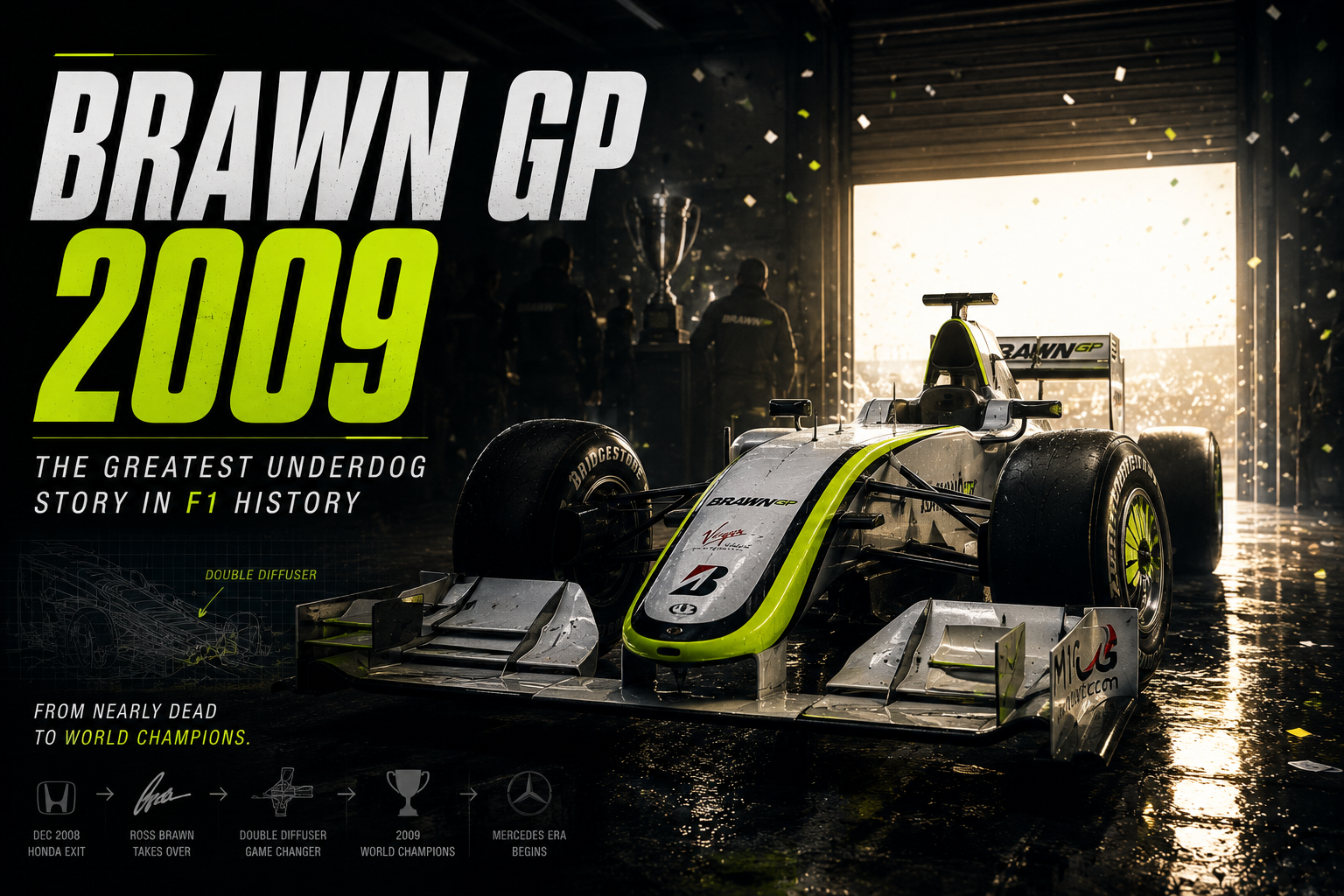

“We had nothing. And then we had everything.” – Ross Brawn
The Most Unlikely Championship in Formula 1 History
Formula 1 does not do fairy tales. It does not do stories where the underdog with no money beats the giants with unlimited resources, where the team that nobody expected to be on the grid in January is standing on top of the podium in November, where a car designed in secret by a skeleton crew becomes the most dominant machine of its season.
Except that in 2009, it did exactly that.
The Brawn GP story is the most improbable championship in the sport’s modern history, a sequence of events so unlikely that if you wrote it as fiction it would be rejected for straining credibility. A team left for dead by Honda in December 2008, acquired for a nominal sum by its own technical director, powered by a customer Mercedes engine, and driven by two drivers who had spent years waiting for the machinery their talent deserved.
By November 2009, Jenson Button was world champion and Brawn GP had won the Constructors’ title. They ceased to exist as an independent team before the following season began.
How It Began: Honda’s Exit
The story starts not with Brawn GP but with Honda Racing F1, and with a decision made in a boardboard room in Tokyo in December 2008 that nobody in the paddock saw coming.
Honda had been in Formula 1 as a constructor since 2006, having taken over the BAR team, and the results had been disappointing by any reasonable measure. The RA108, their 2008 car, finished ninth in the Constructors’ Championship. The global financial crisis that hit in autumn 2008 provided the context and the justification for a decision that Honda’s board had been moving toward regardless.
They pulled out. Completely, immediately, and with a speed that left the team’s 700 employees and its technical staff facing the prospect of redundancy before Christmas.
Ross Brawn, the team’s technical director, was given a short window in which to find a buyer or the team would be dissolved. What followed was weeks of frantic negotiation with potential buyers who ultimately declined, combined with a parallel process of preparation that Brawn was conducting in parallel to the sale process, a preparation that was built around a belief that he held more strongly than anyone else involved.
The car they had built for 2009, the one Honda had funded before their exit, was very good. Possibly very good indeed.
The Double Diffuser
The technical innovation that underpinned Brawn GP’s 2009 dominance was the double diffuser, an aerodynamic device that exploited an ambiguity in the new 2009 regulations to generate significantly more downforce from the rear of the car than the regulations appeared to allow.
The diffuser, which channels airflow under the rear of the car to create downforce, was restricted in size under the 2009 rules. The Brawn technical team, led by their aerodynamicists, found an interpretation of those rules that allowed additional channels to feed airflow into the diffuser from higher in the car’s floor, effectively creating a double layer that generated downforce the regulations had not intended to permit.
Other teams protested – the stewards and ultimately the FIA ruled that the device was legal. By the time rivals had developed their own versions, Brawn GP had built a points lead that the rest of the season could not fully close.
The double diffuser was not the only reason Brawn GP dominated the early part of 2009. The car was well balanced, the Mercedes customer engine was reliable, and Jenson Button drove the early rounds with a smoothness and consistency that extracted every point the car could offer. But the diffuser was the structural advantage that made the dominance possible, and it was the product of technical work done during the Honda years that nobody outside the team had known was coming.
Jenson Button and the Perfect Start
Button’s start to the 2009 season was as close to perfect as a championship campaign gets.
Six wins in the first seven races. A points lead that looked, by mid-season, like it might become insurmountable. A driving style that was ideally suited to the Brawn’s characteristics, smooth on the tyres, precise through the high speed corners, and devastatingly consistent in the races where outright pace was less important than the ability to manage a lead without error.
He had spent years in Formula 1 being told that his ability was not matched by the machinery he drove. His single season at BAR in 2004 had produced results that justified the belief, but the cars that followed had not given him the opportunity to demonstrate what a consistent front runner looked like. The Brawn GP was that opportunity, and he took it with both hands.
His teammate Rubens Barrichello contributed wins and pushed Button hard through the second half of the season as the double diffuser advantage eroded and rivals caught up. The intra-team battle added a dimension to the championship that the early season dominance had not suggested would develop, and Button’s ability to manage the psychological pressure of a narrowing lead whilst continuing to score the points he needed was the final demonstration that he was a worthy champion.
The Takeover and What Came After
By the end of 2009, it was clear that Brawn GP as an independent entity was not viable beyond a single season. The resources required to compete at the front of Formula 1 on a sustained basis were not available to a team whose budget had been constructed around survival rather than development.
Mercedes, who had supplied the customer engine and had been watching the season with increasing interest, stepped in. The acquisition was announced before the season had ended, and Brawn GP became Mercedes AMG Petronas Formula 1 Team for 2010, with Ross Brawn continuing as team principal and the infrastructure that had produced the 2009 miracle forming the foundation of what would eventually become the most dominant team in the sport’s history.
The Mercedes dynasty that followed, eight consecutive Constructors’ Championships from 2014 to 2021, was built on the bones of Brawn GP. The technical culture, the operational approach, and the people who had produced one of the most improbable seasons in the sport’s history went on to produce one of its most dominant eras.
That continuity is one of the most remarkable aspects of a story that already contains more remarkable aspects than most sporting narratives manage in a lifetime.
Why It Still Matters
The Brawn GP story matters in 2026 for reasons that go beyond nostalgia.
It is a reminder that Formula 1’s competitive order is never as fixed as it appears, that the teams which arrive at a regulation change with the clearest technical vision and the most disciplined execution can produce results that the resource differential between them and their rivals would suggest is impossible.
In a season defined by a wholesale regulation reset, where the teams that get the new formula right from the start will have an advantage that takes rivals months to close, the 2009 season is the most instructive recent example of what getting it right looks like.
Brawn GP got it right with nothing – the teams competing in 2026 have considerably more than nothing. Whether any of them produce a season as extraordinary as the one that began with Honda’s withdrawal and ended with a championship nobody predicted is the sport’s most open question.
