
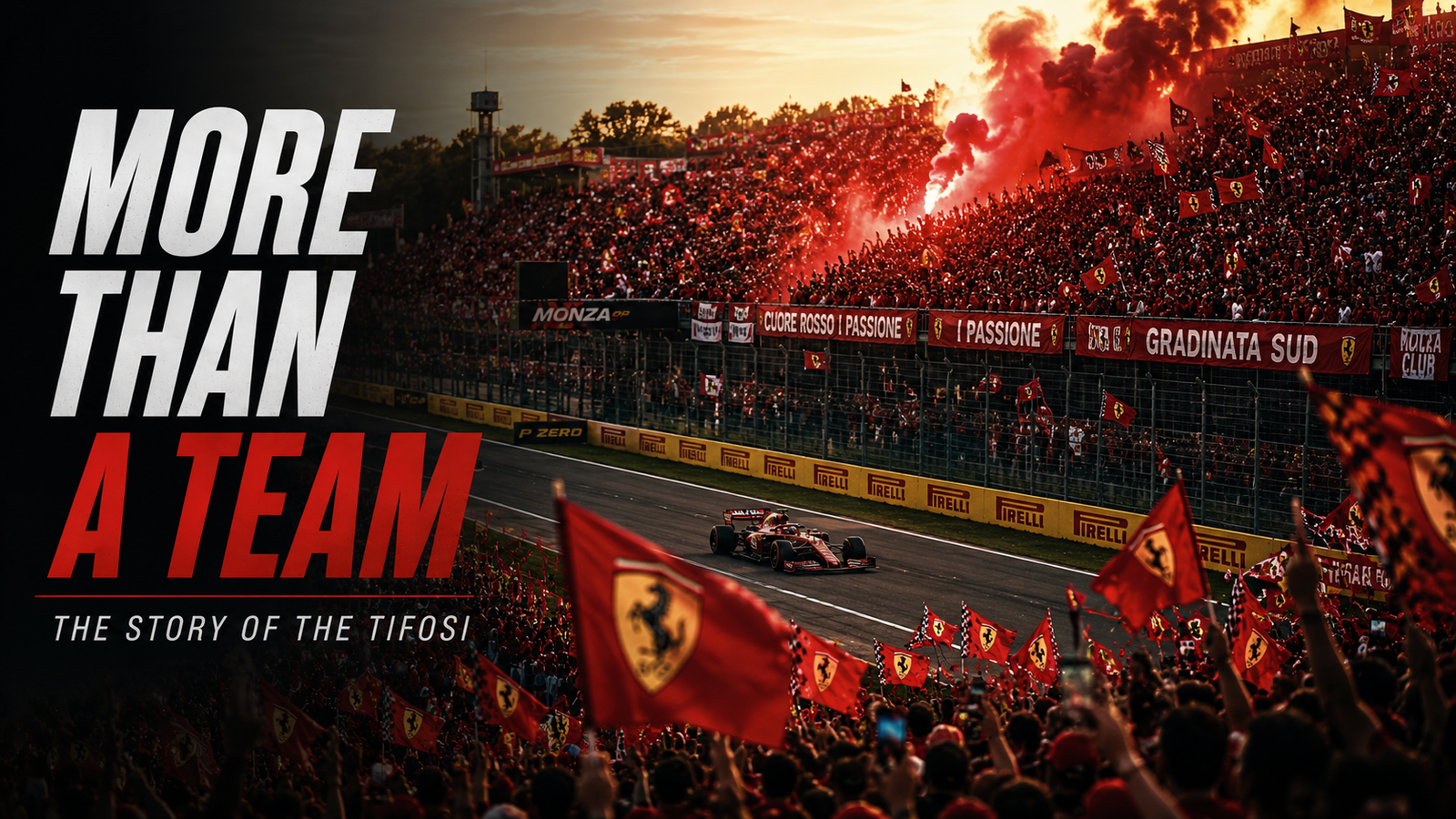

“When Ferrari wins, all of Italy wins. That is the weight we carry.” – Luca di Montezemolo
The Red Army
Every Formula 1 team has supporters. Ferrari has something else.
The Tifosi, the name given to Ferrari’s most devoted fans, are a phenomenon that exists outside the normal framework of sporting support. They are not simply people who prefer one team over another, who have chosen Ferrari as their team in the way that a football supporter chooses their club based on geography or family tradition or a single formative moment.
The Tifosi are an identity. Ferrari support, for those who carry it seriously, is something closer to a cultural allegiance than a sporting preference, a connection to a history, a mythology, and a set of values that the team represents beyond the results it produces on any given Sunday afternoon.
No other team in Formula 1 generates anything comparable. Understanding why requires understanding what Ferrari actually is, and why it means what it means to the people for whom it means everything.
What Ferrari Is
Ferrari was founded by Enzo Ferrari in 1939, though the racing team that grew into the Formula 1 constructor began competing in the world championship from its very first season in 1950. The connection between the road car company and the racing team is more direct and more genuine than the equivalent relationship at most manufacturers, because Enzo Ferrari built road cars primarily to fund his racing operation rather than the other way around.
That inversion of the normal manufacturer logic produced a team whose identity was rooted in racing rather than commerce, in the track rather than the showroom, and that identity has never fully changed despite the commercial transformation that Ferrari has undergone in the decades since Enzo’s death in 1988.
The prancing horse on the Ferrari badge, the Cavallino Rampante, carries a history that predates the team itself, taken from the personal emblem of Francesco Baracca, a First World War flying ace whose mother gave permission for Enzo to use it after her son’s death. The connection between the badge and Italian national identity, between Ferrari’s success and something that feels like collective pride rather than individual sporting allegiance, was built into the team’s identity from before it had won a single race.
The Monza Effect
There is no better illustration of the Tifosi effect than Monza.
The Italian Grand Prix at the Temple of Speed, as the Autodromo Nazionale Monza is known, is the race where the Tifosi are most visible, most vocal, and most overwhelming in the emotional intensity they bring to the circuit. When Ferrari performs well at Monza, the noise from the grandstands produces a physical sensation that drivers and team personnel describe in terms that go beyond crowd enthusiasm into something that feels like participation.
When Ferrari wins at Monza, the scenes that follow are unlike anything else in the sport. The fans who flood the circuit after the chequered flag, the red flags and scarves and shirts that fill the podium area, the noise that accompanies a Ferrari driver standing on the top step in front of his home crowd, these are not the celebrations of sports fans who are pleased their team has won. They are the celebrations of people for whom this result means something that sport does not normally reach.
Hamilton‘s potential victory at Monza in 2026, in his first full season in red, is one of the most anticipated storylines of the year for reasons that go well beyond the championship points it would produce.
Why the Tifosi Are Different
The question of what makes Ferrari’s fanbase different from the devoted supporters that other teams attract is worth examining rather than simply asserting.
Part of the answer is historical depth – Ferrari has been in Formula 1 since the beginning, and the generations of fans who have supported the team across that history have created a continuity of allegiance that newer teams cannot replicate regardless of their success. A McLaren fan who began following the sport in the Senna era is second or third generation compared to the families whose Ferrari support goes back to the 1950s.
Part of the answer is national identity – Ferrari is Italian in a way that transcends the normal relationship between a company and its country of origin. In Italy, Ferrari’s results are not reported as sporting news. They are reported as national news, events that produce responses across Italian culture, politics, and public life that would be extraordinary in any other sporting context. The Tifosi in Italy are not a subsection of the sporting public. They are, to a significant extent, the public.
Part of the answer is mythology – Ferrari has produced more stories, more dramas, more moments that exist in the collective memory of the sport than any other team, and mythology is self-perpetuating. The stories draw people in, the people create new stories, and the mythology grows with each generation of fans who inherit it and add to it.
The Effect on the Team
The Tifosi’s power is not limited to the grandstands, it reaches into the team itself in ways that shape how Ferrari operates and how the people within it feel the weight of what they are doing.
Ferrari drivers speak about the experience of wearing the red suit, of standing on a podium with the prancing horse on their chest, in terms that suggest the symbolic weight of the moment is genuinely felt rather than performed for the camera. Hamilton’s comments about joining Ferrari, about what it meant to him as a driver who had spent his career measuring himself against the sport’s history, reflected an awareness of that weight that went beyond professional ambition.
Team principals at Ferrari carry a burden that their counterparts at other teams do not. When things go wrong at Mercedes or McLaren, the scrutiny is intense and the pressure is real. When things go wrong at Ferrari, it becomes a matter of national conversation in Italy, a subject of newspaper editorials and television debates that no other constructor’s results would generate.
That pressure can be destructive – Ferrari’s history contains episodes where the weight of expectation produced decisions under pressure that cooler circumstances would not have generated. But it can also be motivating in ways that purely commercial pressure cannot replicate, and the teams that have performed best at Ferrari have generally been the ones that found a way to channel the Tifosi’s passion rather than being overwhelmed by it.
What It Means for 2026
The 2026 season is, for Ferrari and their fans, the one that carries the particular weight of Hamilton’s presence.
He is the driver the Tifosi have always wanted to see in red, not because he is the most Italian of champions but because he is the most historically significant driver of his generation and his presence validates something about Ferrari’s continued relevance at the very top of the sport.
If Hamilton and Leclerc can deliver the championship that the resources and the personnel of the current team should be capable of producing, the scenes that would follow at Monza, or wherever the title is clinched, would produce something that the sport has not seen for a generation.
The Tifosi have been waiting. They are patient in the way that people are patient when they believe the outcome is inevitable and the only question is when. But patience has a limit, and Ferrari’s fans have tested that limit more than once in the years since their last constructors’ title.
2026, with the regulation reset and Hamilton in the car and Leclerc at the peak of his powers, feels like the moment they have been building toward. Whether it delivers is the question the season will answer. That it matters, that the answer carries a weight beyond the championship points, is something that no other team in Formula 1 can say with the same conviction.
That is the Tifosi effect. And in Formula 1, it is like nothing else.
