
NEXT RACE
Loading…
starts in
—
Your Time
Track Time
local time
“We don’t have the resources of the big teams. But we have something they don’t – we have nothing to lose.” – Guenther Steiner
Haas are Formula 1’s great pragmatists. Gene Haas built a successful machine tool manufacturing business in North Carolina on the principle that you don’t need to do everything yourself – you need to do the right things yourself and source the rest intelligently.
He applied exactly that philosophy to Formula 1 when he entered the sport in 2016, becoming the first American constructor to join the grid since 1986. The result is a team that has survived and occasionally thrived by being ruthlessly realistic about what it is, what it isn’t, and what it can realistically achieve with the resources available.
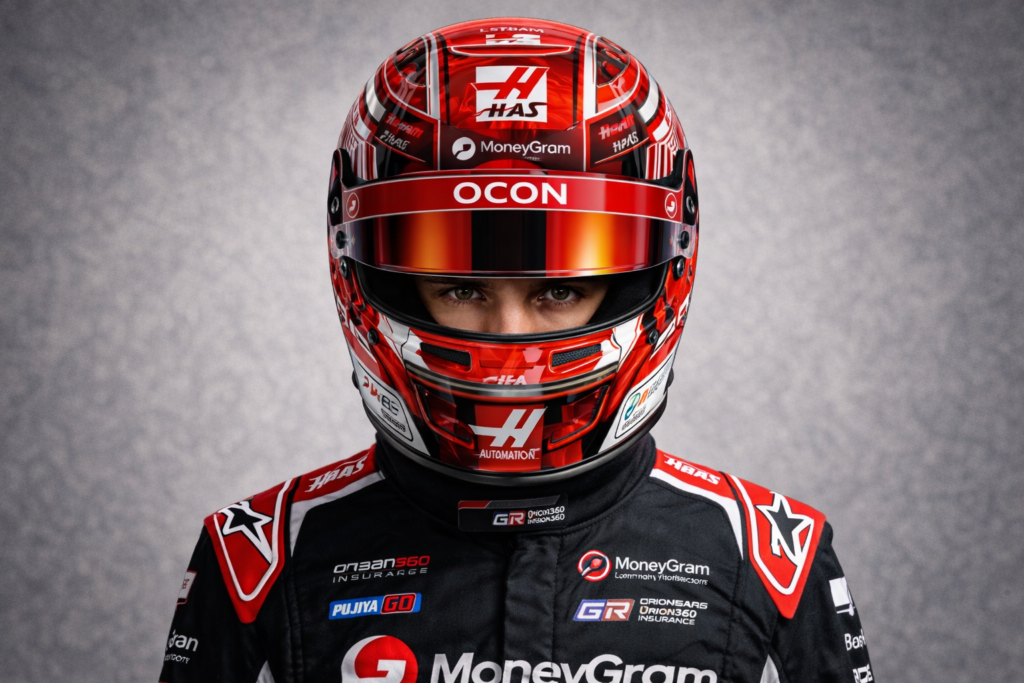
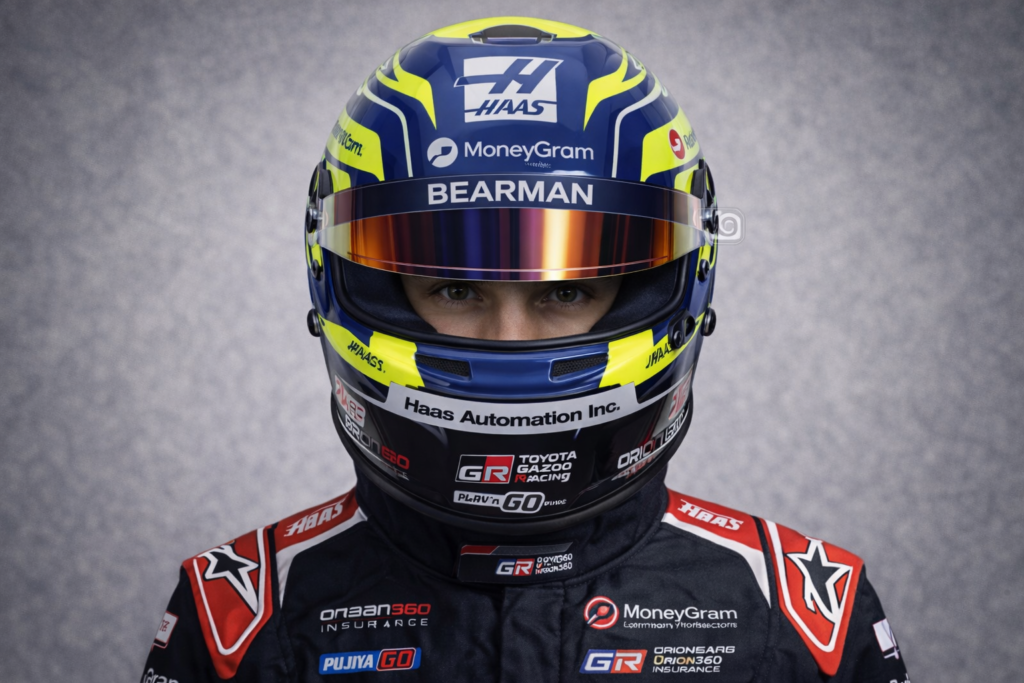
In 2026, with Esteban Ocon and Oliver Bearman sharing the garage, Haas arrive at a new regulation era with two hungry drivers, a clear identity, and the particular freedom that comes from having absolutely nothing to prove to anyone.
Haas F1 Team’s history is short but genuinely eventful. Gene Haas received FIA approval for his entry in 2014, spent two years building the operation in partnership with Ferrari – whose customer power units and technical collaboration provided the foundation – and arrived on the 2016 grid with a car that immediately scored points on debut in Australia.
That opening result set expectations that the team would spend several subsequent seasons struggling to consistently meet.
The early years established Haas’s defining characteristic: capable of genuine performance on their best days, frustratingly inconsistent on their worst. The technical model – heavy reliance on Ferrari’s power unit and certain listed parts, combined with a relatively lean internal operation – meant the car’s baseline was rarely terrible but the development trajectory across a season was limited compared to better-resourced rivals.
Romain Grosjean and Kevin Magnussen formed a combative and entertaining driver pairing that generated more column inches than their results strictly warranted – partly through genuine racecraft and partly through a willingness to race hard that occasionally crossed lines.
The 2018 season was the team’s competitive peak under the previous regulations, finishing fifth in the Constructors’ Championship and demonstrating what the model could deliver when everything aligned.
The subsequent years were harder. 2020 was arguably the team’s worst season, compounded by the mid-year decision to cease development of that year’s car entirely and redirect resources toward 2021. The arrival of Nikita Mazepin alongside Mick Schumacher in 2021 created a driver lineup that generated considerable controversy. Mazepin’s departure following Russia’s invasion of Ukraine in 2022, and the subsequent return of Kevin Magnussen, provided a reset that stabilised the team’s identity.
Guenther Steiner’s high-profile departure ahead of 2024 – the team principal whose personality had become synonymous with Haas through the Drive to Survive era – was a significant moment. Ayao Komatsu’s arrival as his replacement brought a quieter, more technically focused leadership approach that reflected a conscious decision to let results do the talking.
Haas matter because they demonstrate that the barrier to entry in Formula 1, while high, is not exclusively reserved for manufacturers and billionaire vanity projects.
Gene Haas built a competitive constructor on the back of a manufacturing business rather than an automotive empire, and the team’s continued presence on the grid is a genuine achievement that deserves more recognition than it typically receives.
They also matter because the customer team model they pioneered – maximising the use of commercially available components within regulatory limits – influenced how subsequent new entrants thought about building a Formula 1 operation efficiently. Whether that model has a long-term future as the regulations tighten around listed parts is a question Haas will need to answer over the coming seasons.
Haas race with an unpredictability that keeps them interesting even when the results don’t warrant attention. On circuits that suit the car – typically those with high downforce requirements or specific tyre temperature windows – they can ambush results that surprise the paddock. On circuits where their limitations are exposed, the gap to the midfield can look discouraging.
The driver pairing for 2026 injects genuine intrigue. Ocon is experienced, fast, and carrying the particular motivation of someone who lost his previous seat in circumstances that left things unfinished.
Bearman is young, British, and has already demonstrated – through his emergency Ferrari debut in 2024 and his subsequent Haas season – that he belongs at this level. The contrast in career stage makes the pairing compelling, and both drivers have enough to prove to ensure the garage atmosphere remains competitive.
Ayao Komatsu has brought a technical rigour to the team principal role that suits Haas’s current phase. Where Steiner’s strength was personality and energy – invaluable during the team’s establishment years – Komatsu’s strength is engineering precision and operational discipline. The transition reflects a team that has moved past the phase of needing to announce itself and into the phase of needing to optimise what it has.
The Ferrari technical relationship remains central to the operation, providing power unit supply and certain components that underpin the car’s competitiveness. Managing that relationship effectively – extracting maximum benefit while maintaining enough independence to develop a genuine identity – is one of the team’s ongoing strategic challenges.
Esteban Ocon and Oliver Bearman is a pairing that works on multiple levels. Ocon brings seven years of Formula 1 experience, a race win to his name from the 2021 Hungarian Grand Prix, and the kind of measured, technical approach that suits a team still developing its 2026 machinery. His departure from Alpine after 2024 was acrimonious enough to provide additional motivation – there is a particular edge to a driver who feels he has something to prove to a former employer.
Bearman at 19 is one of the more exciting young talents on the current grid. His composed performance replacing Carlos Sainz at Ferrari in Saudi Arabia in 2024 – scoring points on his debut in a car he had minimal preparation in – announced him as someone with the mental strength to handle unexpected pressure. A full season at Haas in 2025 developed him further, and 2026 represents his first campaign where the baseline expectations are genuinely high rather than merely hopeful.
The dynamic between an experienced driver with a point to prove and a young driver with everything to gain is one of the more interesting partnerships on the grid this year.
Haas enter 2026 at a genuine crossroads. The new regulations present an opportunity to reset the competitive order in ways that could benefit a team unencumbered by the legacy infrastructure of larger constructors. The question is whether their technical model – lean, Ferrari-adjacent, pragmatic – is sufficient to capitalise on that opportunity or whether the gap to better-resourced rivals simply reasserts itself under new rules.
Gene Haas has maintained his commitment to the project through seasons that would have prompted many owners to reconsider. That commitment deserves a regulation cycle that rewards it. Whether 2026 provides that reward will define the team’s medium-term future as much as any single result.
In the meantime, Haas will do what Haas always does: arrive, compete, occasionally surprise, and refuse to be embarrassed by the company they’re keeping.
At the British Grand Prix on 2026-07-05, Oliver Bearman finished P12 and Esteban Ocon finished P13. No constructor points were scored.
The 2026 driver lineup consists of Esteban Ocon, carrying car number 31, and Oliver Bearman, carrying car number 87.
MoneyGram Haas F1 Team has not recorded a race win in its Formula 1 history to date.
The team principal of MoneyGram Haas F1 Team is Ayao Komatsu.
MoneyGram Haas F1 Team is based in Kannapolis, North Carolina, USA.
The team competes with the VF-26 chassis during the 2026 Formula 1 season.
MoneyGram Haas F1 Team is powered by Ferrari power units.
MoneyGram Haas F1 Team made its Formula 1 debut in 2016, making it one of the more recent constructor entries on the grid.
At the British Grand Prix on 5 July 2026, Oliver Bearman finished in P12 and Esteban Ocon finished in P13.