

“If the opportunity's there, take it.”
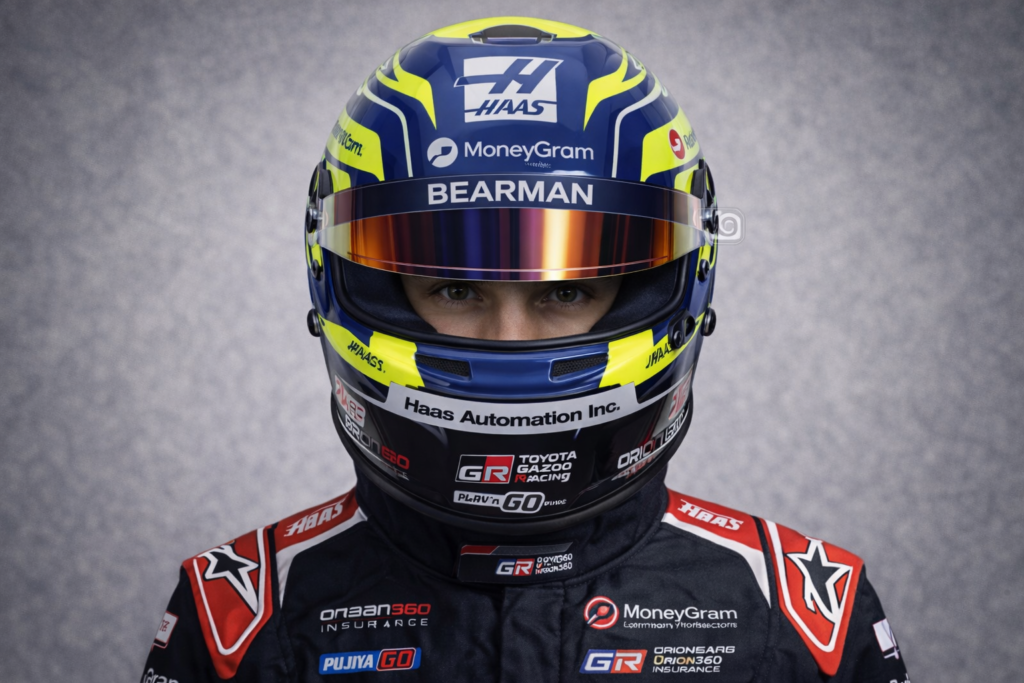
Biography
Recent Form
Oliver Bearman’s last five races have been a difficult stretch for the young Haas driver. Back-to-back retirements at the Monaco Grand Prix and the Barcelona Grand Prix brought his points tally to a standstill, and a lapped finish at the Austrian Grand Prix did little to reverse the momentum. The sequence has underlined the challenges Bearman and the team have faced in converting grid positions into meaningful results.
A bright spot came at the Canadian Grand Prix, where Bearman climbed from P16 on the grid to P10 at the flag — earning a single championship point and demonstrating the pace and racecraft that have kept expectations around him alive. That result remains his only points finish across the five-race window, making it the benchmark he will be looking to match or surpass in the races ahead.
Latest Race
At the British Grand Prix on 5 July 2026, Bearman started from P13 and crossed the line in P12, gaining one position over the course of the race. While the result kept him out of the points, it was a clean, trouble-free run that at least avoided the retirements and lapped finishes that had blighted his previous outings. It was a modest but measured performance on home soil, reflecting a team and driver working to find stability after a bruising run of results.
2026 So Far
Bearman sits P12 in the Drivers’ Championship with 18 points, a tally that reflects a season of inconsistency rather than sustained progress. His points have been hard-won against a backdrop of retirements and difficult races, and with wins yet to come, the focus for the remainder of the campaign will be on stringing together clean, points-scoring weekends to climb further up the standings.
The Snapshot
Oliver Bearman didn’t arrive in Formula 1 slowly, and he didn’t arrive as a long-term project waiting patiently in the wings. He arrived because circumstances demanded it – a substitute call that could have gone sideways in a dozen different ways, and then proved almost immediately that he belonged there.
What began as a high-pressure emergency appearance quickly evolved into something more permanent. By 2026, Bearman is no longer the emergency call-up story that defines his introduction to the grid. He’s a full-time Haas driver now, developing in real time on the sport’s biggest stage with the luxury of consistency and a genuine runway ahead of him. He carries the quiet confidence of someone who has already survived his trial by fire and emerged composed.
Why He Matters
Bearman matters because he represents a genuinely different model of youth integration in Formula 1. He’s part of a generation that grew up in structured development systems, technically polished, media-trained, mentally prepared by the time they reach the top step.
What separates him from that cohort, though, is something harder to teach: adaptability under genuine pressure. Thrown into difficult scenarios early, before he’d had time to ease into the role, he showed genuine calm. No visible panic. No overdriving to compensate for inexperience or prove something to doubters. For Haas, that combination brings long-term upside – a driver who can genuinely develop within the team, but also immediate credibility on the grid. He’s not there purely to soak up experience and learn whilst the team carries him. He’s there to contribute from day one.
The Rise – Fast-Tracked, Not Rushed
Bearman’s junior career was built on consistency and intelligence rather than the kind of spectacle that generates sponsorship hype. His progression through Formula 3 and Formula 2 showed genuine strength, nothing flashy, nothing that screamed generational talent, but results that positioned him as a serious prospect worth watching.
When his Formula 1 opportunity came earlier than expected, years ahead of the original plan, the spotlight intensified instantly. A lot of drivers would have buckled under that pressure or chased the narrative. Bearman didn’t shrink from it. Instead, he absorbed it. Rather than chasing headlines or trying to prove doubters wrong, he focused on the unglamorous work: learning tyre behaviour across different compounds, understanding how race management differs from qualifying sprints, and integrating with engineers and data analysts. His development curve has been steady rather than volatile, which means there’s been no dramatic collapse followed by recovery, no moment where people questioned whether he belonged. That steadiness now defines how people perceive him.
What He’s Actually Like to Watch
Bearman is composed behind the wheel in a way that suggests genuine maturity. He’s not overly aggressive on corner entry, preferring instead to build confidence through mid-corner stability and progressive throttle application. His steering inputs are deliberate and economical; there’s no unnecessary movement, no hunting for grip in places the car simply can’t deliver it. In wheel-to-wheel situations, he’s assertive when opportunities present themselves, but rarely reckless. There’s real calculation in his positioning, a sense that he’s thinking two moves ahead rather than reacting to what’s immediately in front of him. He doesn’t race like someone trying desperately to prove he belongs in the cockpit. He races like someone planning to stay there for a while.
Off-Track: The Understated Arc
Bearman is genuinely understated away from the circuit. Soft-spoken, technically engaged in ways that suggest real curiosity rather than obligation, focused on the kind of incremental improvement that compounds over years. He leans heavily into preparation, simulator sessions, physical conditioning, and detailed technical debriefs – because he understands that talent alone is never the deciding factor.
He’s part of the modern driver mould: media-aware without being performative, confident without overstatement or false bravado. There’s a long-term arc to how he approaches his career, a sense of direction rather than desperation. That distinction matters more than it should.
Where to Follow Oliver
Follow Oliver directly for behind-the-scenes updates, training clips, and race weekend content: Instagram (@oliverbearman) · X / Twitter (@OliverBearman) · Official merchandise. For fixtures and the wider championship picture, our race calendar tracks every round and standings update.
The Haas Platform
Haas in 2026 isn’t chasing titles or expecting miracles overnight. They’re building consistency, developing infrastructure, and establishing the foundation that allows genuine progress.
For Bearman, that environment offers something invaluable: space to develop without the suffocating pressure of immediate championship expectation. He can make mistakes without them becoming existential threats. He can have difficult weekends without needing to justify his seat.
The real test for Bearman, though, will be patience. Because talent clearly isn’t the limiting factor – he’s demonstrated that already. Timing always matters in Formula 1, but so does the ability to stay composed when progress feels incremental rather than exponential – and that’s exactly where his composure will actually be tested.
Oliver Bearman – Frequently Asked Questions
Who does Oliver Bearman drive for in 2026?
As of the 2026 Formula 1 season, Oliver Bearman drives for Haas.
What nationality is Oliver Bearman?
Oliver Bearman is British.
How old is Oliver Bearman in the 2026 season?
Oliver Bearman is 20 years old during most of the 2026 season.
What race number does Oliver Bearman use in Formula 1?
Oliver Bearman races with number 87 in Formula 1.
Who is Oliver Bearman’s team mate at Haas in 2026?
As of 2026, Oliver Bearman’s team mate at Haas is Esteban Ocon.
When did Oliver Bearman make his Formula 1 debut?
Oliver Bearman made his Formula 1 race debut in 2024.
Did Oliver Bearman debut for Ferrari before racing full-time in F1?
Yes. Bearman made a one-off Ferrari race appearance before becoming a full-time F1 driver.
What did Oliver Bearman achieve before reaching Formula 1?
He progressed through the FIA junior ladder and became a race winner in key feeder series before earning an F1 seat.
What is Oliver Bearman known for as a driver?
He is known for quick adaptation, strong qualifying intent, and mature race management for his age.
What is Oliver Bearman like off the track?
He is generally described as calm and grounded, often focusing on training, recovery, and staying close to family between races.