
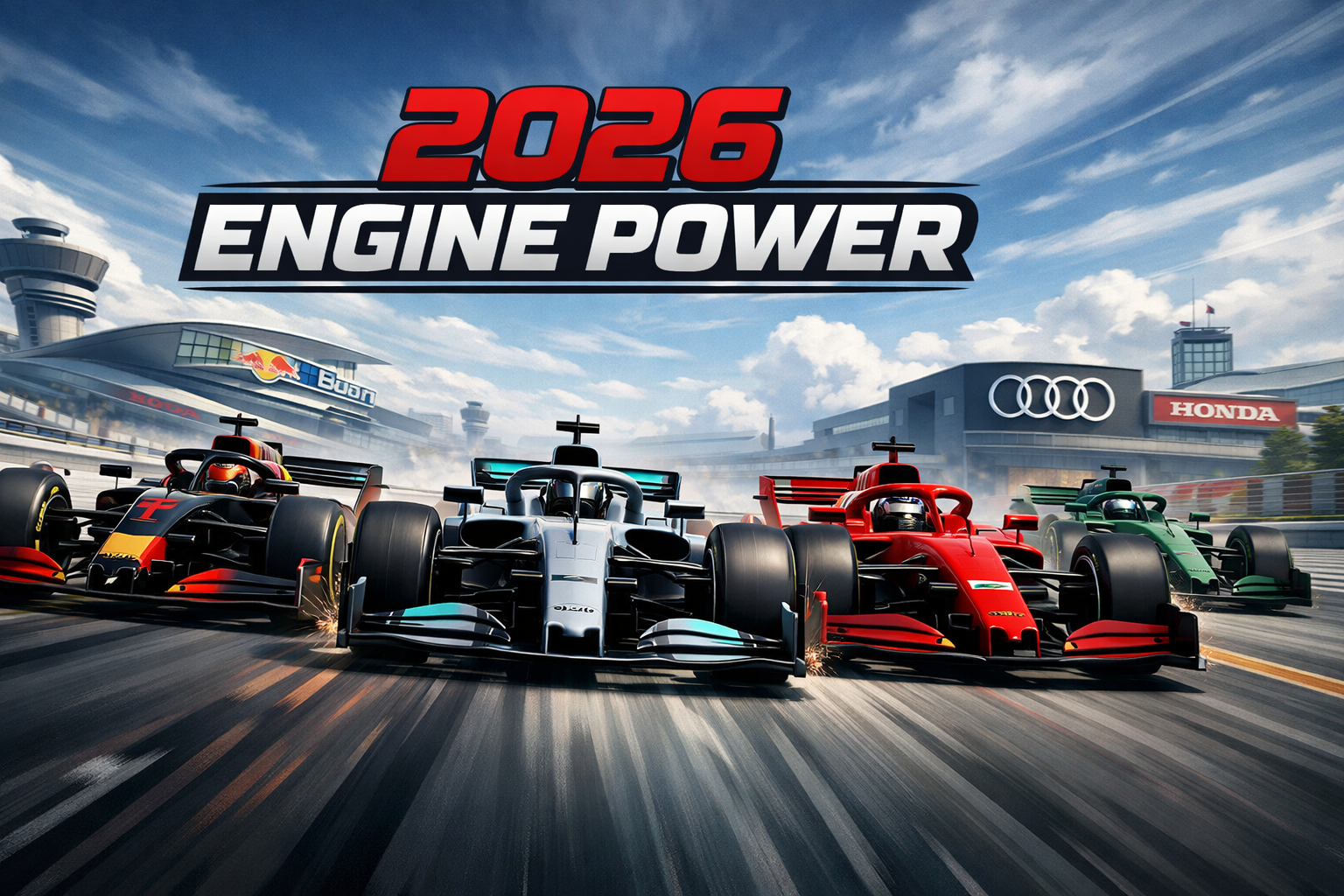

The 2026 Formula 1 season will usher in a new hybrid era, and every team’s choice of engine supplier under the updated power unit rules could decide who starts the cycle on the front foot.
Overview: How F1 Engines Change Under the 2026 Regulations
The 2026 Formula 1 power unit regulations are built around two clear goals: stronger hybrid performance and significantly improved sustainability. The familiar 1.6‑litre turbocharged V6 architecture remains, but the balance of power shifts dramatically. Instead of today’s rough 80/20 split between combustion and electric power, the new units target an even 50/50 split thanks to a much more powerful MGU‑K and heavily revised fuel‑energy limits.
From 2026, the MGU‑H disappears entirely, simplifying the turbo system but placing more responsibility on the MGU‑K to recover and deploy electrical energy. Power from the combustion engine drops, while the electric side triples in output. The total combined power stays over 1,000 bhp, but how that power is delivered – and managed over a lap – will change the way drivers and teams think about energy deployment, overtaking and race strategy.
Fuel flow is no longer just a question of kilograms per hour. Instead, the rules measure and limit the energy content of the fuel, and teams must run fully sustainable fuels. This forces power unit manufacturers to chase thermal efficiency and hybrid synergy rather than simply pushing more fuel through the V6. At the same time, a new “override” deployment mode is designed to help overtaking, with the leading car’s electric boost tapering off at very high speeds while a chasing car in range can use maximum MGU‑K power for longer.
Against this backdrop, six power unit manufacturers are registered for the 2026–2030 rules cycle: Red Bull Ford, Mercedes, Ferrari, Honda, Audi and Alpine. In practice, five of those brands will appear as engine suppliers on the 2026 grid, with Alpine’s programme evolving into a customer arrangement. Below is a team‑by‑team breakdown of who powers whom in 2026 and why those decisions matter.
Red Bull – Red Bull Ford Powertrains
Red Bull enters the 2026 season with a new identity as a full works engine outfit. The World Championship‑winning team will run power units developed by Red Bull Powertrains in partnership with Ford, ending its previous dependency on rebadged Honda engines. The new Red Bull Ford package is built from the ground up around the 2026 rule set, focusing on high electrical output, aggressive energy harvesting and tight integration with the chassis concept.
For a team built around maximising aerodynamic performance, having full control over the power unit lets Red Bull optimise packaging, cooling and weight distribution in a way that wasn’t possible as a customer. With active aerodynamics and energy deployment now deeply intertwined, Red Bull Ford’s ability to synchronise the engine, MGU‑K maps and aero modes could be a major competitive edge right from the first race of 2026.
Racing Bulls – Red Bull Ford Customer
Racing Bulls, Red Bull’s second team, will also run Red Bull Ford Powertrains units in 2026. The Faenza‑based squad has switched suppliers several times over its history, but aligning with its senior partner on the new power unit era is a logical step. Sharing the same basic engine hardware and control systems as Red Bull should make it easier to adopt similar cooling layouts, gearbox casings and rear‑end architecture.
For Racing Bulls, this arrangement offers a clear technical roadmap. As Red Bull Ford develops upgrades and refines its 2026 hybrid strategies, the sister team stands to benefit from downstream improvements, giving its young driver line‑up a more stable and competitive platform than in many previous engine cycles.
Mercedes – Mercedes‑AMG High Performance Powertrains
Mercedes remains synonymous with its in‑house engine operation at Brixworth. The eight‑time constructors’ champions will field a Mercedes‑AMG hybrid tuned for the 2026 rules, leveraging more than a decade of experience with turbo‑hybrid power units. The team’s focus is on maintaining its reputation for class‑leading efficiency while adapting to the loss of the MGU‑H and the increased reliance on the MGU‑K.
With George Russell and highly rated rookie team‑mate Kimi Antonelli at the wheel, Mercedes will look to extract maximum benefit from the new engine maps and manual override modes. The expectation is that Mercedes’ proven ability to connect chassis, aerodynamics and power unit design will be crucial in managing energy through long straights and complex corner sequences under the 2026 format.
McLaren – Mercedes Customer
McLaren made a decisive call for the 2026 era by extending its Mercedes power unit supply through to 2030. Instead of becoming a works team with a new manufacturer, McLaren will double down on a partnership that helped return the team to race‑winning form in the early‑ and mid‑2020s. With the engine side locked in, McLaren can concentrate on aerodynamic development, weight reduction and operational detail.
For drivers like Lando Norris and Oscar Piastri, continuity of power unit supply is a big plus. The team already understands Mercedes’ cooling and packaging requirements, and that knowledge can be applied immediately to its first 2026‑spec car. In a rules reset where battery sizing, radiator placement and MGU‑K integration can define the whole concept, avoiding an engine transition risk could pay off handsomely.
Ferrari – In‑House Power for Maranello and Customers
Ferrari remains Formula 1’s longest‑standing engine manufacturer and will continue to supply itself and customer teams with power units developed in Maranello. For 2026, Ferrari’s V6 hybrid is reshaped to deliver less combustion power but much more from the MGU‑K, all on sustainable fuels and within stringent fuel‑energy limits. The Italian outfit aims to turn its strong recent progress on the engine side into a competitive advantage under the new rules.
Ferrari’s status as both chassis and engine builder gives it full control over integration. That matters because the 2026 package demands close cooperation between the power unit department, aerodynamics group and race engineering staff. How Ferrari aligns its energy deployment profiles with its active‑aero strategies will be central to its hopes of challenging for titles in the new era.
Haas – Ferrari Customer
Haas continues its long‑running relationship with Ferrari for 2026, taking power units, gearbox internals and other listed parts from Maranello. The American team’s business model has always been to lean on a major manufacturer for high‑cost components and focus its own resources on chassis design, aerodynamics and trackside operations.
In the 2026 context, this means Haas will inherit Ferrari’s energy recovery and deployment philosophies, giving its drivers – such as Esteban Ocon and Oliver Bearman – a proven, works‑grade power unit. The challenge will be matching that with a car that is efficient enough to exploit the sustainable‑fuel and high‑hybrid characteristics of the new rules.
Cadillac – Ferrari Customer for Its Debut
New entrant Cadillac joins the grid in 2026 as the eleventh team and has chosen Ferrari as its initial power unit supplier. Rather than attempting the massive undertaking of designing a new engine at the same time as building a team and chassis from scratch, Cadillac’s approach is to secure a stable and competitive power unit baseline.
This Ferrari partnership lets Cadillac’s technical staff concentrate on aerodynamics, cooling layouts and reliability for their first F1 car. Once the organisation has gained experience under race conditions, it will have the option to reassess its long‑term power unit strategy within the 2026–2030 cycle, whether that means continuing as a customer or eventually developing its own solution.
Audi – Full Works Engine and Team Programme
Audi is one of the headline new manufacturers in the 2026 power unit era. The German brand enters Formula 1 with a fully fledged works programme, supplying engines to its own team built on the foundations of the current Sauber operation. As a clean‑sheet project, Audi’s power unit has been designed from day one for the 50/50 hybrid split and the absence of an MGU‑H.
Unlike manufacturers adapting existing engine architectures, Audi can optimise its V6, turbo layout, MGU‑K positioning and energy store packaging without legacy constraints. For its drivers and engineers, that could translate into a car with highly efficient harvesting, strong mid‑range torque and predictable deployment behaviour – exactly the traits needed to exploit the manual‑override overtaking tools and reduced fuel‑energy limits.
Aston Martin – Works Partnership with Honda
Aston Martin enters the 2026 season as a works partner of Honda, which continues its long relationship with Formula 1 by adapting its successful hybrid knowledge to the new regulations. This tie‑up gives Aston Martin access not just to the power unit itself, but also to Honda’s experience in calibration, reliability and race‑weekend power management.
With ambitious infrastructure growth at Silverstone and a dedicated engine partner, Aston Martin will try to position itself as a long‑term title contender. The team’s 2026 car will be designed from the ground up around Honda’s cooling and packaging requirements, and the collaboration will be vital in managing the more complex energy‑recovery and deployment profiles demanded by the new rules.
Williams – Mercedes Customer
Williams remains a Mercedes customer into the 2026 era, continuing a partnership that has delivered strong reliability and solid straight‑line performance in recent seasons. The team’s decision aligns with a broader strategy of building up its facilities, staff and aerodynamic capability before contemplating a more radical engine change.
Running the same basic power unit as Mercedes, McLaren and other customer teams puts Williams in a known performance window. The Grove‑based outfit’s task is to produce a 2026 chassis that is light, aerodynamically efficient and gentle on tyres while making full use of the high‑output MGU‑K and sustainable‑fuel engine mapping developed in Brixworth.
Alpine – Switch from In‑House to Mercedes Power
Alpine takes one of the boldest steps for 2026 by ending its long‑running Renault engine programme and becoming a Mercedes customer. This move closes an iconic chapter in French F1 engine history but reflects the massive investment required to remain competitive under the new power unit rules.
For Alpine’s race team, the upside is that it can benchmark itself directly against other Mercedes‑powered outfits and divert more resources into aerodynamics, mechanical grip and operations. The Enstone squad will no longer have to solve every power unit development problem alone, instead aligning with the same engine roadmap as several front‑running teams.
Why the 2026 Engine Suppliers Matter
In previous eras, outright horsepower and top‑speed figures often defined the “best” engine. Under the 2026 regulations, the differences between power unit manufacturers are more likely to show up in efficiency, energy‑recovery capability and how well each unit integrates into the overall car concept. Teams that can harvest more energy without upsetting the car’s balance, deploy it smoothly, and keep fuel consumption under control will enjoy a meaningful advantage over a race distance.
That is why so many teams have locked in their engine decisions early. Works outfits like Red Bull Ford, Mercedes, Ferrari, Audi and Honda‑powered Aston Martin will chase every last fraction of efficiency by developing chassis and power unit together. Customer teams such as McLaren, Williams, Haas, Cadillac and Alpine are betting that proven manufacturers give them enough performance and reliability to close the gap through smart car design and race execution.
For fans and analysts, understanding who powers each team in 2026 is essential context when judging early‑season form. A midfield car with a strong engine and clever energy deployment strategy could punch above its weight, while even a traditionally big team might struggle if it underestimates the challenge of integrating the new hybrid architecture. As the 2026 Formula 1 season unfolds, RukiF1 will be tracking exactly how each engine–team partnership performs in this demanding new era of power units.
