

NEXT RACE
Loading…
starts in
—
Your Time
Track Time
local time
“Audi has always stood for progress through technology. Formula 1 is the ultimate test of that.” – Oliver Hoffmann
Audi’s arrival in Formula 1 is a statement of intent dressed up as a racing team. The German manufacturer didn’t enter the sport because they needed the exposure – the four rings are one of the most recognised automotive brands on the planet. They entered because Formula 1’s shift toward sustainable hybrid power units from 2026 onwards created a technical landscape that aligned with where Audi’s road car division was already heading.
This is not a vanity project. It is a long-term industrial commitment from a company that has won Le Mans 13 times and understands exactly what sustained motorsport investment looks like.
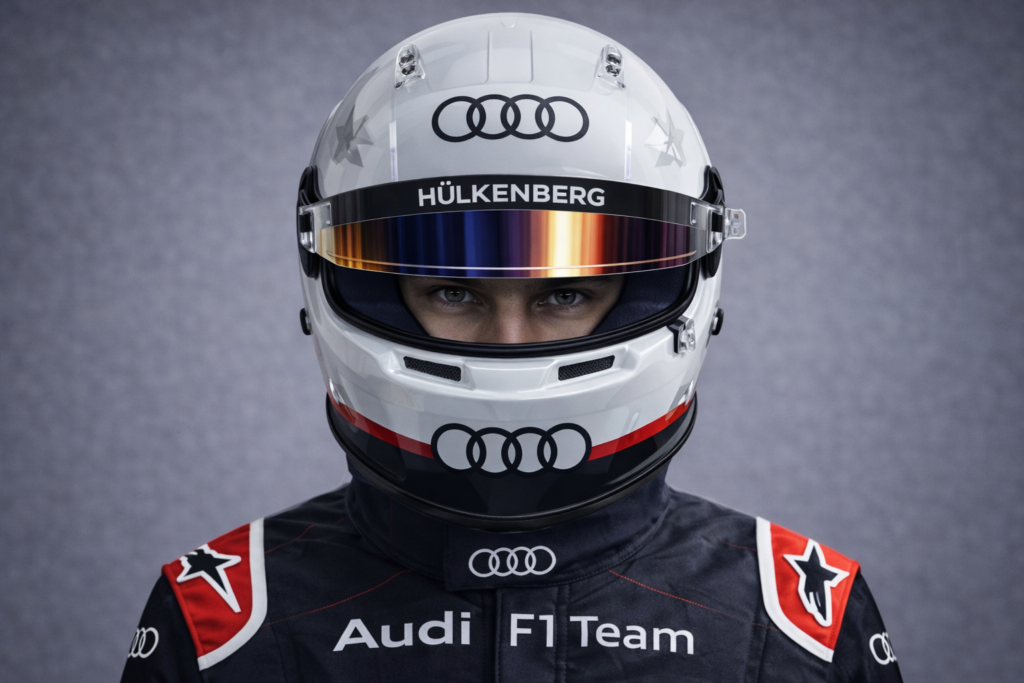
Nico Hulkenberg and Gabriel Bortoleto are the drivers tasked with beginning a chapter that Audi intends to be very long indeed.
The team’s Formula 1 roots predate Audi’s involvement by several decades. What is now the Audi Revolut F1 Team began life as Brabham, one of the sport’s founding constructors, before a series of ownership changes carried it through the Ligier, Prost, and Midland eras before becoming Force India – a team that punched consistently above its weight for years from its Silverstone base. Force India became Racing Point in 2019 following a controversial administration process, then transformed into Aston Martin for 2021 when Lawrence Stroll’s consortium completed their takeover.
The Audi chapter began formally in 2023 when the manufacturer acquired a stake in the Sauber Group, who operated the team under the Alfa Romeo name. The transition from Sauber to Audi has been methodical rather than explosive – new facilities, new personnel, new ambitions – culminating in the full factory entry under the Audi name from 2026.
What makes this lineage interesting is that the Hinwil factory in Switzerland, where the team is based, has been a continuous Formula 1 operation since 1993. The infrastructure is not new. The resources now flowing into it absolutely are.
Audi’s entry matters for reasons that extend well beyond their own championship prospects. A major automotive manufacturer committing to Formula 1 with a full factory programme validates the sport’s direction of travel on sustainability and power unit technology in a way that no amount of marketing can manufacture. When Audi says the 2026 regulations are worth building around, it carries genuine industrial weight.
For the midfield, their presence raises the floor. Audi will spend what is necessary, develop what is required, and approach the project with the long-term patience of a company that measures return on investment in decades rather than seasons. Teams that assumed Sauber would remain a soft touch at the back of the grid have had to recalibrate.
It is genuinely too early to define an Audi racing identity with any confidence – the full factory machinery makes its competitive debut in 2026, and the team’s character will emerge through results rather than reputation. What can be said is that Audi’s motorsport DNA tends toward precision and technical thoroughness rather than flair. Their Le Mans dominance was built on reliability, efficiency, and eliminating errors rather than outright pace. Whether that philosophy translates into a Formula 1 approach that is conservative or calculated will become clear through the season.
Hulkenberg will provide a baseline of experience against which everything can be measured. He knows how to extract the maximum from unfamiliar machinery.
Oliver Hoffmann, as Audi’s Motorsport chief overseeing the F1 project, represents the manufacturer’s senior commitment to the programme. On the operational side, the team has undergone significant restructuring as it transitions from customer operation to full factory entry.
Mattia Binotto – who previously served as Ferrari Team Principal before his exit in late 2022 – joined as Chief Operating Officer, bringing a technical background and front-running team experience that the programme needed. His appointment was a signal that Audi were serious about accelerating the learning curve rather than spending years reinventing wheels that others have already built.
The technical operation in Hinwil has been substantially reinforced with new hires from across the paddock, reflecting the scale of investment Audi are deploying to make this project credible from the outset.
Nico Hulkenberg and Gabriel Bortoleto represent a pairing built around one experienced operator providing stability while a significant young talent develops. Hulkenberg is one of the grid’s more interesting characters – the man without a podium who has nonetheless remained competitive across multiple stints in Formula 1 through sheer racecraft and technical intelligence. He is exactly what a new team needs when building relationships between drivers and engineers from scratch. He communicates clearly, develops cars methodically, and doesn’t create unnecessary noise.
Bortoleto is the long-term investment. The 2023 Formula 3 and 2024 Formula 2 champion arrived in Formula 1 with a reputation for smooth, intelligent driving and a maturity that belies his age. His composure in the junior categories suggested someone who processes pressure productively rather than being consumed by it.
Audi will be patient with him. The timeline here is measured in years.
Audi’s objectives for 2026 are realistic rather than ambitious in the conventional sense.
Establishing reliable, competitive power unit performance. Building the team culture and operational rhythms that sustained success requires. Giving Bortoleto the environment to develop without premature pressure. Hulkenberg – the competitive machinery he has deserved for most of his career.
A first points finish will matter. A first podium will be celebrated as a milestone. A first win, when it comes, will be treated as confirmation that the project is on schedule rather than a surprise.
Audi don’t do surprises. They do plans. And they tend to see them through.
At the Brazilian Grand Prix on 2026-11-08, Nico Hülkenberg finished P10 and Gabriel Bortoleto finished P16. The team scored 1 constructor point.
Nico Hülkenberg (#27) and Gabriel Bortoleto (#5) drive for the team in 2026. Hülkenberg is the experienced hand, with Bortoleto stepping up to F1 as a rookie.
The team hasn’t won a race yet. 2026 is their first season in Formula 1, so every point they score is a milestone.
Mattia Binotto is the team principal. He oversees the operation from the team’s base in Hinwil.
The team is based in Hinwil, Switzerland. It’s the same site that has housed a Formula 1 operation for decades.
The team runs the Audi R26 in 2026. It’s the first chassis to carry the Audi name in Formula 1.
Audi supplies their own power unit, making them one of the few teams on the grid running a fully in-house engine programme.
The team made their Formula 1 debut in 2026. It marks Audi’s first direct entry into the sport as a constructor.
Nico Hülkenberg finished P10 and Gabriel Bortoleto finished P16 at the Brazilian Grand Prix on 8 November 2026. Hülkenberg’s point was a solid return for the team’s first season.