
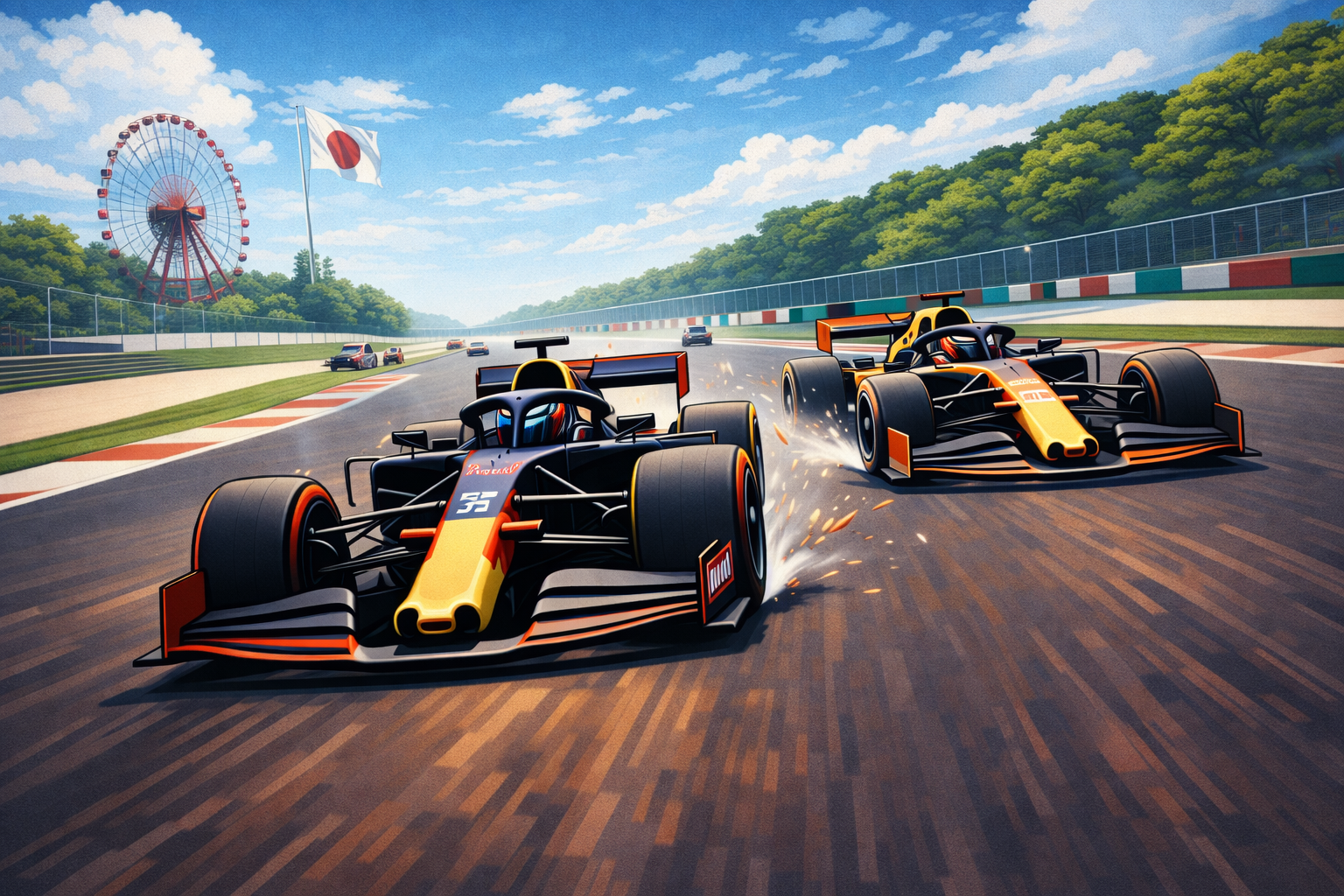

The Japanese Grand Prix 2025 at Suzuka delivered a tense strategic battle as Max Verstappen fought off the twin threat of Lando Norris and Oscar Piastri, with the Red Bull driver taking victory ahead of both McLaren cars in a race that heavily influenced the early title fight.
Japanese Grand Prix 2025 overview
The Japanese Grand Prix 2025, held at the iconic Suzuka International Racing Course, was the third round of the season and a critical test of high-speed balance and tyre management. Suzuka’s flowing esses, fast Degner corners and the flat-out 130R demanded a well-sorted chassis and a confident driver, making it a true driver’s circuit and an important indicator of which teams had produced the most complete packages for 2025.
Verstappen led home Norris and Piastri after 53 laps, with the McLaren pair finishing just over two seconds behind the race winner in total. Charles Leclerc secured fourth for Ferrari, ahead of a strong double-points result for Mercedes with George Russell and Andrea Kimi Antonelli in fifth and sixth. Lewis Hamilton took seventh for Ferrari, followed by an excellent drive from rookie Isack Hadjar in eighth, Alexander Albon in ninth and Oliver Bearman in tenth.
Qualifying at the Japanese Grand Prix 2025
Qualifying for the Japanese Grand Prix 2025 set the tone for a close fight at the front. Verstappen delivered a superb lap to secure pole position for Red Bull, extracting maximum performance from the car through the fast first sector and the technical final chicane. His effort highlighted that Red Bull still possessed formidable single-lap speed, even as rivals continued to close the gap.
McLaren responded strongly, with Norris and Piastri lining up directly behind Verstappen on the grid. The MCL’s balance through the esses and stability in the braking zones allowed both drivers to challenge for the front row and the small margins separating the top three hinted that Sunday’s race would be decided more by race pace and tyre choices than by outright qualifying advantage.
Race start: Verstappen holds off the McLarens
At lights out, Verstappen made a clean launch and covered the inside line into Turn 1, preventing Norris from attempting a move around the outside into the opening right-hander. The Red Bull driver held the lead through the first sector, while Norris fended off Piastri to keep second place in a tense but clean start among the front-runners.
Behind the leading trio, Leclerc maintained his position and settled into fourth, with Russell and Antonelli forming a Mercedes rear guard just behind. Hamilton, starting further back than he would have liked, focused on staying clear of early trouble while positioning himself for a long-run fight through the field. The pack threaded its way through the high-speed esses and by the end of the first lap, the leading order had stabilised with Verstappen ahead of both McLarens.
Strategy and tyre management at Suzuka
The Japanese Grand Prix 2025 was predominantly a two-stop race, with teams carefully managing tyre wear on the demanding Suzuka layout. The combination of long, loaded corners and high lateral forces meant that managing the front tyres, particularly through the esses and Spoon, was crucial to preserving lap time over a stint.
Red Bull and McLaren mirrored each other closely on strategy, cycling between the medium and hard compounds and pitting at similar laps to minimise the risk of an undercut. Verstappen’s first stop was timed to cover any potential threat from Norris behind, while McLaren responded immediately with Norris and then Piastri to maintain track position. Mercedes and Ferrari also ran conventional two-stop plans, with minor variations in stint length used to try to create offset advantages late in the race.
Key race phases and decisive moments
One of the defining aspects of the Japanese Grand Prix 2025 was the sustained pressure Verstappen faced from both Norris and Piastri. Through the middle stint, Norris appeared particularly strong in clear air, keeping the gap to the Red Bull within a couple of seconds and occasionally nibbling into the lead when Verstappen encountered minor traffic. However, Suzuka’s layout and the turbulent air in the fast sections made it extremely difficult to get close enough for a realistic passing attempt.
Piastri, running just behind his team-mate for much of the race, had to manage his tyres carefully while staying within range of Norris. In the closing laps after the final pit stops, all three front-runners pushed hard, but Verstappen’s consistent pace and small but important margin on track meant Norris never quite got into a position to launch a serious attack into the chicane or Turn 1. The race ended with all three separated by only a couple of seconds, reflecting how tight the performance window has become at the front of the 2025 grid.
McLaren performance: close but not quite enough
For McLaren, the Japanese Grand Prix 2025 underlined the team’s status as a genuine title contender, even if victory at Suzuka escaped them. Norris delivered a controlled, intelligent drive to finish second, matching Verstappen’s pace for long stretches and keeping the pressure on throughout all three stints. His result allowed him to retain a narrow lead in the drivers’ championship after Japan.
Piastri’s third place completed another double podium for McLaren. Although he remained just behind Norris in the final classification, his race pace suggested that, on another day with different track position or strategic circumstances, he could easily have been fighting directly with Verstappen for the win. Together, the McLaren drivers once again scored heavily, helping the team extend its advantage at the top of the constructors’ standings.
Ferrari at Suzuka: solid points, room for more
Ferrari enjoyed a more straightforward weekend at the Japanese Grand Prix 2025 than at some earlier rounds, with both cars bringing home points. Leclerc finished fourth after a relatively lonely race, unable to match the leading trio’s pace but fast enough to stay safely ahead of the chasing Mercedes pair. His consistency over all three stints provided Ferrari with a dependable haul of points and a clearer baseline for future development.
Hamilton, meanwhile, had to work harder for his seventh place, navigating through midfield traffic and managing tyre life during key phases. Although he did not have the outright pace to challenge Leclerc or the podium contenders, his experience and racecraft allowed him to pick off slower cars and avoid mistakes. Ferrari left Suzuka encouraged by its race execution but still aware that a performance step is needed to regularly trouble McLaren and Red Bull at the very front.
Mercedes progress: Russell and Antonelli in the fight
Mercedes produced another strong team result at the Japanese Grand Prix 2025, with Russell taking fifth and Antonelli close behind in sixth. The team’s 2025 car showed good balance through the fast sections of Suzuka and both drivers were able to run competitive lap times in clear air, even if they lacked just a little extra performance to challenge Ferrari or McLaren on outright pace.
Russell’s race was a model of consistency, managing his tyres well and staying close enough to Leclerc to take advantage of any potential mistakes, though such an opportunity never fully materialised. Antonelli continued his impressive rookie campaign with another composed drive, staying within touching distance of his team-mate and handling the technical demands of Suzuka with maturity. Mercedes left Japan with more evidence that its path of development is moving in the right direction.
Red Bull beyond Verstappen: Tsunoda’s home disappointment
While Verstappen delivered the result Red Bull needed at the Japanese Grand Prix 2025, the team’s second car had a more challenging afternoon. Yuki Tsunoda, racing on home soil, finished outside the points despite flashes of promising pace. Locked in tight midfield battles and dealing with tyre wear in turbulent air, he was unable to convert his home race into a top-ten finish.
The contrast between Verstappen’s victory and the struggles of the second Red Bull underscored one of the themes of the 2025 season: while the world champion can still extract race-winning performances from the car, the broader package can be vulnerable when track position and conditions are less than ideal. Red Bull knows it must improve the consistency of both cars if it wants to close the gap to McLaren in the constructors’ standings.
Midfield battles: Williams, Haas, Alpine and Aston Martin
The Japanese Grand Prix 2025 midfield fight was typically intense, with Williams, Haas, Alpine, Aston Martin and Kick Sauber all involved in close racing throughout the field. Albon’s ninth place for Williams highlighted his ability to manage tyres and execute clean overtakes, while Bearman’s drive to tenth gave Haas yet another important point in its effort to solidify its place in the midfield.
Further back, experienced names such as Fernando Alonso and Lance Stroll battled alongside younger talents like Liam Lawson, Pierre Gasly, Jack Doohan, Nico Hülkenberg and Gabriel Bortoleto. Small mistakes, track-limit infringements and strategic gambles all played a part in shuffling the order, emphasising how competitive and unforgiving the midfield has become in 2025.
Championship implications of the Japanese Grand Prix 2025
With the chequered flag falling at Suzuka, the Japanese Grand Prix 2025 left the championship picture finely poised. Verstappen’s victory cut Norris’s lead in the drivers’ standings to a single point, while Piastri’s third place kept him firmly in the hunt as well. The top three now each have race wins in 2025, setting up a compelling three-way fight as the season continues.
In the constructors’ championship, McLaren’s double podium allowed it to maintain its position at the top, but Red Bull’s win and Mercedes’ double-points finish ensured the gaps remain manageable rather than decisive. Ferrari’s solid points were enough to keep it in the chase, but the team knows that podiums and victories will be essential if it wants to stay in touch with the leading trio.
As the 2025 Formula 1 season moves on from the Japanese Grand Prix 2025, the narrative is clear: McLaren, Red Bull, Mercedes and Ferrari are all capable of big results and the margins between victory and defeat are smaller than ever. Fans can expect more strategic battles, intense wheel-to-wheel action and pivotal championship moments in the rounds to come, with every race adding a new chapter to an already gripping season followed closely on RukiF1.
What Suzuka tells us about the 2025 title fight
Three races in and the pattern is already obvious. Verstappen wins when Red Bull gets everything right. McLaren scores big even when it doesn’t. That combination is exactly what makes this championship so difficult to call. Norris leads by a single point but has two team-mates breathing down his neck. Piastri is fast enough to win on any given Sunday. And Verstappen, as Suzuka reminded everyone, still knows how to close the door when it matters most.
The constructors’ fight is arguably even more interesting. McLaren’s ability to score 1-2 finishes regularly is the kind of consistency that wins titles. Red Bull needs Tsunoda to start delivering points on a regular basis. A 25-point swing between the two cars at a single race is a gap that compounds fast over a 24-race season. If you want to follow how this plays out round by round, the driver market picture heading into 2027 is already being shaped by exactly these kinds of performances.
Hadjar’s eighth: the rookie story nobody expected
Isack Hadjar in eighth deserves more than a passing mention. Suzuka is one of the most demanding tracks on the calendar. The esses alone separate the confident from the cautious and Hadjar looked neither nervous nor reckless. He was just quick. Clean in traffic, sensible on tyres and composed when it counted. That’s a rare combination for a driver in his first season. Antonelli gets most of the rookie attention right now but Hadjar is making a very strong case for himself race by race.
Key takeaways
- Verstappen took a crucial victory that trimmed Norris’s championship lead to a single point, keeping the drivers’ title fight wide open after just three rounds.
- McLaren’s double podium confirmed its status as the most consistent team of 2025 so far, even without a win at Suzuka.
- Piastri’s pace throughout the race showed he’s a genuine title threat, not just a support act for Norris.
- Tsunoda’s failure to score at his home race highlighted Red Bull’s ongoing weakness with its second car, which could prove costly in the constructors’ fight.
- Hadjar’s eighth place was one of the drives of the day and a sign that the 2025 rookie class is genuinely competitive. Much like the Brawn GP story, sometimes the unexpected performers end up defining a season.
Frequently Asked Questions
Who won the Japanese Grand Prix 2025?
Max Verstappen won the 2025 Japanese Grand Prix at Suzuka, leading from pole position and holding off Lando Norris and Oscar Piastri throughout the race. The Red Bull driver crossed the line with a margin of just over two seconds to the McLaren pair, taking a vital victory that cut Norris’s championship lead to a single point.
What strategy did the front-runners use at Suzuka in 2025?
Verstappen, Norris and Piastri all ran two-stop strategies, cycling through medium and hard compound tyres. Red Bull and McLaren mirrored each other closely, with Verstappen pitting first to cover the undercut threat from Norris. Minor variations in stint length were used by Ferrari and Mercedes but neither team found a strategic advantage over the leaders.
How did the Japanese Grand Prix 2025 affect the championship standings?
Verstappen’s win reduced Norris’s drivers’ championship lead to just one point, with Piastri also staying firmly in contention. In the constructors’ standings, McLaren retained the top spot thanks to its double podium but Red Bull’s victory and Mercedes’ double-points finish kept the gaps between the teams manageable heading into the next round.
Why did Yuki Tsunoda fail to score points at his home race?
Tsunoda struggled with tyre wear in traffic and was caught up in tight midfield battles throughout the afternoon. Despite showing promising pace at times, he couldn’t find a clear enough window to make the moves needed for a top-ten finish. It was a frustrating afternoon for the Japanese driver racing in front of his home crowd at Suzuka.
How did the rookies perform at the 2025 Japanese Grand Prix?
Isack Hadjar was the standout rookie with an impressive eighth-place finish, handling Suzuka’s demanding layout with real composure. Andrea Kimi Antonelli took sixth for Mercedes, continuing his strong start to the 2025 season. Both drivers showed the kind of racecraft that suggests the next generation of F1 talent is arriving ahead of schedule.
