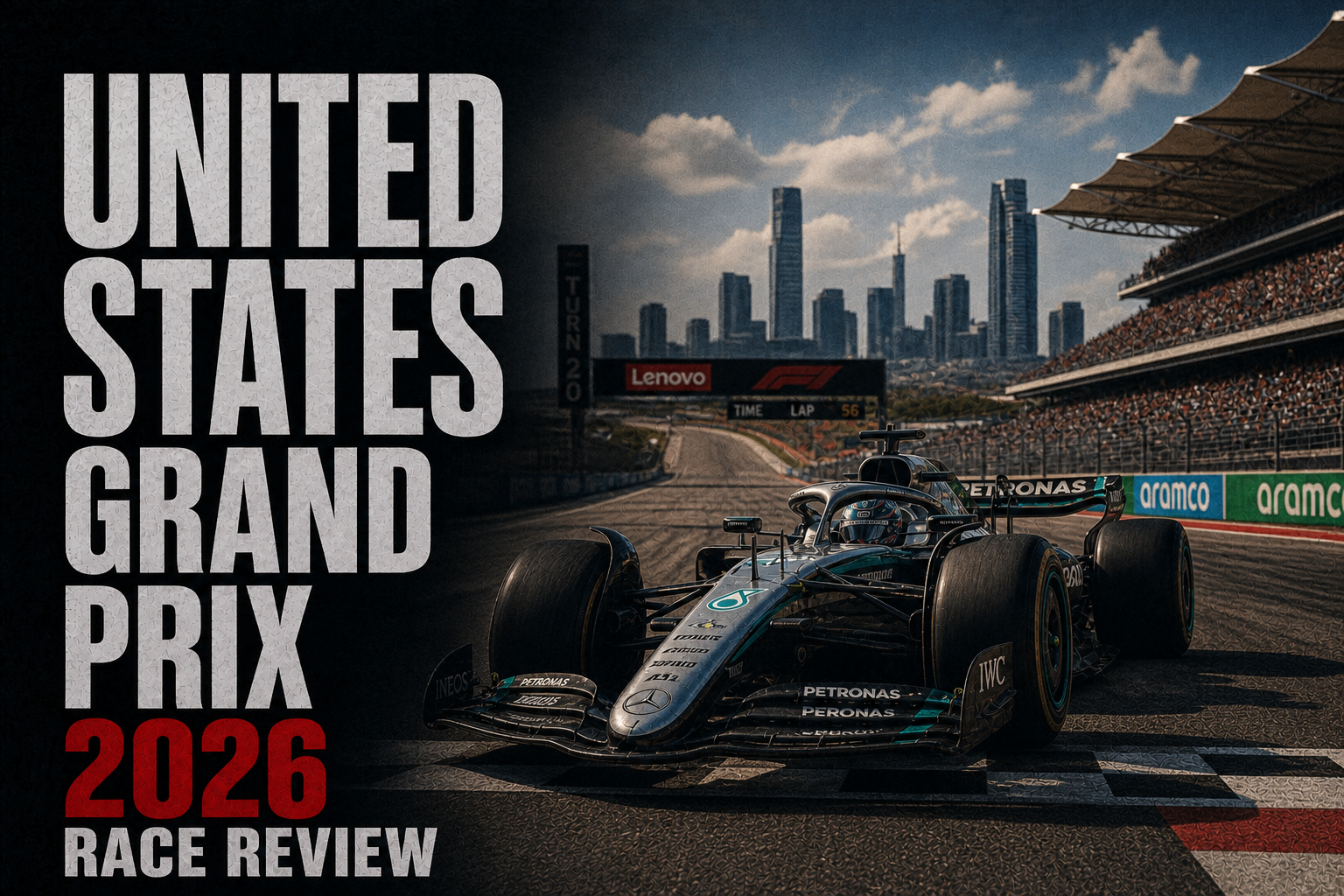

“The best race in Formula 1 so far.”
Toto Wolff on Kimi Antonelli‘s drive at the 2026 United States Grand Prix
1. Championship context and the historic title race
Antonelli’s precipice of greatness
The 2026 United States Grand Prix at the Circuit of the Americas marked a watershed moment in modern Formula 1 history. Kimi Antonelli delivered a drive of supreme composure to secure his ninth career Grand Prix victory in only his second season at the pinnacle of motorsport. By converting pole position into a commanding victory in Austin, Texas, the 20-year-old Mercedes prodigy extended his lead in the World Drivers’ Championship to a formidable 123 points over his nearest rivals.
Entering the weekend, the statistical probability of Antonelli sealing the world title in Austin was a mathematical possibility requiring a specific alignment of midfield results behind him. While the coronation was deferred by a margin of two finishing positions, Antonelli exiting COTA on the absolute precipice of glory underscored his meteoric trajectory. When he secures the crown, Antonelli will become the youngest World Drivers’ Champion in Formula 1 history at 20 years of age, shattering Sebastian Vettel’s long-standing 2010 record by a margin of three full years.
Mercedes’ technical resurgence
The underlying foundation of Antonelli’s dominant performance in Austin was the validation of Mercedes’ complex aerodynamic upgrade package. Initially introduced at Spa-Francorchamps and subsequently refined through Singapore, the development path had previously yielded mixed signals. However, COTA provided the definitive proving ground, confirming that the aerodynamic package delivers elite race pace when operating inside its optimum window.
Technically, the revised floor and bodywork geometry operate on a noticeably narrower setup window than their predecessor. COTA’s prominent surface bumps, particularly through the high-speed compression into Turn 2 and the braking zone for Turn 10, exacerbated ride-height sensitivity, triggering transient underbody aero stalls if the chassis was improperly balanced. Yet, once tuned into its sweet spot, the package yielded unmatched tyre preservation on Sunday. Paddock commentary from Mercedes Team Principal Toto Wolff highlighted the significance of the result, declaring Austin to be Antonelli’s best race in Formula 1 so far, surpassing even his celebrated victories at Monaco and Monza. The technical feedback loop between Antonelli’s side of the garage and the engineering trackside team enabled Mercedes to out-execute both Red Bull Racing and Ferrari across a high-degradation 56-lap distance.
Title permutations heading to Mexico City
As the championship transitions directly to the Autódromo Hermanos Rodríguez for the Mexican Grand Prix, the title permutations have narrowed to a virtual certainty.
2. Qualifying highlights and grid formation
Antonelli’s scorching Q3 pole lap
Antonelli’s route to pole position was forged through remarkable adaptability following a compromised practice baseline. During Friday and Saturday morning, the Italian struggled with balance fluctuations, failing to extract peak performance from the soft compound prior to qualifying.
However, as the track rubbered in for Q3, Antonelli unleashed a devastating initial benchmark, eclipsing Red Bull’s Max Verstappen by nearly four-tenths of a second on his opening run. Shifting crosswinds through Sector 1 and Sector 3 in the closing minutes rendered track conditions treacherous, causing several drivers to abort or lose time. Despite snapping into a momentary slide on his final attempt through Turn 19 and Turn 20, Antonelli’s earlier sector times held firm, securing his seventh pole position of the 2026 season.
Red Bull’s divergent Saturday
Red Bull Racing experienced a stark contrast in garage fortunes during Saturday’s qualifying session.
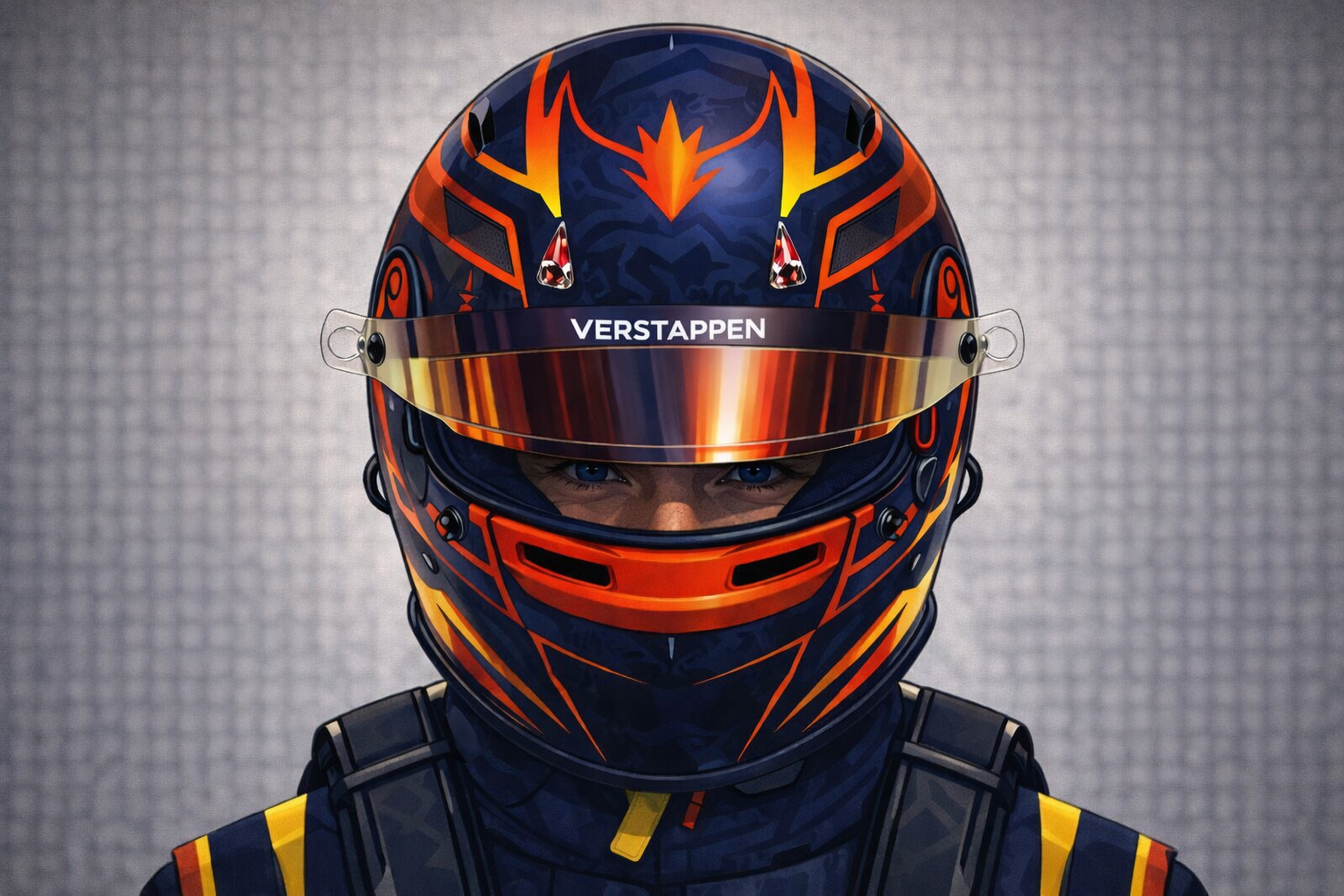
Max Verstappen (P2). The Dutchman was denied a shot at pole position due to persistent powertrain deployment glitches and rear-end instability. On his first Q3 run, Verstappen suffered snapping oversteer and wheelspin out of low-speed traction zones, preventing effective power delivery. A sudden increase in wind velocity during his second Q3 run eliminated any opportunity for sector improvements across the board.
Isack Hadjar (P3). Hadjar produced one of the standout individual performances of qualifying, rebounding from a chaotic Friday where setup changes rendered the car virtually undrivable. Hadjar was so compromised in FP3 that he could not even complete a single representative flying lap on the soft compound tyre. Through diligent overnight engineering work, Hadjar recovered to qualify P3, directly behind his teammate on the second row.
Midfield heartbreak and track-limit woes
Track limits at COTA’s Turn 11 and Turn 19 proved decisive for several midfield contenders during Q1 and Q2.
Oliver Bearman (Haas). Bearman produced a lap sufficient to progress into Q3, but had his lap time deleted for exceeding track limits at Turn 11. Bearman noted post-session that severe sun glare blinded the braking point, making precise tyre placement on the white line a matter of arbitrary millimetres.
George Russell (Mercedes). After looking competitive in Q2, Russell experienced a dramatic drop in pace during Q3. Overdriving through the low-speed stadium section to compensate for a minor error, Russell actually went slower in Q3 than he had in Q2, leaving him stranded in P8.
Pierre Gasly (Alpine). Gasly put together a clean flying lap in Q2 but missed out on a Q3 berth by an agonising margin of 0.020 seconds (20 milliseconds).
Qualifying elimination summary
Eliminated in Q1: Franco Colapinto (Alpine), Alex Albon (Williams), Esteban Ocon (Haas), Lance Stroll (Aston Martin), Sergio Pérez (Cadillac), Valtteri Bottas (Cadillac).
Eliminated in Q2: Pierre Gasly (Alpine), Nico Hülkenberg (Audi), Gabriel Bortoleto (Audi), Fernando Alonso (Aston Martin), Oliver Bearman (Haas).
Post-qualifying driver reactions
3. Race analysis and strategy masterclass
Turn 1 drama and opening lap mechanics
The run up COTA’s steep hill into Turn 1 yielded immediate tactical drama. Pole-sitter Antonelli executed a clean getaway, but second-placed Verstappen suffered a sluggish launch off the line due to clutch bite-point mapping and clutch overdelivery inconsistencies, compounding his weekend-long ERS deployment struggles.
Recognising Verstappen’s poor launch, Antonelli swept to the inside line to cover off any counter-attack. Behind them, Charles Leclerc produced an extraordinary opening sequence. Braking late on the wide entry to Turn 1, Leclerc swept around the outside of Verstappen, hanging his Ferrari on the limit through Turns 1 and 2 before completing a stunning pass through the high-speed Sector 1 S-curves.
→ ━
P1
→ ▼
P3
→ ▲
P2
→ ▲
P4
Simultaneously, Lewis Hamilton capitalised on Hadjar’s compromised entry to slot into P4. Verstappen mounted an immediate recovery effort later on Lap 1, lunging down the inside of Leclerc into Turn 12 to reclaim P2, while the midfield behind them checked up in heavy traffic.
Strategy split: the 1-stop masterclass vs the 2-stop trap
The strategic defining factor of the Grand Prix was the stark divide in tyre degradation management between Mercedes and their prime rivals, Red Bull and Ferrari.
Mercedes committed unequivocally to a 1-stop strategy (Medium to Hard), trusting Antonelli’s ability to manage degradation rates. Antonelli extended his opening stint on the Medium compound metronomically, maintaining lap times within two-tenths of a second variance lap after lap.
Conversely, Red Bull reacted early. Unhappy with thermal degradation on the Medium rubber and battling engine braking balance inconsistencies, Red Bull pitted Verstappen prematurely on Lap 14. This locked Verstappen into a forced 2-stop strategy, requiring him to clear midfield traffic on two separate occasions and exposing him to severe degradation on his final soft-tyre stint.
Wheel-to-wheel showdowns: Leclerc’s surge and Hamilton to P4
The final 15 laps of the Grand Prix showcased sensational wheel-to-wheel combat generated by diverging tyre ages.
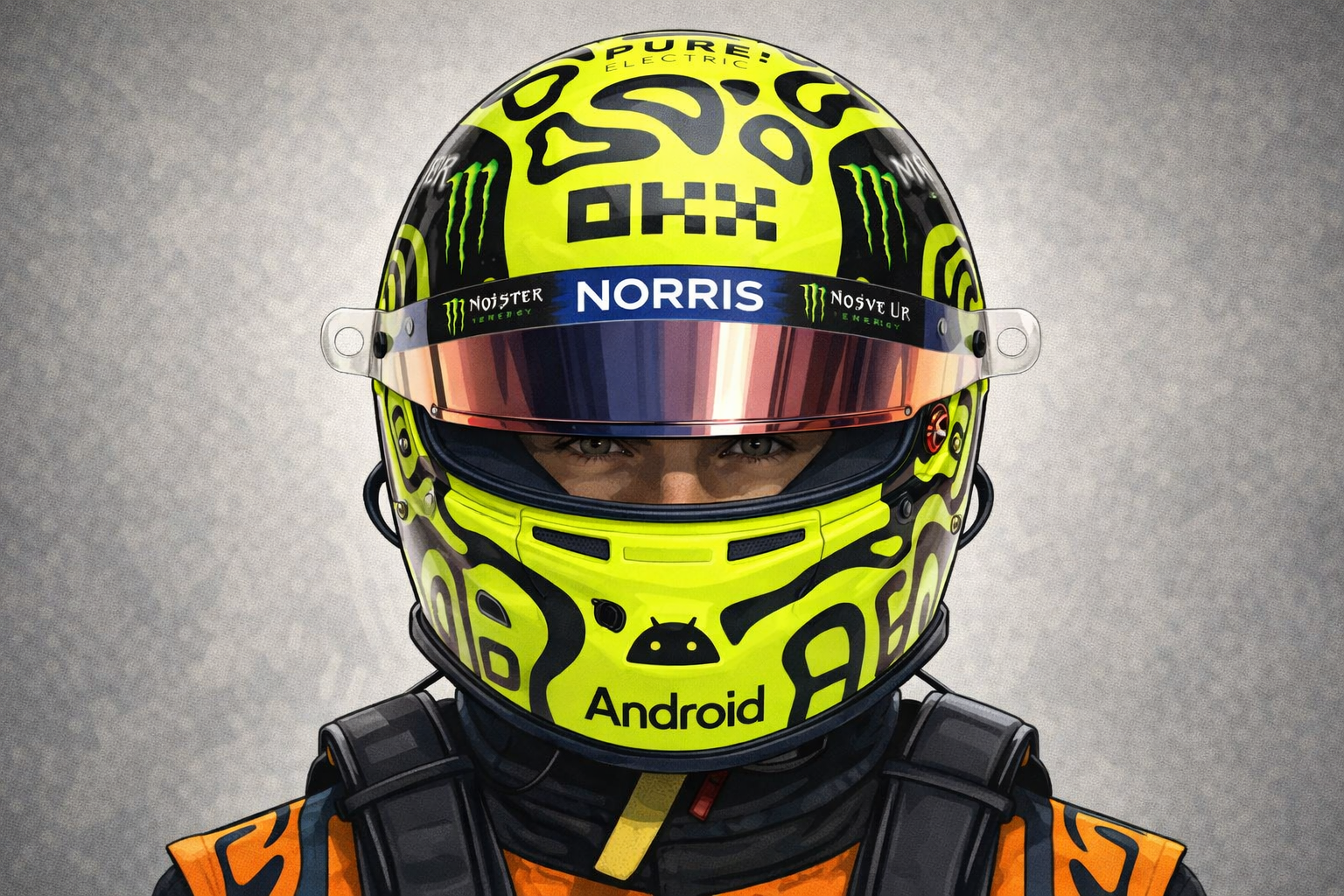
Leclerc’s charge for P2. After making his final pit stop for fresh Hard tyres, Charles Leclerc found himself eight seconds adrift of Verstappen with 10 laps remaining. Leveraging superior mechanical grip, Leclerc closed the gap in just eight laps. Leclerc executed a decisive move on Lando Norris, before forcing Verstappen into a lock-up at Turn 13 to snatch P2.
Hamilton’s late surge to P4. Lewis Hamilton mirrored his teammate’s late-race pace. Slicing past Norris into Turn 1 with a decisive late-braking manoeuvre, Hamilton closed down Verstappen in the dying stages, crossing the finish line just 1.0 second off the podium.
4. Radio rewind and on-track controversies
Hadjar’s cockpit crisis and throttle pedal glitch
Isack Hadjar‘s race was severely compromised following his pit stop due to a critical electronic control glitch. The Red Bull pit stop throttle pedal map failed to disengage, introducing a 40% deadband into the accelerator travel. Hadjar was left driving a car that offered zero power output for the first 40% of pedal depression.
The situation led to explosive team radio exchanges as Hadjar was instructed to yield position to Verstappen while fighting the vehicle’s erratic telemetry.
“You’ve got the pit stop pedal up so you have a large deadband, so your throttle only comes in at 40 percent. We cannot get out of it. We have to deal with this now.”
“Why are we on the hub? What strat have? Please come on.”
“Isack, let Max pass into Turn 12.”
“I don’t want to lose race time. Sorry, no mate.”
“Isack, this is what you do. Let’s remind you of the rules of engagement.”
“Yeah, thank you guys.”
Despite the system failure, Hadjar managed engine settings manually to bring the car home in the points, albeit deeply frustrated by the lost potential.
Incident briefings: track limits, pit wall squeezes and collisions
The stewards were kept exceptionally busy throughout the 56 laps.
George Russell penalised. Russell received a 5-second time penalty for leaving the track and gaining a lasting advantage at Turn 12/13 while battling Oscar Piastri and the midfield group. Russell voiced his disagreement over the radio, stating he was on the inside and Piastri attempted to overtake around the outside.
Bearman vs Gasly collision. Oliver Bearman attempted a late lunge up the inside of Pierre Gasly into Turn 12/13 following a Virtual Safety Car restart. The two cars collided heavily, causing significant floor damage to both vehicles. Bearman was penalised with a 10-second time penalty. Post-race, Bearman defended his move, while Gasly lamented losing massive downforce.
Bearman: “I sent one up the inside. He saw me because he left space, but for me it didn’t really feel like enough. I had to even climb up onto the kerb to try and avoid contact. Ruined my race anyway, I was losing a second a lap due to downforce.”Gasly: “After the contact with Ollie we lost quite a lot. Had quite a big damage on the floor. Considering the pace after that, the fact we managed to hold on to P10 is positive.”
Lindblad squeezes Sainz into pit wall. On Lap 1, Arvid Lindblad squeezed Carlos Sainz toward the pit wall on the main straight. Sainz made heavy contact with the barrier, destroying his front wing assembly. Sainz completed a full lap with a dragging front wing, undergoing a lengthy nose-change stop that ruined his early prospects.
Albon vs Alonso contact. Alex Albon and Fernando Alonso collided at Turn 11 on Lap 1. Albon defended that he was pinched on the inside kerb by a third car on Alonso’s right, while Alonso reported floor damage that compromised his steering geometry for the remainder of the race.
Bottas VSC and the final neutralisation
On Lap 44, Valtteri Bottas suffered a sudden power unit breakdown entering Turn 1. Describing the mechanical failure over team radio, Bottas noted:
Bottas: “I got this sound like putting nuts and bolts in a blender, and then engine cuts on power.”
Bottas pulled his Cadillac off track near Turn 1, requiring marshals to deploy a crane. Race Control initiated a Virtual Safety Car to safely recover the vehicle, momentarily freezing gap intervals across the field before the green flag signalled the final ten-lap sprint.
5. Midfield performers and post-race debriefs
Lawson’s metronomic solitude and Gasly’s damaged defiance
Liam Lawson (P9, Racing Bulls). Lawson executed a clinical, solitary race to secure two precious championship points for Racing Bulls. Starting inside the top ten, Lawson ran 56 clean laps in clear air without making an operational error, extending the gap to the chasing pack and reinforcing Racing Bulls’ hold on P5 in the constructors’ championship.
Pierre Gasly (P10, Alpine). Gasly demonstrated relentless resilience to drag his Alpine into the final points-paying position. Despite losing a significant fraction of his car’s underbody downforce following the collision with Bearman, Gasly held off a late-race charge to secure P10.
Post-race driver quote synthesis



6. Paddock verdict and strategic outlook
George Russell’s mental crossroads and Track Pulse insights
Analysis in the paddock focused heavily on the contrast between Mercedes teammates. Telemetry metrics provided by the AWS Track Pulse system revealed empirical discrepancies regarding Russell’s performance in Austin.
Adding context to Russell’s mental state, Mercedes Team Principal Toto Wolff remarked post-qualifying that Russell’s Q3 lap represented the actual baseline capability of the car, implying that Antonelli had actively outperformed the package. This connected directly to Russell’s ongoing setup struggles and loss of confidence in high-speed entry stability, leaving him despondent post-race. It sparked intense paddock debate regarding Russell’s long-term position within Mercedes. Paddock analysts noted that with Antonelli clearly established as Toto Wolff’s ultimate protégé, Russell faces a critical crossroads regarding his five-year career outlook.
The butterfly effect: Hamilton’s Ferrari switch
A compelling narrative raised during the paddock debrief was the butterfly effect of Lewis Hamilton‘s decision to depart Mercedes for Ferrari.
Had Hamilton chosen to remain on a single-year deal at Mercedes through 2025/2026, Antonelli’s promotion to the works team would likely have been deferred to a customer seat. Consequently, Russell would have operated as the undisputed team leader at Mercedes during the 2026 technical development cycle, potentially positioning Russell as the primary 2026 World Championship contender. Hamilton’s move to Maranello inadvertently accelerated Antonelli’s trajectory directly into the factory seat, sidelining Russell’s title ambitions.
Constructors’ championship tie and development pipelines
The battle behind Mercedes in the Constructors’ Championship reached a critical juncture in Austin.
McLaren’s drop to P4 behind Red Bull on tiebreak countback highlights their current developmental lag. McLaren Team Principal Andrea Stella confirmed that the team is bringing aerodynamic upgrades as late as Brazil and Las Vegas. This developmental lag stems from turn-of-the-year development cycle missteps, forcing McLaren to launch with a basic spec and continually spend resources widening their car’s narrow setup window, while competitors like Ferrari and Mercedes pivot focus toward the 2027 engine and chassis regulations.
Driver of the day debates
The paddock panel concluded their review by selecting their driver accolades for the United States Grand Prix.
Definitive Driver of the Day: Kimi Antonelli. Unanimously praised for executing a flaw-free victory on a 1-stop strategy while under supreme championship pressure.
Honorary mention (race craft): Charles Leclerc. Cited for his aggressive, surgical overtakes on Verstappen and Norris and extracting peak performance from the Ferrari package.
Honorary mention (midfield execution): Liam Lawson. Awarded for his metronomic drive to P9 under pressure, in addition to his impromptu musical performance on the COTA fan stage earlier in the weekend.
Related reading
For the full round-by-round story of how Antonelli built the lead that puts him on the brink of a Mexico City coronation, see The Prodigy on the Precipice: Antonelli’s Road to Champion. The weekend before Austin, our United States GP preview laid out the clinch maths and Ferrari’s upgrade package. For last round’s narrative, read our Singapore Grand Prix review.
Related picks on Amazon
A few things worth a look if this review got you curious. Links are affiliate: buying through them supports the site at no extra cost to you.
