
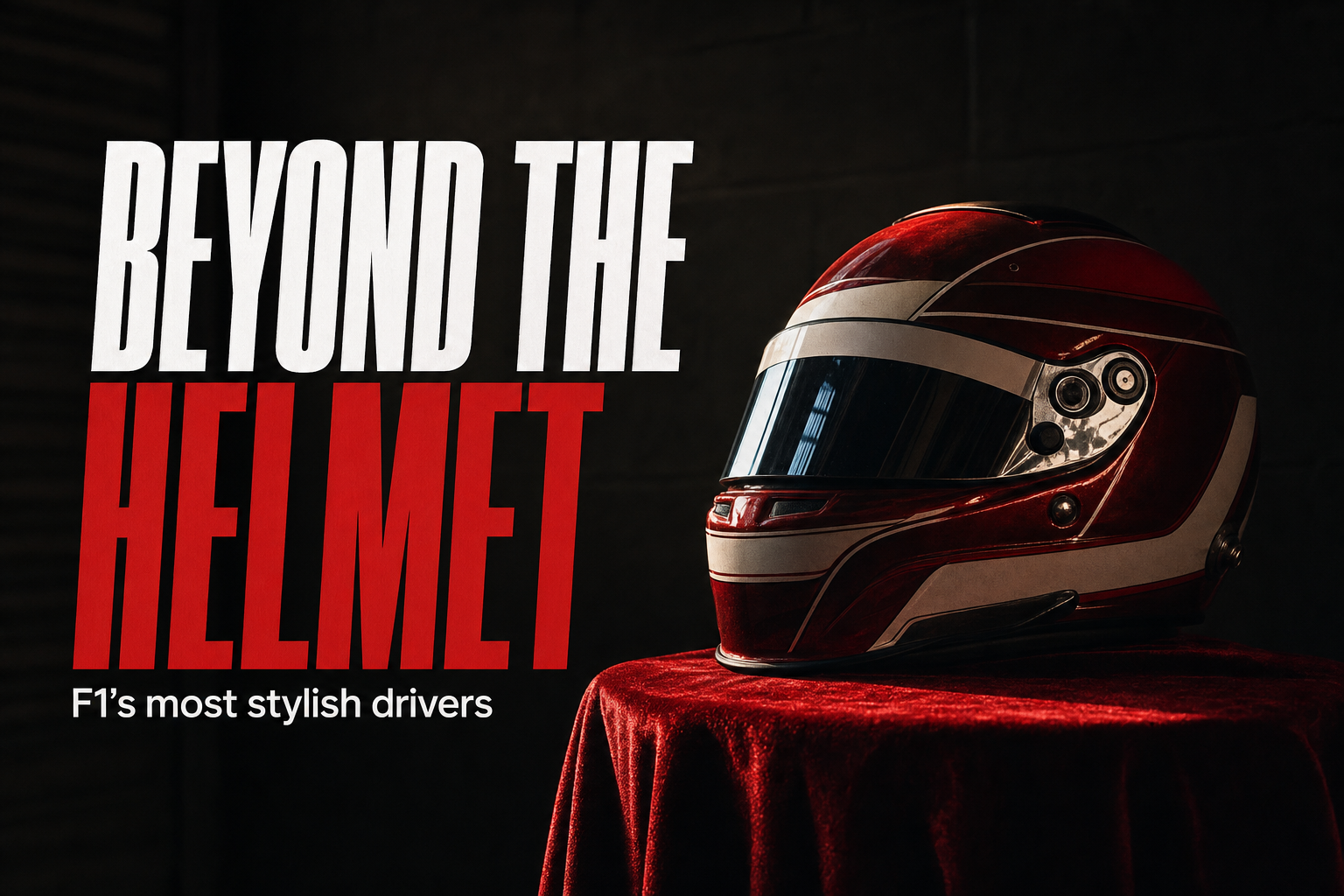

“I want to turn up to the track in what I want to wear.” That quote from Lewis Hamilton is a reasonable summary of what separates the drivers on this list from everyone else. Formula 1 has always existed at the intersection of sport and culture. The paddock on a race weekend is one of the most photographed environments in professional sport. Monaco, Milan, the pit lane at dusk. The drivers who bring genuine aesthetic intelligence to that environment add something to the sport that lap times alone can’t measure.
Where Speed Meets Style
The sport’s commercial glamour has always coexisted with its technical extremity. What’s changed over the decades is how deliberately some drivers have engaged with that duality. The ones who do it best become figures whose influence is acknowledged by industries that have no particular interest in the championship standings. Fashion editors, photographers, cultural commentators. They notice. These are the drivers who gave them something to write about.
Latest race: Lando Norris won the Brazilian Grand Prix on 8 November 2026, Round 20 of the 2026 season. Championship after Round 20: Kimi Antonelli (Mercedes) leads on 390 points, 111 ahead of Max Verstappen (Red Bull) on 279. George Russell (Mercedes) sits third on 262, 128 off the lead.
Lewis Hamilton
Hamilton’s status as one of the most influential style figures in professional sport is sufficiently established that it doesn’t need much argument. The Met Gala appearances. Paris Fashion Week. Fashion collaborations that exist entirely outside the F1 commercial ecosystem. He’s a genuine crossover figure whose cultural footprint extends well beyond the sport.
What makes it work is that his engagement with fashion reads as a creative interest rather than a sponsorship obligation. Most athletes in team sports can’t afford to take the risks he takes with personal presentation. Hamilton can and does. The purple helmet that defined his later Mercedes years was a deliberate choice. In a sport where team liveries dominate the visual landscape, creating that kind of individual visual identity takes thought.
His on-track presentation and his off-track persona have always felt like the same person. That consistency is rarer than it looks.
James Hunt
Hunt’s style was rooted in the specific aesthetic of 1970s Britain and it was inseparable from the personality that made him one of Formula 1’s most compelling characters. He wore his race suit with an unconventionality that the regulations of the time permitted. He exploited that space with what appeared to be deliberate disregard for convention.
Off track: long hair, casual clothes, a general indifference to the formal presentation that most drivers of his era maintained. It wasn’t a calculated image. That’s the point. Hunt looked like someone who had just won a race and wasn’t particularly interested in attending the formal reception afterwards. That quality, authentic rather than performed, made him one of the most photographed drivers of his generation. It’s also why he’s still remembered so clearly decades later.
Nico Rosberg
Rosberg’s style is more conventionally European in its sensibility than either Hamilton’s or Hunt’s. The son of a world champion, educated across multiple countries, fluent in several languages. That background produced a specific kind of international polish that fitted naturally into Formula 1’s dual identity as both a sport and a commercial spectacle.
His retirement from Formula 1 immediately after winning the 2016 championship was the most striking thing he ever did. He walked away at thirty-one, at the peak of his career and moved into technology investment and sustainability advocacy. His style in that post-racing chapter has been consistent with that decision. Considered, international, entirely without the desperation for sporting relevance that affects many drivers who leave the cockpit earlier than expected.
Kimi Raikkonen
Raikkonen belongs on this list precisely because he represents the extreme opposite of the conventional celebrity driver aesthetic. And in representing that opposite so completely, it became a style of its own.
Minimal engagement with fashion or image management. An appearance at public events that suggested someone who would rather be somewhere else. A wardrobe that prioritised practicality over statement. All of that became recognisable as an aesthetic choice rather than an absence of one.
The drivers who try to look like they don’t care about how they look almost always look like they’re trying. Raikkonen looked like he genuinely didn’t care. That’s an entirely different and considerably rarer quality. It’s also, paradoxically, one of the hardest things to pull off in a sport that demands constant performance of various kinds.
Sebastian Vettel
Vettel’s post-racing public presence reflected a personal style that had always existed but that the demands of active competition had partially obscured. The environmental activism. The deliberate distance from the sport’s commercial mainstream that defined his final years as a driver. After retirement, those qualities became more visible.
His appearance at events after leaving the cockpit was relaxed and deliberately unstylish in the conventional sense. It suggested someone who had spent years performing for audiences of various kinds and was now performing only for himself. The authenticity of that shift was legible in how he presented himself. It produced a kind of style that the more conventionally polished drivers on this list can’t replicate, because it requires a disregard for the audience that most public figures can’t quite achieve.
The Current Generation
The sport’s style conversation doesn’t stop with the drivers above. Charles Leclerc has built a public presence that extends well beyond the Ferrari brand, with fashion appearances and collaborations that reflect a genuine engagement with that world. Lando Norris has carved out a different kind of cultural presence entirely, one rooted in gaming culture and social media that connects with audiences Hamilton’s generation never reached. George Russell brings a composed, considered public image that fits the Mercedes tradition without being defined by it.
Each of them is building something. Whether any of them reaches the cultural weight of Hamilton or the mythological status of Hunt is a question that takes years to answer.
Why Style Matters in Formula 1
The drivers on this list have contributed to Formula 1’s cultural identity in ways their lap times alone can’t account for. They’ve been the faces through which people who don’t follow the sport have encountered it. The presences in photographs, on red carpets, in collaborations with fashion and culture that have kept Formula 1 in conversations it wouldn’t otherwise have reached.
Style in Formula 1 isn’t separate from the sport. It’s part of what the sport is. It’s part of why the paddock draws the attention it draws and why the drivers who inhabit it become figures whose influence extends beyond the circuits they race on.
The fastest drivers win championships. The most stylish ones change the culture around the sport. Both things matter. They always have.
Further reading
- British Fashion Council — The BFC has formally recognised Lewis Hamilton’s contribution to British fashion, making it a primary source for his crossover cultural status.
Related picks on Amazon
A few things worth a look if this article got you curious. Links are affiliate: buying through them supports the site at no extra cost to you.
- James Hunt: The Biography by Tom Rubython — shop on Amazon
- Lewis Hamilton: My Story autobiography — shop on Amazon
- Official F1 racing helmet replica collectible — shop on Amazon
- Rush (2013) film on Blu-ray — shop on Amazon
