
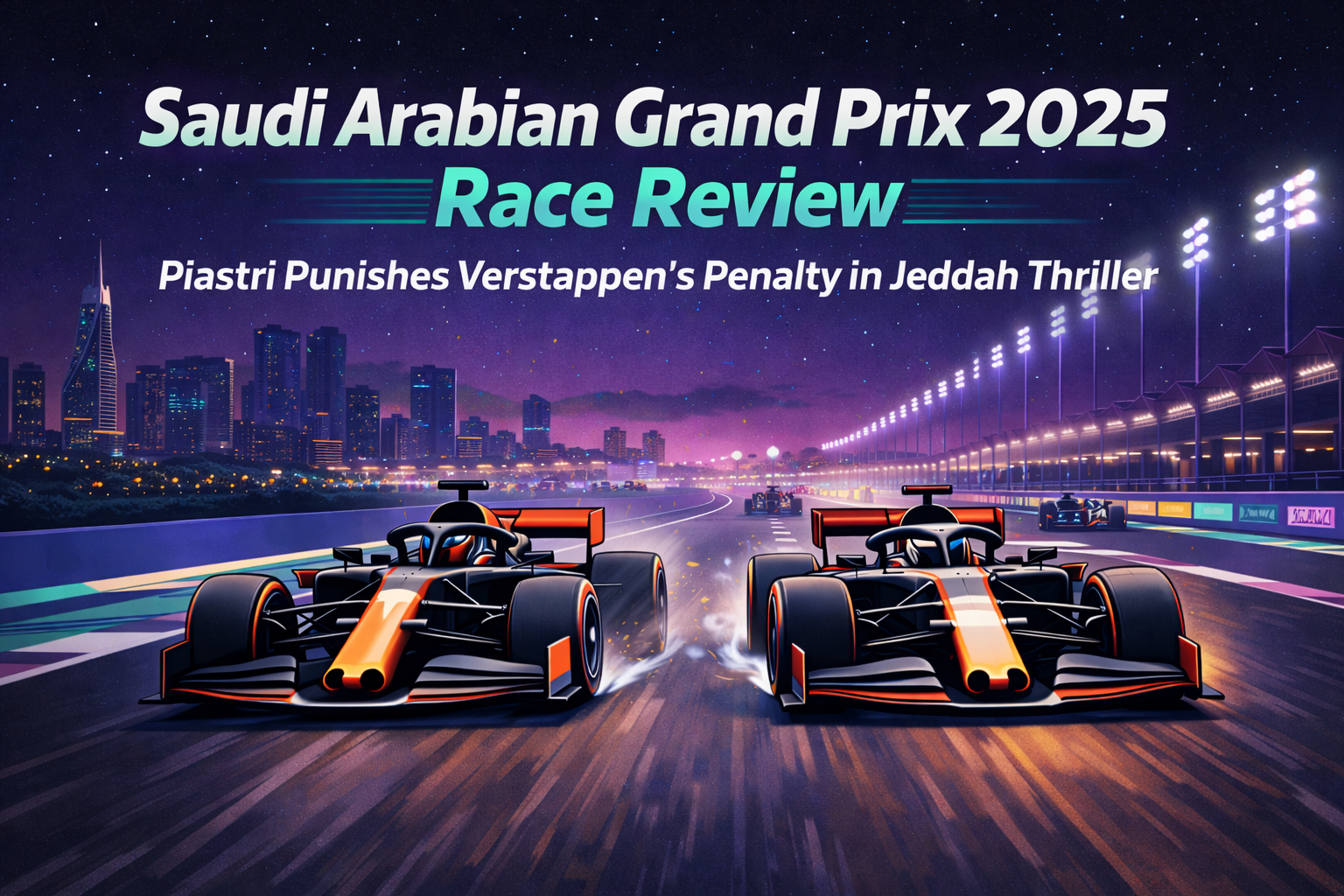

The Saudi Arabian Grand Prix 2025 at the Jeddah Corniche Circuit produced another dramatic chapter in the Formula 1 season, as Oscar Piastri converted front-row pace and flawless execution into victory for McLaren, capitalising on a costly penalty for polesitter Max Verstappen and holding off challenges from both Red Bull and Ferrari across 50 intense laps under the lights.
Saudi Arabian Grand Prix 2025 overview
The Saudi Arabian Grand Prix 2025, the fifth round of the season, once again showcased the unique challenge of the high-speed Jeddah Corniche Circuit. With its blind sweeps, concrete walls and narrow, flat-out sections, the street track rewarded commitment and punished even minor mistakes, making it an ideal arena for a crucial early title showdown between McLaren, Red Bull, Ferrari and Mercedes.
Piastri took the win ahead of Verstappen and Charles Leclerc, with Lando Norris finishing fourth after a recovery drive from a compromised qualifying session. Just behind, George Russell and Andrea Kimi Antonelli secured a strong double points finish for Mercedes, while Lewis Hamilton, Carlos Sainz, Alexander Albon and Pierre Gasly completed the top ten in a race defined by strategy, penalties and razor-thin margins.
Qualifying at the Saudi Arabian Grand Prix 2025
Qualifying on the Jeddah Corniche Circuit is always high-risk, high-reward and the Saudi Arabian Grand Prix 2025 session was no exception. Verstappen delivered a stunning lap to take pole position, breaking the track record and underlining the continued one-lap potency of the Red Bull package through Jeddah’s relentless high-speed sequences.
Piastri was just behind in second, putting McLaren on the front row and directly alongside its main title rival. Russell and Leclerc locked out the second row for Mercedes and Ferrari respectively, while Antonelli impressed with a top-five start. Norris, who had looked fast all weekend, saw his qualifying hopes compromised by a mistake and resulting crash in Q3, leaving him only tenth on the grid after failing to set a representative time when it mattered most.
Race start: drama into Turn 1
The start of the Saudi Arabian Grand Prix 2025 delivered immediate drama. As the lights went out, Verstappen and Piastri made strong launches, but into the tight opening chicane the Red Bull driver overstepped the limit. Defending aggressively from Piastri on his outside, Verstappen cut across the escape area to retain the lead, triggering instant scrutiny from the stewards and frustration on the McLaren radio.
Behind them, Russell and Leclerc navigated the chaos cleanly to hold third and fourth, while Antonelli, Hamilton and Sainz jostled for position in the packed midfield train. Norris focused on staying out of trouble from tenth on the grid, knowing his race would be built on long-run pace and patience rather than early heroics in the walls-lined opening laps.
Strategy and Verstappen’s penalty
The early incident at the first chicane proved decisive. The stewards handed Verstappen a five-second time penalty for leaving the track and gaining an advantage against Piastri into Turn 1. That ruling transformed the strategic picture of the Saudi Arabian Grand Prix 2025, forcing Red Bull to plan its race around serving the penalty, while McLaren adapted its approach to keep Piastri close enough to benefit when the time was added.
Most of the leading runners committed to a one-stop strategy on the soft and medium compounds, taking advantage of Jeddah’s relatively smooth surface and the benefits of track position. Verstappen led the early laps on track, but Piastri stayed calmly within the crucial five-second window, managing tyres and energy deployment with impressive discipline. When Red Bull brought Verstappen in for his sole stop, the penalty was served and Piastri’s consistent pace allowed him to cycle through to the net race lead once McLaren covered the strategy.
McLaren execution: Piastri wins, Norris fights back
Once Piastri inherited track position after Verstappen’s stop and penalty, the McLaren driver never relinquished control of the Saudi Arabian Grand Prix 2025. His out-laps and in-laps around the pit window were decisive and his composure in traffic allowed him to maintain clean air when it mattered most. In the final stint, he managed the gap to Verstappen expertly, crossing the line with a margin of just under three seconds to secure his third win of the season and move into the lead of the drivers’ championship.
Norris’s race was all about recovery and damage limitation after his Q3 crash. Starting tenth, he carved his way through the field with a combination of decisive overtakes and well-timed strategy, using strong long-run pace to pass cars from the midfield and close in on the top three. Although he ultimately had to settle for fourth behind Leclerc’s Ferrari, Norris’s charge through the pack added important points to McLaren’s constructors’ tally and underlined the team’s race-day strength.
Ferrari: first podium of the season in Jeddah
For Ferrari, the Saudi Arabian Grand Prix 2025 marked an important step forward in its campaign. Leclerc drove a clean and controlled race to finish third, securing the team’s first podium of the season and proving that its 2025 car can compete strongly on a fast, flowing street circuit. He shadowed the leading duo at a small but steady distance, never quite able to launch an attack on Verstappen but comfortably ahead of the chasing pack.
Hamilton brought the second Ferrari home in seventh after a more eventful race. Starting in the midfield, he spent much of the evening in close battles with Mercedes and Williams machinery, having to balance overtakes with careful tyre management. While the result did not match the heights of his previous podium-challenging performances, the double-points finish nevertheless helped Ferrari consolidate its position in a tightly packed group behind McLaren in the standings.
Red Bull: pace and penalty define the night
Red Bull left the Saudi Arabian Grand Prix 2025 knowing that raw pace alone was not enough on this occasion. Verstappen clearly had the speed to challenge for victory, but his aggressive defence at the start and subsequent five-second penalty ultimately handed the strategic initiative to McLaren and Piastri. Once the penalty was served at his pit stop, he could do little more than chase, as Piastri controlled the gap in the final stint.
Red Bull’s second car also had a challenging evening. Yuki Tsunoda, now established alongside Verstappen, showed glimpses of speed but struggled to convert them into a top result amid the chaos of the midfield and the fine margins of Jeddah’s walls. His final placing outside the top six highlighted how demanding the Saudi Arabian Grand Prix 2025 was for any driver starting away from the very front.
Mercedes: strong points from Russell and Antonelli
Mercedes had plenty of positives to take from the Saudi Arabian Grand Prix 2025. Russell’s fifth place came after a competitive run that saw him stay in touch with the leading group for much of the race, his car showing good stability in the high-speed sections and strong braking performance into the tight corners that punctuate the Jeddah lap.
Antonelli once again impressed with a mature drive to sixth, collecting more valuable points in his rookie season. Navigating a street circuit of this difficulty without major errors and doing so while running close to experienced names such as Hamilton and Sainz, further underlined his potential. With both cars in the top six, Mercedes strengthened its grip on second place in the constructors’ battle, even as McLaren stretched its advantage at the top.
Midfield storylines: Williams, Alpine, Haas and others
The midfield at the Saudi Arabian Grand Prix 2025 was, as ever, fiercely contested. Williams enjoyed another solid outing, with Sainz finishing eighth and Albon ninth. Sainz’s experience proved crucial as he managed tyre wear and picked off opportunities in traffic, while Albon extracted strong pace in clean air and protected his tyres well in the closing laps.
Gasly rounded out the points in tenth for Alpine after a hard-fought race that involved sustained battles with cars from Haas, Aston Martin and Kick Sauber. Drivers such as Fernando Alonso, Lance Stroll, Isack Hadjar, Liam Lawson, Jack Doohan, Nico Hülkenberg and Gabriel Bortoleto all featured in the midfield battles, where small errors under pressure and the timing of pit stops often made the difference between points and disappointment.
Key incidents and safety car influence
The Saudi Arabian Grand Prix 2025 also featured its share of incidents that affected strategy and rhythm. An early crash further down the order triggered a brief Safety Car period, neutralising the race and compressing the field just as the leading teams were settling into their first stint. Piastri’s ability to stay calm on restarts and maintain proximity to Verstappen was critical in ensuring McLaren remained positioned to exploit the Red Bull driver’s penalty.
Later in the race, minor contact and off-track excursions in the midfield created yellow flags at various points, forcing drivers to be cautious in certain sectors. The leaders navigated these phases without major issues, but the disruptions contributed to the complexity of tyre management, particularly for those attempting to stretch stints on the medium compound.
Championship implications of the Saudi Arabian Grand Prix 2025
By the end of the Saudi Arabian Grand Prix 2025, the title picture had shifted decisively. Piastri’s victory, his third of the season, moved him into the lead of the drivers’ championship, edging ahead of Norris and Verstappen in what is shaping up to be a three-way fight between McLaren’s young pairing and Red Bull’s star driver.
In the constructors’ standings, McLaren’s combined haul from Piastri’s win and Norris’s fourth place extended the team’s advantage at the top. Mercedes consolidated its second position with another strong double finish, while Ferrari’s podium through Leclerc and points from Hamilton helped stabilise its campaign after earlier setbacks. Red Bull, meanwhile, found itself relying heavily on Verstappen’s results, highlighting the need to consistently score with both cars if it wants to challenge McLaren over a full season.
As the 2025 Formula 1 season moves on from the Saudi Arabian Grand Prix 2025, the narrative is clear: McLaren’s rise, Red Bull’s resilience, Ferrari’s recovery and Mercedes’ resurgence are combining to create one of the most competitive campaigns in recent memory. With every race, the margins tighten and the stakes grow higher and fans can follow every twist and turn of this thrilling battle on RukiF1.
Piastri’s growing championship credentials
Three wins from five rounds is a serious statement. Piastri isn’t just collecting results. He’s doing it in the way champions do: clean starts, no drama, consistent pressure on the leader and clinical execution when the opportunity arrives. Jeddah was a perfect example. He didn’t need to force anything. He just had to stay within five seconds of Verstappen and let the stewards do the rest. That kind of patience is rare in a driver still in his second full season as a race winner.
The comparison to how dominant teams have historically converted pace into titles is hard to ignore. Think about how Brawn GP turned a single car advantage into a title in 2009. McLaren has two drivers capable of winning on any given Sunday and Piastri is rapidly becoming the lead act. If he keeps this up, the championship conversation will centre on him alone by the summer break.
What Jeddah tells us about the 2025 title fight
Jeddah is a circuit that strips away excuses. The walls are close, the speeds are brutal and one mistake costs you everything. That’s exactly why this race told us so much about the pecking order. McLaren has the fastest race car right now. Verstappen has the fastest qualifying car. Ferrari has the most consistent second driver in Leclerc. Mercedes has the best team structure behind the top two.
Red Bull’s problem isn’t Verstappen. It’s the gap between him and Tsunoda on race day. Until that closes, McLaren can afford to play the long game. Norris finishing fourth from tenth on the grid means Red Bull lost ground in both championships in a single afternoon. That’s the kind of swing that decides titles in October.
If you want to keep track of how the driver market shapes up around these results, our breakdown of F1’s 2026 free agents and where every out-of-contract driver lands in 2027 is worth a read. Performance in 2025 is already influencing conversations that will define the next era of the grid.
Key takeaways
- Piastri’s ability to stay within the five-second penalty window was the decisive tactical move of the entire race. It required both tyre management and nerve.
- Verstappen’s Turn 1 defence cost Red Bull a likely victory. Aggressive driving at Jeddah carries a steep price when the stewards are watching closely.
- Norris’s recovery from tenth to fourth showed McLaren’s race-day depth. Two drivers consistently scoring big points is how you win a constructors’ title.
- Ferrari’s first podium of the season through Leclerc was a confidence boost. The Scuderia’s fans, the Tifosi, needed that result after a difficult start to the year.
- Antonelli’s sixth place in only his fifth race at this level continues to look like one of the stories of the season. Mercedes made the right call promoting him.
Frequently Asked Questions
Why did Verstappen receive a five-second penalty at the Saudi Arabian Grand Prix 2025?
The stewards ruled that Verstappen left the track and gained a lasting advantage over Piastri at the Turn 1 chicane on the opening lap. He cut across the escape road to retain the lead rather than surrendering the position. Under F1 regulations, gaining an advantage by leaving the circuit carries a mandatory time penalty and five seconds was applied at his pit stop.
How did Piastri manage to win despite Verstappen leading on track for much of the race?
Piastri stayed within the five-second penalty window throughout the first stint, which meant that when Verstappen pitted and the penalty was applied, the net lead transferred to Piastri. McLaren’s strategy was built entirely around that gap management. Piastri’s tyre discipline and consistent lap times made it possible. Once he had the lead, he controlled the margin to the finish without drama.
What does Piastri’s win mean for the drivers’ championship standings?
Piastri’s third victory of the season moved him to the top of the drivers’ championship ahead of Norris and Verstappen. With five rounds complete, McLaren’s two drivers occupy the top two positions in the standings. Verstappen remains close but Red Bull’s inability to score heavily with Tsunoda is already creating a gap in the constructors’ fight that compounds the pressure on the drivers’ title battle.
How significant is Jeddah as a circuit for judging car performance?
Jeddah is one of the most demanding tests on the calendar. Its combination of flat-out sweeps, tight chicanes and concrete barriers close to the racing line means there’s almost no margin for error. A car that’s fast there tends to be fast everywhere. McLaren’s ability to win both on one-lap pace and race pace at Jeddah suggests its 2025 package is genuinely well-rounded rather than circuit-specific.
Will Ferrari’s Jeddah podium change expectations for the rest of the season?
It should give Ferrari some confidence, but one podium doesn’t rewrite the picture. Leclerc was third because Verstappen had a penalty and McLaren was ahead on pace. Ferrari’s car suits flowing high-speed circuits, so Jeddah was a favourable venue. The real test comes at tracks where downforce and mechanical grip matter more. Hamilton’s seventh suggests the car still has work to do across a full race distance.
