
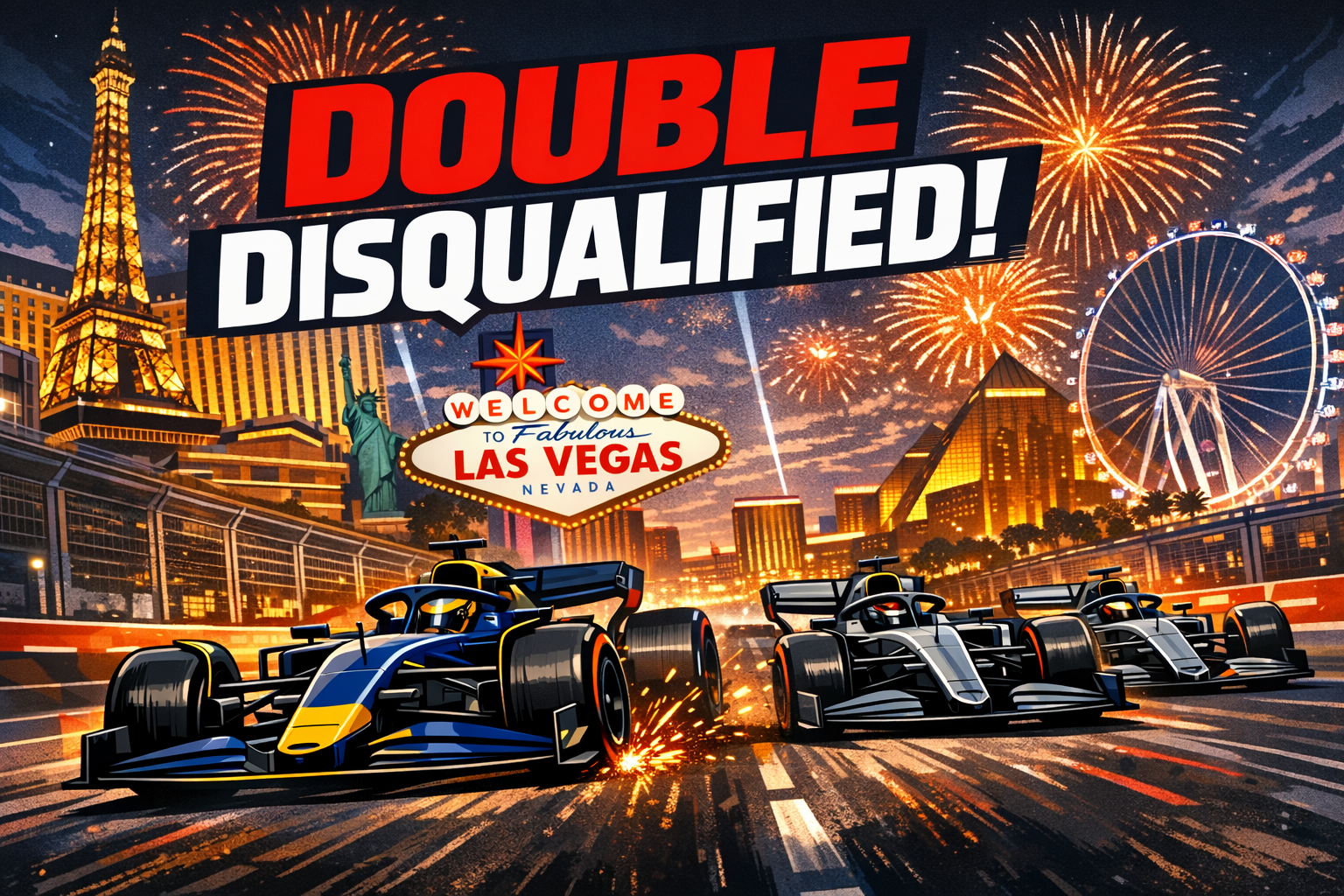

The Las Vegas Grand Prix 2025 on the famous Strip saw Max Verstappen win for Red Bull ahead of a double Mercedes podium, but late technical disqualifications for Lando Norris and Oscar Piastri turned the championship narrative on its head.
Las Vegas Grand Prix 2025 overview
The Las Vegas Grand Prix 2025, officially the Formula 1 Heineken Las Vegas Grand Prix 2025, took place over 50 laps of the 6.12 km Strip Circuit, a high‑speed night layout running past many of the city’s most iconic landmarks. Long straights, low‑grip surfaces and tight braking zones into slow corners made the race a test of confidence and straight‑line performance, with cool desert night temperatures further complicating tyre warm‑up.
Verstappen took the chequered flag in 1:21:08.429 to claim victory for Red Bull. After post‑race disqualifications for both McLarens, George Russell was classified second and rookie Andrea Kimi Antonelli third for Mercedes. Charles Leclerc took fourth for Ferrari, with Carlos Sainz fifth for Williams. Isack Hadjar, Nico Hülkenberg, Lewis Hamilton, Esteban Ocon and Oliver Bearman completed the final points positions after the stewards’ decisions.
Qualifying at the Las Vegas Grand Prix 2025
Qualifying around the low‑grip Las Vegas Strip Circuit delivered a mixed grid. Norris produced an outstanding lap to take pole for McLaren, beating Verstappen’s Red Bull as both teams ran skinny rear wings and minimal drag. Piastri lined up third, giving McLaren a potent front‑row‑and‑a‑half presence for the Las Vegas Grand Prix 2025.
Russell and Antonelli qualified fourth and sixth for Mercedes, split by Leclerc’s Ferrari. Sainz lined up seventh for Williams, ahead of Hadjar, Hülkenberg and Hamilton in the top ten. Further down, drivers like Alexander Albon, Liam Lawson and Pierre Gasly faced the challenge of fighting forward from the crowded midfield under the neon lights of the Las Vegas Grand Prix 2025.
Race start: Verstappen seizes lead as Norris runs wide
The start of the Las Vegas Grand Prix 2025 was frantic. Norris launched reasonably well from pole but locked up into Turn 1 and ran wide, opening the door for Verstappen to cut underneath and seize the lead. Piastri also lost momentum in the concertina effect, allowing Russell and Leclerc to challenge into the early corners.
By the end of the opening lap, Verstappen led from Norris, Russell and Piastri, with Leclerc, Antonelli and Sainz in close attendance. Behind them, Stroll’s Aston Martin retired on the spot after contact in the pack, while Bortoleto’s Sauber sustained damage that would later force his early exit from the Las Vegas Grand Prix 2025.
Early phase: Verstappen in control, Norris shadowing
Once the field settled, Verstappen began to assert his authority at the front. The Red Bull’s straight‑line efficiency and strong braking stability allowed him to manage a gap of around two seconds over Norris. McLaren’s race pace was strong, but Norris could not quite get within DRS range consistently enough to launch a sustained attack.
Piastri, now running in fourth behind Russell, struggled slightly more with tyre warm‑up and rear stability in the cool conditions. He reported oversteer and tyre graining over the radio, forcing McLaren to adjust their thinking for the remainder of the Las Vegas Grand Prix 2025. Behind the leading quartet, Leclerc and Antonelli held station, with Sainz and Hadjar forming the heart of the upper midfield.
Strategy at the Las Vegas Grand Prix 2025
Strategy in Las Vegas centred on a one‑stop race from medium to hard tyres, with the pit window opening around laps 18. 25. The combination of long straights and relatively smooth tarmac kept tyre degradation lower than at some other street venues, but the cool air made getting the front tyres into the right operating window critical.
Red Bull opted for a conservative approach with Verstappen, stopping him at a moment that allowed him to rejoin with clear air and maintain control of the race. McLaren mirrored Red Bull’s timing for Norris and Piastri, ensuring both cars stayed within strategic range of Verstappen on track. Mercedes staggered its stops for Russell and Antonelli to avoid double‑stack losses and to give the rookie a shot at undercutting Leclerc in the mid‑stages of the Las Vegas Grand Prix 2025.
Mid‑race: Norris chases, McLaren set up late attack
Following the pit stops, Verstappen retained the lead, with Norris still in second and the gap hovering in the two‑to‑three‑second range. Norris kept pushing, trimming a few tenths whenever backmarkers or minor errors gave him a sniff, but Verstappen always had enough performance in hand to respond.
Piastri regained fourth after the stops but was now under pressure from Leclerc and Antonelli. The McLaren’s pace remained strong through the quick corners, but its ride over bumps looked more aggressive than some rivals, which would later prove significant when the technical checks were carried out after the Las Vegas Grand Prix 2025.
Key moments: Antonelli’s false start penalty and midfield battles
One of the key subplots of the Las Vegas Grand Prix 2025 involved Antonelli. The Mercedes rookie was handed a five‑second time penalty for a false start, having crept slightly in his grid slot before the lights went out. Despite this, his pace over a full stint was strong enough that he remained firmly in the fight for the podium once the time addition was factored in.
Further back, battles between Hadjar, Hülkenberg, Hamilton and Ocon defined much of the midfield intrigue. Hadjar’s Racing Bulls car showed excellent top speed, allowing him to defend robustly against Hülkenberg’s Sauber and Hamilton’s recovering Ferrari. Ocon, running a slightly alternate strategy for Haas, used tyre offsets to move forward in the closing laps of the Las Vegas Grand Prix 2025.
Late phase: Verstappen unchallenged, Norris and Piastri secure podiums on the road
In the final phase of the race, Verstappen controlled proceedings from the front, never allowing Norris to get close enough to make a serious move into the heavy braking zones. The Red Bull’s combination of efficient aero and strong traction off the slow corners proved decisive and Verstappen crossed the line first to take a deserved Las Vegas Grand Prix 2025 victory.
On the road, Norris finished a strong second, around 20 seconds behind Verstappen, with Piastri fourth behind Russell after the McLaren driver was unable to find a clean way past the Mercedes in the closing laps. The initial classification showed Verstappen, Norris and Russell on the podium, Piastri fourth and Antonelli fifth, with Leclerc, Sainz, Hadjar, Hülkenberg and Hamilton rounding out the top ten.
Post‑race shock: double McLaren disqualification
The biggest drama of the Las Vegas Grand Prix 2025 arrived after the chequered flag. During routine post‑race scrutineering, both McLarens were found to have excessive skid‑block wear, in breach of the technical regulations. As a result, Norris and Piastri were disqualified from the final classification.
The disqualifications promoted Russell to second and Antonelli to third, giving Mercedes a double podium under the Las Vegas lights. Leclerc moved up to fourth, Sainz to fifth, Hadjar to sixth, Hülkenberg to seventh, Hamilton to eighth, Ocon to ninth and Bearman into the final points‑paying position in tenth. For McLaren and their title‑contending drivers, the loss of points from the Las Vegas Grand Prix 2025 was a heavy blow at a critical stage of the season.
Ferrari, Williams and the rest of the midfield
Ferrari left Las Vegas with a much‑improved result after a difficult Sao Paulo weekend. Leclerc’s fourth place (promoted from sixth after the McLaren disqualifications) reflected strong race pace and careful tyre management, even if he never had the performance to challenge Verstappen or Mercedes on outright speed. Hamilton’s eighth place, from further down the grid, added more points and showcased his ability to race through the midfield at a circuit that punished small errors.
Williams’ Sainz took a valuable fifth, underlining the car’s effectiveness in low‑drag trim. Hadjar’s sixth for Racing Bulls continued his excellent rookie season, while Hülkenberg’s seventh for Sauber and Ocon and Bearman’s double‑points result for Haas ensured all three midfield teams left the Las Vegas Grand Prix 2025 with something to show for their efforts. Alpine’s Gasly and Colapinto, along with Albon and Lawson, missed out on the top ten, largely due to timing misfortune around pit windows and Safety Car phases.
Championship implications of the Las Vegas Grand Prix 2025
The Las Vegas Grand Prix 2025 had enormous implications for both championships. Verstappen’s win and the McLarens’ disqualifications meant the Red Bull driver closed the gap dramatically in the drivers’ standings, moving level on points with Piastri and cutting the deficit to Norris to just 24 points with two races remaining.
For McLaren, the zero‑point haul from Las Vegas was a rare disaster in an otherwise dominant season. While the team still held a comfortable lead in the constructors’ standings thanks to its prior consistency, the technical infringements raised questions about set‑up risk versus championship security in the final flyaway races. Mercedes, by contrast, capitalised fully: Russell’s second and Antonelli’s third at the Las Vegas Grand Prix 2025 gave the team a huge points boost in its fight with Ferrari for second in the constructors’ table.
As the 2025 Formula 1 season heads from the Las Vegas Grand Prix 2025 into the final rounds in Qatar and Abu Dhabi, the title picture is more finely balanced than ever. Norris remains in control but under intense pressure from Verstappen and Piastri, while teams up and down the grid fight for every remaining point. Fans can follow every race report, title twist and analysis through to the season finale on RukiF1.
What the McLaren disqualification actually means technically
Skid-block wear is one of those regulations that sounds dry on paper but matters enormously in practice. Every car runs a plank of wood (or composite material) along the underfloor. If it wears beyond a set thickness limit, the stewards conclude the car ran too low. That’s an immediate DSQ. No appeal changes the physics of a worn plank.
McLaren’s aggressive low-ride-height set-up in Las Vegas was clearly a calculated risk. The Strip Circuit rewards minimal drag and a low centre of gravity, so running the car close to the ground makes sense on lap time. The problem is that cool tarmac, bumps and 50 laps of punishment can eat through that plank faster than the engineers predict. It’s happened before. Teams have lost race results to technical infractions even in title-winning seasons. McLaren will have known the risk. They took it. It didn’t pay off.
The bigger question now is whether the FIA will see this as a one-off miscalculation or a pattern. If McLaren push the same margins in Qatar, they’re gambling with a championship lead that suddenly looks a lot thinner than it did 48 hours ago.
Verstappen’s title credentials on full display
It’s easy to forget, in the noise of the McLaren drama, that Verstappen drove a genuinely excellent race. He didn’t just benefit from fortune. He nailed the start, managed his tyres without drama and kept Norris honest for 50 laps without ever looking rattled.
This is what Verstappen does. He wins races that look like they should belong to someone else. The Red Bull RB21 isn’t the fastest car in the field right now. It probably hasn’t been for most of 2025. But Verstappen extracts every tenth available and then adds a few more that shouldn’t be there. With the drivers’ title back in genuine contention, the final two races are going to be brutal. The grid reshuffles coming in 2026 and 2027 make this feel like one of the last chances for this generation of rivalry to produce a truly dramatic finish.
Key takeaways
- Verstappen won on merit. The Red Bull was not the quickest car but he drove the cleanest race of the night.
- Both McLarens were disqualified for excessive skid-block wear, costing Norris and Piastri a combined 27 points and handing Mercedes a double podium they didn’t expect to be celebrating.
- The title fight is alive. Verstappen trails Norris by just 24 points with Qatar and Abu Dhabi remaining. Piastri is level with Verstappen.
- Antonelli continues to impress. A false-start penalty and he still finished on the podium. That’s a serious rookie performance.
- Mercedes’ constructors’ fight with Ferrari got a massive boost. Russell and Antonelli scoring second and third changes the picture heading into the final two rounds.
Frequently Asked Questions
Why were Norris and Piastri disqualified from the Las Vegas Grand Prix 2025?
Both McLarens failed post-race scrutineering because their skid blocks showed wear beyond the permitted limit. The skid block sits on the underfloor of the car and acts as a reference point for ride height. Excessive wear indicates the car ran too low during the race, which is a breach of the technical regulations. The stewards had no option but to disqualify both drivers.
How does the skid-block rule work in F1?
Every F1 car carries a plank of material along the underside of the floor. After the race, stewards measure its thickness at set points. If it has worn down more than 1mm from its original thickness, the car is deemed to have run illegally low. It’s a straightforward measurement with no grey area. Teams know the rule and accept the risk when they set aggressive ride heights.
Where does the drivers’ championship stand after Las Vegas?
Norris leads the championship but his advantage over Verstappen is just 24 points with two races left in Qatar and Abu Dhabi. Piastri sits level with Verstappen in third. McLaren still leads the constructors’ standings but the gap has shrunk considerably. Every point in the final two rounds will matter enormously for all three title contenders.
Has a double disqualification like this happened before in F1?
Double disqualifications are rare but not without precedent. The most famous example came at the 1995 Belgian Grand Prix when both Benettons were excluded for fuel irregularities. Technical infringements that affect an entire team’s cars usually point to a shared set-up decision rather than individual errors, which is exactly what appears to have happened with McLaren in Las Vegas.
What does Antonelli’s podium mean for his rookie season?
Antonelli’s promoted third place in Las Vegas is a significant result. He absorbed a five-second penalty for a false start and still finished on the podium through pace alone. For a driver in his debut season replacing Lewis Hamilton at Mercedes, that kind of composure under pressure is exactly what the team needed to see. He’s firmly in the conversation as one of the stronger rookies in recent F1 history.
