
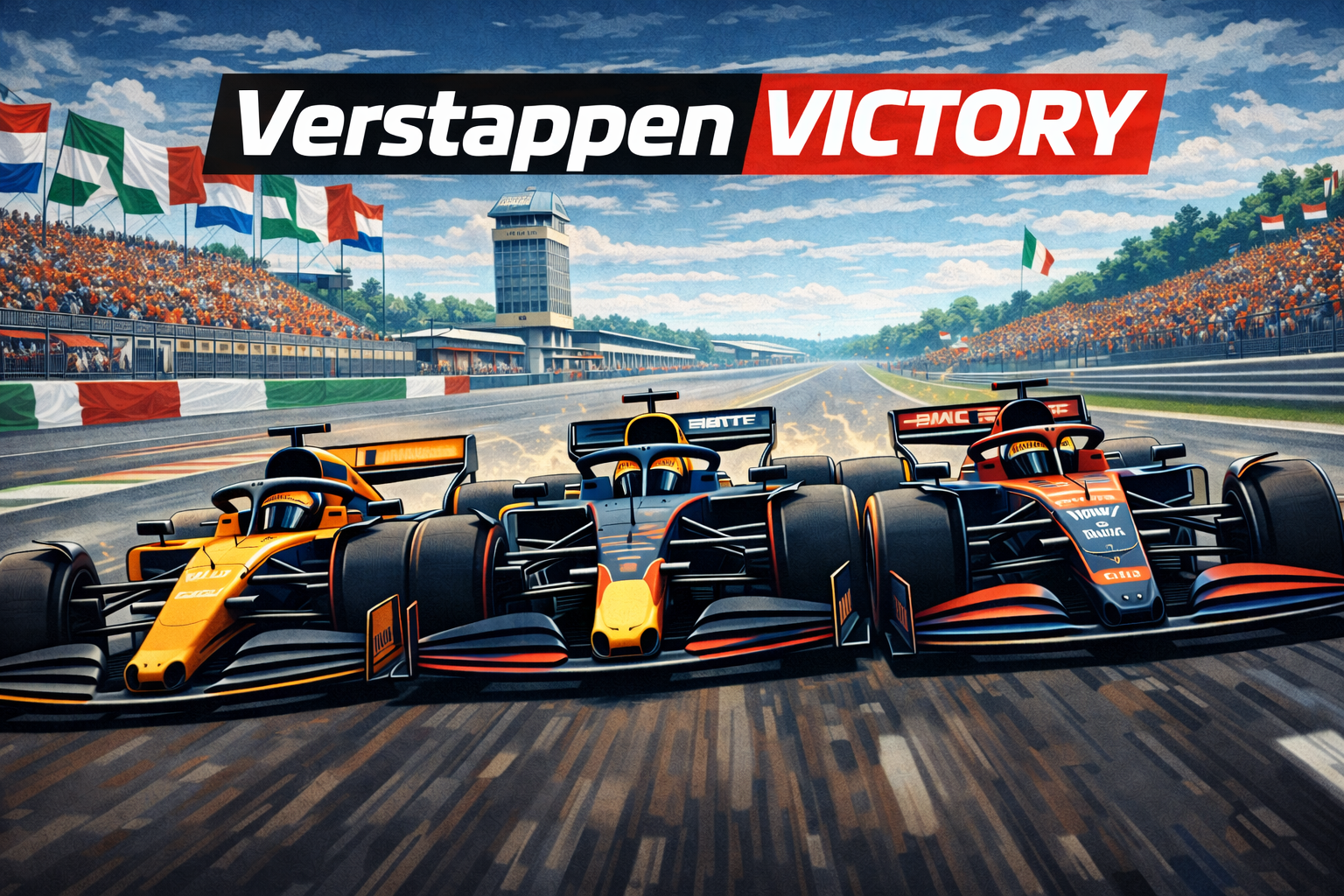

The Italian Grand Prix 2025 at Monza saw Max Verstappen deliver a dominant lights‑to‑flag victory for Red Bull, with Lando Norris and Oscar Piastri completing the podium for McLaren after late pit stop drama and team orders at the Temple of Speed.
Italian Grand Prix 2025 overview
The Italian Grand Prix 2025, officially the Formula 1 Pirelli Gran Premio d’Italia 2025, was held over 53 laps of the 5.793 km Autodromo Nazionale Monza. Known for its ultra‑high speeds, long straights and heavy braking zones, Monza once again produced a flat‑out strategic showdown with minimal tyre wear but huge emphasis on power, drag efficiency and slipstreaming.
Verstappen won in a time of 1:13:24.325, setting a new benchmark for one of the fastest Grands Prix in Formula 1 history. He finished 19.207 seconds ahead of Norris, who crossed the line second after McLaren instructed Piastri to hand the place back following a slow pit stop that had temporarily reversed their positions. Piastri completed the podium in third, with Charles Leclerc fourth for Ferrari, Russell fifth for Mercedes, Hamilton sixth for Ferrari and the remaining points going to Alexander Albon, Gabriel Bortoleto, Andrea Kimi Antonelli and Isack Hadjar.
Qualifying at the Italian Grand Prix 2025
Qualifying at Monza delivered a front row that underlined Red Bull’s top‑speed strength. Verstappen produced a blistering 1:18.7 lap in Q3 to secure pole position, using an ultra‑low‑downforce set‑up that made the most of Red Bull’s power unit and drag‑efficient chassis. His lap put him ahead of Norris, who continued McLaren’s strong qualifying form with second on the grid.
Piastri lined up third, setting up the prospect of a fierce three‑way fight for the Italian Grand Prix 2025 victory, while Leclerc delighted the Tifosi by taking fourth on the grid for Ferrari. Russell started fifth for Mercedes, with Alonso sixth for Aston Martin and Albon securing seventh for Williams. Hamilton, carrying a five‑place grid penalty from the Dutch Grand Prix, started tenth despite qualifying higher on pure pace, while Bortoleto, Antonelli, Hadjar and Lawson filled out the competitive midfield.
Race start: Verstappen vs Norris into the Rettifilo chicane
The start of the Italian Grand Prix 2025 brought immediate drama at the front. Verstappen made a good launch from pole, but Norris’s getaway was even better from second, allowing the McLaren to draw alongside the Red Bull on the long run to the Rettifilo chicane. Verstappen defended aggressively, briefly skipping across the inside kerbs and cutting the chicane as he held track position.
After reviewing the incident, Red Bull chose to avoid a penalty risk by instructing Verstappen to hand the position back to Norris on the following lap. Norris temporarily took the lead of the race, with Verstappen tucking in behind and Piastri holding third from Leclerc. Russell slotted into fifth ahead of Alonso and Albon, while Hamilton made early gains from the midfield, climbing towards the top eight in front of the Italian fans.
Early laps: Verstappen strikes back, McLarens consolidate
Once Verstappen ceded the place, the Italian Grand Prix 2025 quickly settled into a pattern that would define the race. Using DRS and superior straight‑line speed, Verstappen slipstreamed Norris down the main straight and reclaimed the lead with a decisive move into Turn 1 a few laps later, this time staying within track limits and leaving no room for dispute.
From that point on, Verstappen began to edge away from the McLarens, building a gap of several seconds by the time the first pit window approached. Norris stayed comfortably ahead of Piastri in second, while Leclerc tried to hang onto the back of the McLarens. Russell kept Ferrari under pressure in fifth, but top‑speed limitations made it difficult for the Mercedes to launch a serious attack on the straights without a major mistake from Leclerc.
Strategy at the Italian Grand Prix 2025: one‑stop at the Temple of Speed
Strategy at the 2025 Italian Grand Prix revolved around a straightforward one‑stop from medium to hard tyres for most of the field. The relatively low tyre degradation at Monza meant that the focus was on timing rather than compound choice: stopping too early risked late‑race vulnerability, while stopping too late opened the door to undercuts.
Verstappen and Red Bull executed their plan flawlessly, pitting around the halfway mark for hard tyres and rejoining with a comfortable margin over the McLarens once their stops were completed. McLaren mirrored Red Bull’s general timing, bringing Norris in first to cover Leclerc and then Piastri shortly afterwards. It was here that the key moment of the McLaren story in the Italian Grand Prix 2025 unfolded.
McLaren pit drama: slow stop for Norris, Piastri undercuts
When Norris came in for his stop, a slow rear‑left tyre change cost him several seconds. That delay proved critical. On the next lap, Piastri pitted for his own switch to hard tyres and thanks to a clean stop and strong in‑ and out‑laps, he emerged from the pit lane ahead of Norris on the road.
Piastri’s undercut temporarily promoted him to second place in the Italian Grand Prix 2025, behind Verstappen and ahead of his team‑mate. On pure pace, there was little to separate the two McLarens in clear air, but given the context of the slow stop and the championship battle, McLaren now faced a tough strategic and political decision: should the positions remain as they were or should Norris be restored to the second place he had held before the pit window?
Team orders: Piastri swaps with Norris
McLaren ultimately opted for a pragmatic approach. Over team radio, Piastri was told to allow Norris back through into second place, with the message that the swap was a response to the unusual circumstances of the slow pit stop rather than a permanent hierarchy decision. Piastri initially questioned the call but complied a few laps later, lifting off on the approach to the Rettifilo chicane and letting Norris retake P2.
From that point on, the Italian Grand Prix 2025 settled into a relatively static top‑three order: Verstappen out front, Norris second and Piastri third. With similar tyre life and virtually identical race pace, there was no realistic prospect of either McLaren catching the Red Bull over the remaining laps unless Verstappen encountered traffic issues, mechanical problems or a Safety Car intervention that never came.
Ferrari at home: Leclerc and Hamilton in the top six
For Ferrari, the Italian Grand Prix 2025 was a case of solid points rather than the fairy‑tale home win the Tifosi had hoped for. Leclerc’s fourth place reflected the SF‑25’s strengths and weaknesses: strong enough to stay in touch with the McLarens in the twistier sections but lacking the straight‑line punch to threaten them meaningfully without a significant strategy advantage.
Hamilton’s sixth place was a respectable recovery from his grid penalty. The seven‑time world champion made an excellent start, quickly climbing through the midfield and executing clean overtakes into the Rettifilo and Roggia chicanes. After passing Bortoleto, he ran a relatively lonely race in sixth, unable to close the gap to Russell ahead but comfortably ahead of the Williams and Sauber behind. The double‑points finish strengthened Ferrari’s hold on second in the constructors’ standings after the Italian Grand Prix 2025.
The Monza crowd’s reaction to Ferrari’s result was telling. Polite applause rather than the roar that greets a home victory. The Tifosi’s passion is unmatched anywhere on the calendar, but fourth and sixth is a hard sell to fans who turned up expecting a repeat of Leclerc’s 2019 and 2022 Monza wins. The pressure on Ferrari to deliver at their home race never really goes away.
Mercedes consistency: Russell and Antonelli score again
Mercedes left Monza with another consistent showing. Russell finished where he started in fifth, running a clean, well‑managed race with solid pace but not quite enough top speed to attack Leclerc’s Ferrari ahead. He kept a safe gap to Hamilton and the midfield throughout, ensuring that the team banked important points on a day when victory was out of reach.
Antonelli’s ninth place added two more points to his debut‑season tally. For the Italian rookie, scoring at his home Grand Prix was a significant milestone. He managed his one‑stop strategy well and held his own in battles with Hadjar, Sainz and Bortoleto. The Italian Grand Prix 2025 thus provided further evidence that Mercedes’ long‑term driver line‑up is on solid footing.
Midfield battle: Williams, Sauber, Racing Bulls and Alpine
The midfield at the Italian Grand Prix 2025 was as intense as ever, with Williams, Kick Sauber, Racing Bulls and Alpine all scrapping for the remaining points. Albon’s seventh place for Williams was another standout drive, as he made the most of Williams’ low‑drag package to overtake in DRS trains and defend robustly when necessary.
Bortoleto brought his Kick Sauber home in eighth after a strong performance that included a long first stint and several brave moves under braking into Turn 1. Behind Antonelli in ninth, Hadjar completed the top ten for Racing Bulls, scoring a crucial point by beating team‑mate Lawson and several more experienced drivers on merit. Alpine’s Gasly and Colapinto finished just outside the points, hampered by top‑speed deficits that left them struggling to attack even when tyre life was in their favour.
Incidents, penalties and non‑finishers at Monza
The Italian Grand Prix 2025 was relatively light on major incidents but not entirely clean. The most notable penalty involved Bearman, who clashed with Sainz while battling in the midfield. The Haas driver was deemed responsible for the collision and handed a ten‑second time penalty that dropped him to twelfth at the flag, outside the points.
Alonso’s afternoon ended in disappointment when an issue forced him to retire his Aston Martin after making only 24 laps. Hülkenberg, meanwhile, did not start the race at all due to a problem on the grid with his Sauber, reducing the field to 19 by the time the lights went out. Despite these setbacks for some, the Italian Grand Prix 2025 largely ran without Safety Cars, allowing strategy and raw pace to determine the outcome.
Championship implications of the Italian Grand Prix 2025
Verstappen’s win at the Italian Grand Prix 2025. his third victory of the season. significantly improved his position in the drivers’ championship, cutting into Piastri’s advantage and reminding rivals that Red Bull remains a potent threat, particularly at high‑speed circuits. His commanding performance at Monza, combined with sprint success earlier in the year, kept him mathematically and realistically in the title hunt.
For McLaren, the double podium of Norris and Piastri ensured another large haul of constructors’ points, further consolidating the team’s lead in the standings. However, Norris’s second place and Piastri’s third had important intra‑team implications: the championship leader’s margin over his team‑mate shrank to 31 points, keeping the McLaren title battle very much alive heading into the final flyaway races.
As the 2025 Formula 1 season moves on from the Italian Grand Prix 2025 and into the remaining rounds in Asia and the Americas, the narrative is clear: McLaren leads the way but is under pressure from a resurgent Verstappen and Red Bull, Ferrari remains a constant podium threat, Mercedes is edging closer with consistent points and a strong driver pairing and the midfield is more competitive than ever. Fans can continue to follow every Grand Prix review, result and strategic twist from this thrilling campaign on RukiF1.
What Monza 2025 tells us about the rest of the season
Monza is a circuit that exposes weaknesses brutally. There’s nowhere to hide at 340 km/h. The fact that Verstappen was able to pull nearly 20 seconds on Norris over 53 laps says something real about Red Bull’s straight-line package. McLaren’s car is clearly the class of the field in most conditions, but at the very highest-speed venues, the gap narrows fast.
The team orders call will keep people talking. Piastri’s radio message was clipped and frustrated. You could hear it. McLaren handled it better than some teams would have, but the optics of asking your championship leader to give up a position are always uncomfortable. If Norris loses the title by fewer than 7 points, this moment will be replayed endlessly.
Red Bull’s reliability has also improved sharply compared to the middle part of the season. Verstappen crossed the line without drama. No overheating, no floor damage, no late safety car chaos. That’s the version of Red Bull that wins championships. With the 2026 driver market already shifting, the pressure on every team principal to deliver results now is enormous.
Key takeaways
- Verstappen’s lights-to-flag win was his most complete drive of the 2025 season. Red Bull’s low-downforce package was perfectly suited to Monza and the gap to McLaren was larger than most expected.
- McLaren’s slow pit stop for Norris changed the race narrative completely. A mechanical error in the pit lane forced a team orders situation that could have been avoided with a clean stop.
- Piastri’s compliance with team orders was grudging but professional. His championship lead over Norris shrank to 31 points, which makes the remaining flyaway races genuinely tense.
- Ferrari scored solid points at their home race but never threatened the podium. The Tifosi deserved more and the team knows it.
- Antonelli scoring at his home Grand Prix was one of the feel-good moments of the weekend. Two points in front of the Italian crowd at Monza is a memory he’ll carry for a long time.
Frequently Asked Questions
Why did McLaren use team orders at the 2025 Italian Grand Prix?
McLaren asked Piastri to let Norris back through because a slow rear-left tyre change during Norris’s pit stop had artificially reversed their running order. The team judged that Norris had earned his second place on track before the stop and that the mechanical error shouldn’t decide the outcome between the two drivers. Piastri complied a few laps after the initial request.
How did Verstappen win from pole at Monza despite giving the lead back to Norris?
Verstappen briefly cut the Rettifilo chicane at the start and Red Bull instructed him to hand the position back to avoid a penalty. He then used DRS and Red Bull’s superior straight-line speed to repass Norris cleanly into Turn 1 within a few laps. From that point he built a gap that the McLarens couldn’t close, eventually winning by over 19 seconds.
What does the Italian Grand Prix 2025 result mean for the drivers’ championship?
Verstappen’s win cut into Piastri’s championship lead, which stood at 31 points over Norris heading into the flyaway rounds. Verstappen himself moved closer to both McLaren drivers. With several high-speed and street circuits still to come, the title fight is genuinely open across three drivers for the first time this season.
How did the midfield rookies perform at Monza in 2025?
Antonelli scored two points in ninth at his home race, which was a meaningful result for the Italian driver in his debut season. Hadjar took tenth for Racing Bulls, beating team-mate Lawson on merit. Bortoleto finished eighth for Kick Sauber after a strong strategic race. All three rookies showed they belong at this level on a circuit that punishes any mistake severely.
Has Monza historically favoured Red Bull and high-power units?
Monza rewards power unit output and low aerodynamic drag above almost everything else. Red Bull’s Honda-era and post-Honda power units have been competitive at Monza across multiple seasons. Verstappen won there in 2021 and the circuit’s characteristics, long straights and minimal slow corners, consistently suit cars with strong top-end power and efficient drag reduction systems.
