
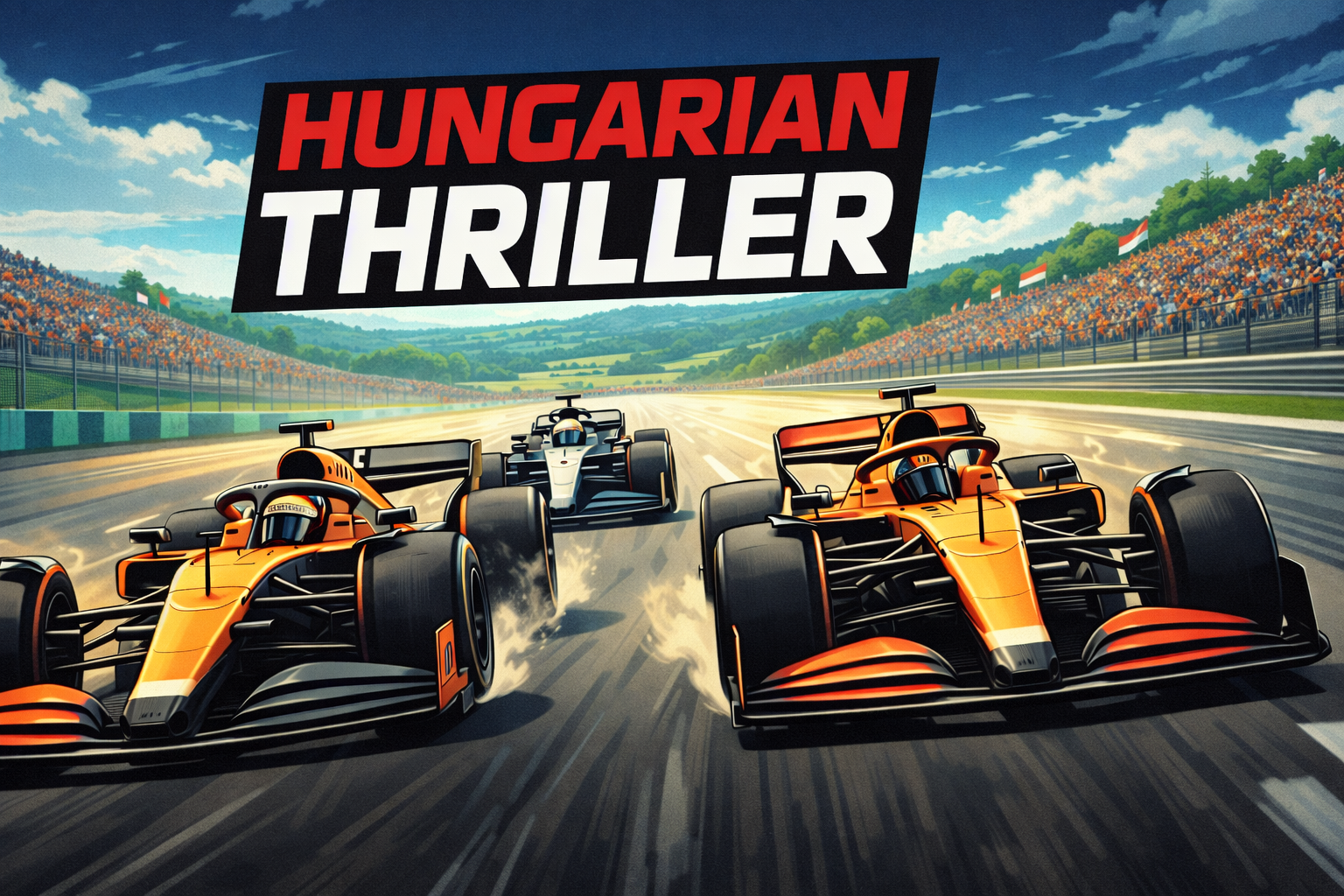

The Hungarian Grand Prix 2025 at the Hungaroring produced a tense, strategic thriller as Lando Norris charged from fifth on lap one to defeat team‑mate Oscar Piastri by less than a second, giving McLaren its historic 200th Formula 1 race win.
Hungarian Grand Prix 2025 overview
The Hungarian Grand Prix 2025, held over 70 laps of the tight and twisty 4.381 km Hungaroring near Budapest, was the final race before the summer break and a key milestone in the 2025 Formula 1 World Championship. Known as “Monaco without walls,” the circuit places a premium on track position, tyre management and clean air, rewarding disciplined, mistake‑free driving.
Norris ultimately triumphed in 1:35:21.231, finishing just 0.698 seconds ahead of Piastri after withstanding an intense late charge. George Russell completed the podium in third for Mercedes, with polesitter Charles Leclerc a disappointed fourth for Ferrari. Fernando Alonso took fifth for Aston Martin, followed by an outstanding sixth for Gabriel Bortoleto, Lance Stroll, Liam Lawson, Max Verstappen and Andrea Kimi Antonelli rounding out the points.
Qualifying at the Hungarian Grand Prix 2025
Qualifying on Saturday delivered a dream scenario for Ferrari. Leclerc produced a superb lap to take pole position for the Hungarian Grand Prix 2025, mastering the technical middle sector and the crucial final corners to edge out Piastri. The Ferrari’s strong front‑end grip on a single lap made it the car to beat over one lap at the Hungaroring.
Piastri lined up second for McLaren, while Norris secured third on the grid, giving the Woking team a front‑row and second‑row lock‑in against their main rivals. Russell took fourth for Mercedes, ahead of Alonso’s Aston Martin in fifth. Verstappen could only manage ninth on the grid after a scruffy Q3 session for Red Bull, while Hamilton started 12th for Ferrari after being knocked out in Q2. The scene was set for a strategic battle where Leclerc’s track position would be tested by McLaren’s race‑day strength.
Race start: Leclerc leads as Norris drops to fifth
The start of the Hungarian Grand Prix 2025 saw Leclerc make a clean launch from pole and hold the inside line into Turn 1 to retain the lead from Piastri. The Ferrari driver then controlled the opening corners, using the clear air advantage to avoid the turbulence and tyre slide that typically plague cars running further back.
Behind them, Norris suffered a tougher first lap. Squeezed into Turn 1 and then Turn 2, he briefly dropped behind Russell and Alonso, falling to fifth by the end of the opening tour. That setback changed the complexion of his race: instead of attacking Leclerc and Piastri immediately, Norris found himself stuck in dirty air behind a Mercedes and an Aston Martin on a track where overtaking is notoriously difficult.
Early phase: Leclerc builds a lead, McLarens play the long game
Leclerc used his pole advantage to build a gap of around three seconds over Piastri in the early laps, with Russell holding third and Norris stuck in fifth behind Alonso. A long DRS train formed from Alonso down through the midfield, making life difficult for anyone hoping to move forward without major strategy intervention.
Piastri kept the Ferrari within sight, carefully managing his tyres while feeding back information on Leclerc’s pace and degradation. McLaren knew that with temperatures high and the Hungaroring’s constant corners stressing the tyres, the race would likely hinge on pit stop timing and whether anyone could make a one‑stop strategy work at the Hungarian Grand Prix 2025.
Strategy shifts: undercut vs one‑stop gamble
The first major strategic move came around lap 18. 20. Piastri blinked first among the front‑runners, pitting for hard tyres in an attempt to undercut Leclerc and take track position. Ferrari responded immediately, bringing Leclerc in on the next lap to cover the threat and maintain the effective race lead.
Russell pitted soon after, while Norris stayed out, extending his stint on the medium tyres and hinting at a possible one‑stop strategy. In free air, once Alonso had pitted, Norris unleashed strong pace, cutting into Leclerc and Piastri’s margins and positioning himself for a long first stint that would become crucial later in the Hungarian Grand Prix 2025.
Norris’s one‑stop vs Piastri’s two‑stop
As the race moved into its middle phase, the Hungarian Grand Prix 2025 pivoted on diverging strategies within McLaren. Piastri committed to a more conventional two‑stop approach, using his first set of hards to stay close to Leclerc and Russell, then planning a second stop later for fresher tyres.
Norris, by contrast, stretched his first stint to around lap 31 before pitting for hard tyres, aiming to go to the flag on a one‑stop strategy. That decision dropped him behind Leclerc and Russell initially, but with much fresher tyres, he rapidly closed the gap once the others completed their second stops. McLaren had effectively split strategies to attack Ferrari and Mercedes from both angles in the Hungarian Grand Prix 2025.
Leclerc and Russell falter, McLarens rise
Leclerc’s race began to unravel in the second half. After his second stop around lap 40, he emerged behind Russell and was soon under heavy pressure from the Mercedes. Russell, on a strong two‑stop plan with good tyre life, attacked decisively and eventually passed Leclerc with a bold move, pushing the Ferrari down to fourth.
At the same time, Norris’s one‑stop strategy came into its own. With his hard tyres in good condition and fuel loads lighter, he moved past Russell and Leclerc on track as their older tyres faded. By lap 46, Norris had taken the lead of the Hungarian Grand Prix 2025, with Piastri cycling back into second after his second stop and now armed with fresher hards for a final push at his team‑mate.
The final charge: Piastri hunts Norris down
Those last 24 laps were genuinely gripping. Piastri’s fresher rubber gave him a clear pace advantage and he closed the gap lap by lap. At one point he was within half a second. Norris, to his enormous credit, didn’t crack. He managed his tyres brilliantly, kept his lines clean and refused to make the kind of small error that the Hungaroring punishes so harshly.
McLaren’s pit wall stayed quiet. No team orders. Both drivers were free to race and they did exactly that. Norris crossed the line 0.698 seconds clear. It was the kind of finish that reminds you why this sport is worth following.
Piastri was gracious in second. He knew he’d given everything. The gap simply wasn’t quite enough on a track where clean laps matter more than raw pace.
McLaren’s 200th win: what it means
The number 200 is staggering when you sit with it for a moment. McLaren’s first win came at the 1968 Belgian Grand Prix with Bruce McLaren himself behind the wheel. Since then the team has produced champions like Emerson Fittipaldi, James Hunt, Niki Lauda, Ayrton Senna, Alain Prost, Mika Hakkinen and Lewis Hamilton. Reaching 200 wins puts McLaren in a conversation shared by only Ferrari and Mercedes.
The team’s journey back to the front has been one of the better stories in recent F1 history. A few years ago they were nowhere near this level. Now they’re winning races with a one‑two finish and splitting strategies to outfox their rivals. If you want a comparison for a team rebuilding from almost nothing to genuine glory, the Brawn GP miracle is the obvious reference point, though McLaren’s rebuild has taken considerably longer.
Championship picture after Hungary
Norris’s win tightens the drivers’ championship heading into the summer break. Verstappen’s ninth place was a disaster by his own standards and the gap at the top of the standings has shrunk. McLaren also extended their lead in the constructors’ championship, with both cars scoring heavily while Ferrari and Red Bull had difficult afternoons.
Leclerc will be frustrated. Pole position converted to fourth is not the result Ferrari needed. Their race pace simply couldn’t match McLaren’s over a full stint distance. The tifosi will be hoping the summer break gives the Maranello engineers time to close that gap before the second half of the season.
Bortoleto’s sixth for Sauber deserves a specific mention. It was a composed, mature drive from the rookie and exactly the kind of result that gets people talking about a driver’s future. Worth keeping an eye on the 2026 free agent picture as the season develops.
Key takeaways
- Norris drove a near‑perfect race from fifth on lap one to first at the flag, managing tyres and pressure with real composure.
- McLaren’s split strategy was the decisive call of the weekend. One‑stop versus two‑stop gave them control of the race from multiple angles.
- Leclerc’s pole position counted for very little in the end. Ferrari’s race pace remains a genuine weakness compared to McLaren.
- Verstappen finishing ninth is a significant championship moment. Red Bull look short of answers at circuits that demand high‑downforce balance.
- McLaren’s 200th win is a landmark that puts the team back among F1’s all‑time greats after years of struggle.
Frequently Asked Questions
Was this really McLaren’s 200th Formula 1 victory?
Yes. McLaren’s first win came at the 1968 Belgian Grand Prix with founder Bruce McLaren driving. The team has won championships across multiple eras with drivers including Senna, Prost, Hakkinen and Hamilton. Reaching 200 wins puts them behind only Ferrari in the all‑time list, with Mercedes close behind depending on how you count constructor histories.
Why did Norris start fifth if he qualified third?
Norris qualified third but lost positions at the race start. He was squeezed through Turns 1 and 2 on the opening lap, dropping behind Russell and Alonso. It’s a common hazard at the Hungaroring where the narrow track and tight first corner create chaos in the opening seconds. He recovered brilliantly from that point.
Did McLaren use team orders to help Norris win?
No team orders were issued. Both drivers were free to race. Piastri pushed hard on fresher tyres in the closing laps and closed to within half a second. Norris held on through tyre management and clean driving rather than any instruction from the pit wall. It made for a far more compelling finish.
How significant was Verstappen finishing ninth?
Very significant. Ninth place yields just two championship points and Norris took 25. That kind of gap in a single race swings a title fight considerably. Red Bull have struggled at high‑downforce circuits this season and Hungary exposed those weaknesses again. The summer break gives their engineers a chance to find answers before the championship run‑in.
What does this result mean for the constructors’ championship?
McLaren extended their lead over Ferrari and Red Bull. A one‑two finish scores 43 points combined and neither rival came close to matching that haul. If McLaren can maintain this level of strategic execution and raw pace in the second half of the season, the constructors’ title looks increasingly like theirs to lose.
