
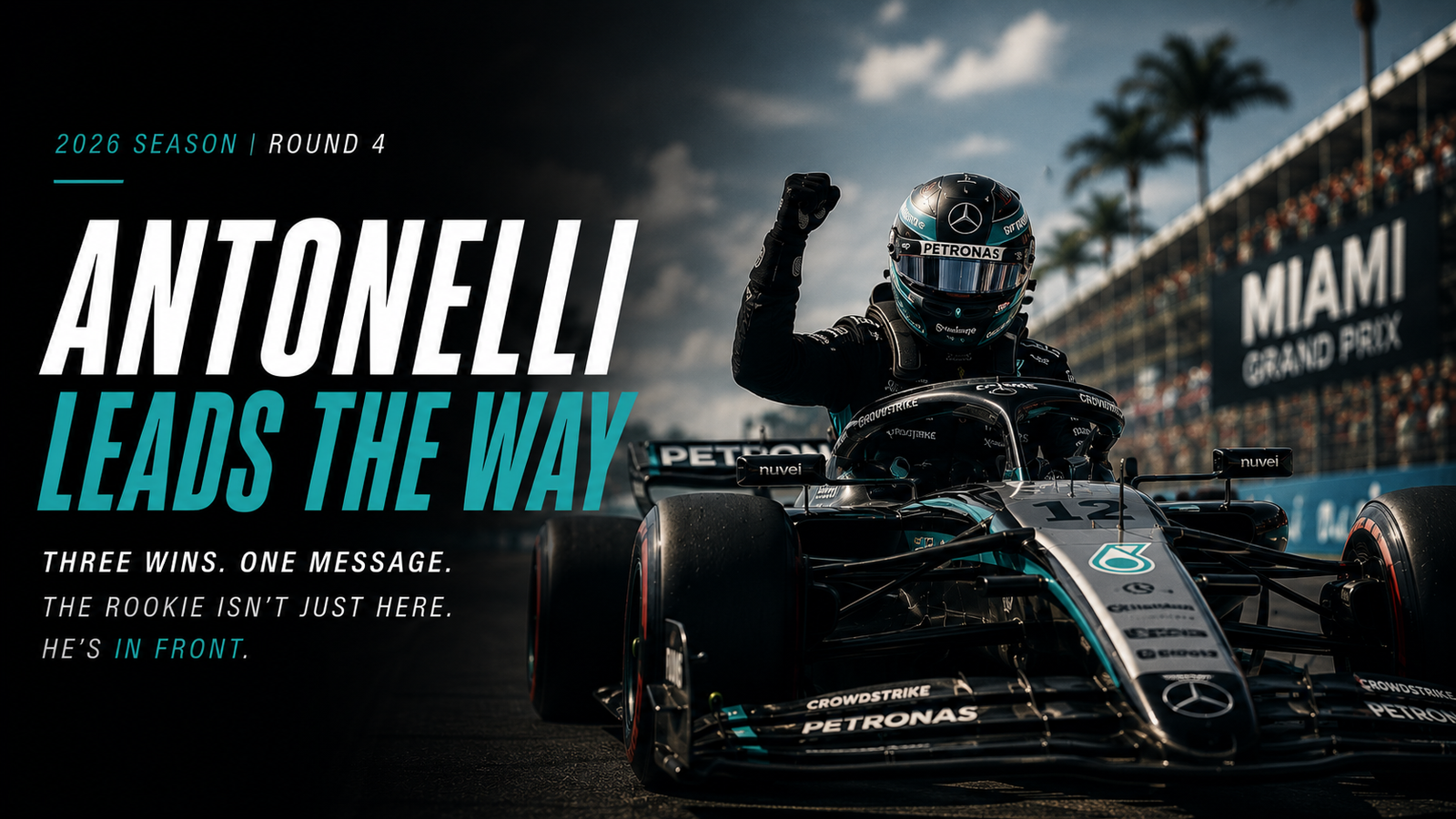

Andrea Kimi Antonelli leads the 2026 Formula 1 World Championship with 100 points after just four races – a margin of 20 points over his Mercedes teammate George Russell, and 74 points over a floundering Max Verstappen in seventh.
Antonelli’s Title Run Is Real
Thirteen days after the 2026 Miami Grand Prix, the standings have not moved in a way that flatters anyone chasing Andrea Kimi Antonelli. He won in Australia, Japan, and Miami. Three victories from four races as a rookie is not a hot streak – it is a pattern of dominance that the rest of the field has not found an answer to.
At Miami International Autodrome on May 3rd, Antonelli took pole with a 1:27.798, led every meaningful lap, and crossed the line in 1:33:19.273. Lando Norris finished 3.264 seconds behind in second. That gap, in a race run to the flag without a safety car intervention to compress the field, reflects how comfortable Antonelli was at the front.
The 100-point total is the number that matters most right now. No rookie in the current points-scoring era has arrived at round five of their debut season with a championship lead of this size. Antonelli has not just collected wins – he has collected them in ways that suggest the Mercedes W17 suits his driving style in a way that will be difficult for rivals to neutralise mid-season.
The remaining concern for his title campaign is inexperience under pressure. Four races is a small sample. Canada, Silverstone, and Monza will test whether Antonelli can manage a points lead as well as he manages a race lead. So far, there is no evidence he cannot.
Mercedes Have a Regulation Advantage
Mercedes-AMG Petronas have won all four races of the 2026 season. Their constructor championship total stands at 180 points, 70 ahead of Ferrari in second. No team has dominated the opening four rounds of a season this thoroughly since the early hybrid era.
The 2026 technical regulations introduced significant changes to aerodynamic philosophy and power unit architecture. Mercedes read those regulations correctly. Their car generates consistent downforce across a wider range of track types – Miami’s low-speed corners and high-speed sweeps both suited the W17, which is not something you can say about every chassis on the grid.
George Russell finished fourth in Miami, 43.051 seconds behind Antonelli. That result looks modest on paper, but Russell sits second in the drivers’ championship with 80 points. Mercedes are the only constructor with both drivers in the top two of the standings. The last time that happened this early in a season was over a decade ago.
Russell’s title relevance matters because it gives Mercedes a second strategic asset. If Antonelli hits a mechanical problem or a bad weekend, Russell is positioned to collect maximum points. Ferrari and McLaren do not have that same insurance. Charles Leclerc started third in Miami and finished eighth, 1:04.245 behind Antonelli. Lewis Hamilton finished sixth in his Ferrari debut season, 53.753 seconds back, without threatening the podium at any stage.
The constructor lead of 70 points is not a buffer that evaporates with one bad result. Ferrari would need to outscore Mercedes by 18 points per race for the next four rounds just to draw level. Given Miami’s result, that requires a fundamental shift in relative pace that the data does not yet support.
McLaren’s Qualifying Problem
Norris finished second and Oscar Piastri finished third in Miami. McLaren’s race pace is clearly the second-best on the grid. Their qualifying pace is not.
Norris qualified fourth and Piastri qualified seventh. Both drivers moved forward on Sunday, which confirms the MCL40 comes alive on used rubber over a race distance. The problem is that starting fourth and seventh at a track where overtaking requires a significant pace advantage costs them points they cannot afford to give away to Mercedes. A front-row lockout for McLaren in Miami would have changed the strategic picture entirely. Instead, Antonelli controlled the race from pole without serious pressure.
Canada will be an early test of whether McLaren can close the Saturday gap. The Circuit Gilles Villeneuve rewards mechanical grip and traction – areas where McLaren have shown strength. If they can qualify on the front row in Montreal, they will be in a genuine position to challenge Antonelli for the win.
Where Does Red Bull Go From Here?
Max Verstappen has 26 championship points after four races. He is seventh in the standings. In 2024, Verstappen won the championship with a record-breaking points total. The drop-off between that season and this one is the largest early-season decline for a reigning champion in the current era.
Miami illustrated the problem in precise terms. Verstappen qualified second, behind only Antonelli. His one-lap pace remains elite. Over the race distance, he finished fifth, 48.949 seconds behind the winner – over 10 seconds further back than Russell in the second Mercedes. A car that can qualify second but finish fifth, beaten by both McLarens and a Mercedes that started from pole, has a fundamental race-pace deficit.
Isack Hadjar did not finish the race for Red Bull Racing, adding to a DNF count that has cost the team heavily in the constructor standings. Red Bull sit well outside the top three constructors after four rounds. That is not a setup issue that can be solved with a few front-wing adjustments.
The question Red Bull’s engineers face is whether the RB21’s race-pace problem stems from tyre degradation, aerodynamic efficiency at higher fuel loads, or a power unit characteristic that does not suit the 2026 regulations. All three are fixable in theory. None of them are fixable quickly. Verstappen is experienced enough to extract everything the car offers, but Miami showed that ceiling is not high enough to win races in 2026.
Red Bull brought significant updates to Bahrain and Jeddah earlier in the season. Neither produced a step change in race performance. If Montreal does not show clear improvement, the conversation will shift from “can they recover” to “how much of the season have they already conceded.”
The Rest of the Field After Miami
Franco Colapinto finished seventh for Alpine, his best result of the 2026 season. That result deserves more attention than it received in the immediate post-race coverage. Alpine have been building quietly, and Colapinto’s racecraft on a track that punishes errors was genuinely impressive.
Carlos Sainz started fifteenth for Williams and finished ninth. A 15-place starting deficit converted into points is a strong result for a team still developing their 2026 package. Alexander Albon finished tenth to give Williams both cars in the points.
Cadillac scored zero points in Miami, continuing a difficult start to their first season in the sport. Four DNFs across the full field added to the attrition picture, and Cadillac’s reliability has been a recurring problem. Their development trajectory will be worth monitoring at Canada, where a street circuit with heavy braking zones tends to expose mechanical weaknesses.
What to Watch at Canada – Round 5, May 24
The 2026 Canadian Grand Prix at Circuit Gilles Villeneuve on May 24th arrives with Antonelli holding a 20-point lead over Russell and a 74-point cushion over Verstappen. The championship context makes qualifying more important than usual – a Mercedes front-row lockout would effectively end the strategic conversation for the rest of the field before the lights go out.
Watch Verstappen’s qualifying performance against his race pace. If the gap between his Saturday and Sunday results narrows at Canada, it suggests Red Bull are making progress on their race setup. If it stays wide, the RB21’s problems run deeper than the team has acknowledged publicly.
McLaren’s Saturday pace is the other variable. Norris and Piastri have the race speed to challenge Antonelli, but they cannot keep giving away grid positions in qualifying and expect to win. Canada is the race where McLaren need to prove their Saturday deficit is a solvable problem.
The 2026 Miami Grand Prix set a clear order at the top. Canada will tell us whether that order is as fixed as it currently looks.
| Pos | Driver | Team | Time / Status | Pts |
|---|---|---|---|---|
| 1 | Andrea Kimi Antonelli | Mercedes | 1:33:19.273 | 25 |
| 2 | Lando Norris | McLaren | +3.264 | 18 |
| 3 | Oscar Piastri | McLaren | +27.092 | 15 |
| 4 | George Russell | Mercedes | +43.051 | 12 |
| 5 | Max Verstappen | Red Bull | +48.949 | 10 |
| 6 | Lewis Hamilton | Ferrari | +53.753 | 8 |
| 7 | Franco Colapinto | Alpine F1 Team | +1:01.871 | 6 |
| 8 | Charles Leclerc | Ferrari | +1:04.245 | 4 |
| 9 | Carlos Sainz | Williams | +1:22.072 | 2 |
| 10 | Alexander Albon | Williams | +1:30.972 | 1 |
