
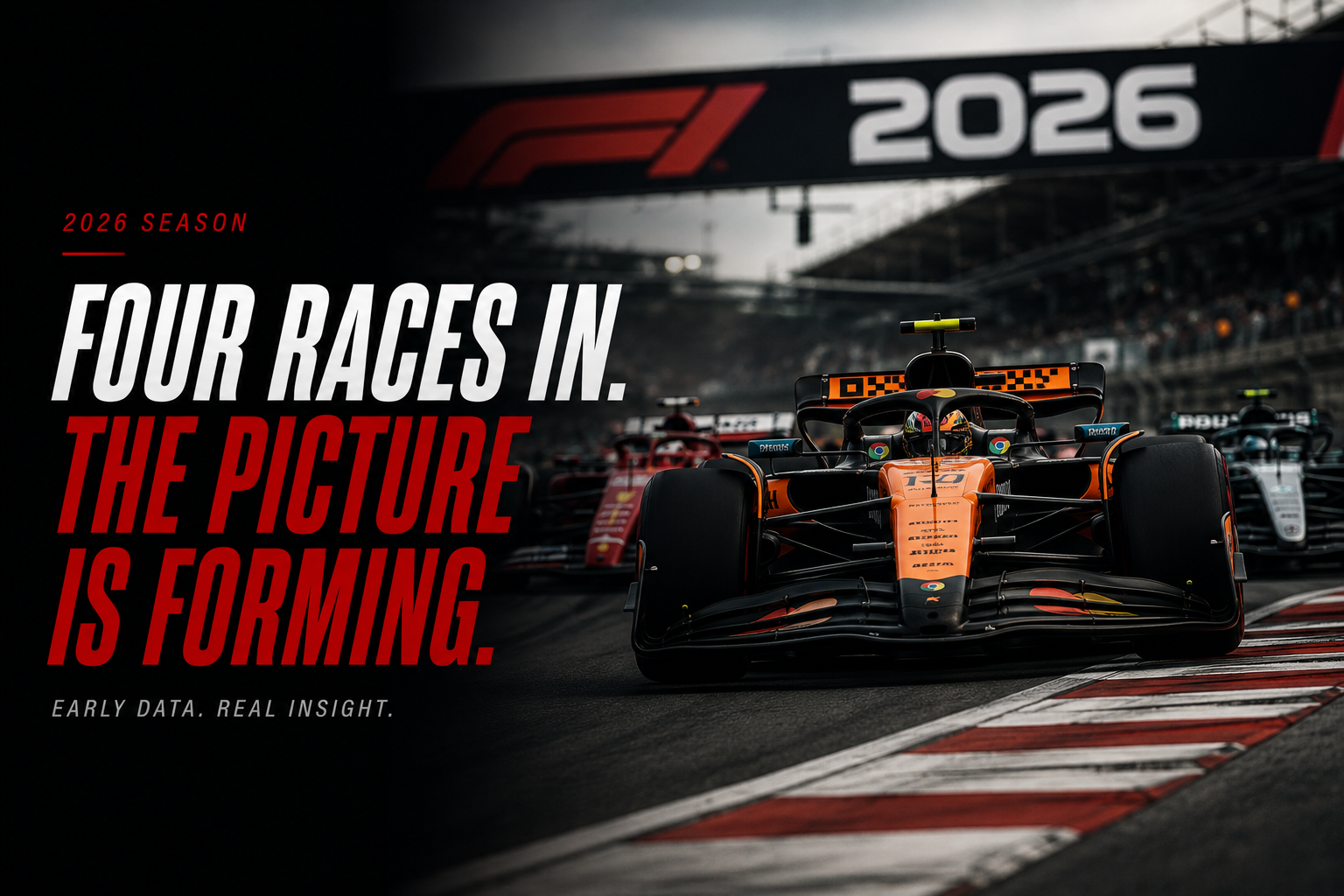

“In Formula 1, the first few races tell you everything and nothing at the same time.” – Martin Brundle
Early Days, Real Data
There is a temptation, in the opening races of any Formula 1 season, to treat the results as definitive. The team that wins the first race is the team to beat. The driver who leads after three rounds is the championship favourite. The pecking order that emerges from the opening flyaway races is the pecking order that will define the year.
Formula 1 history suggests this is almost always wrong, and the 2026 season, with its wholesale regulation reset and genuinely uncertain performance hierarchy, is less predictable than most. But four races in, patterns are beginning to emerge that are worth examining with the confidence that early data deserves, which is considerable but not total.
Here is what the quarter-mark of the 2026 championship is actually telling us.
The Power Unit Story Is Real
The most significant technical narrative of the 2026 season so far is not aerodynamic. It is the power unit, and specifically the way the fifty-fifty split between internal combustion and electrical power has created performance differences that were not fully visible until the cars were racing in anger.
The teams that have managed their energy deployment most effectively in the opening races have had a consistent advantage that goes beyond car design. The interaction between the battery, the deployment strategy, and the driver’s ability to manage the system in real time has produced a new layer of performance differential that strategists and engineers are still working to fully understand.
This matters because it suggests that the gaps we are seeing in the early results are not purely the product of aerodynamic development, which teams can address relatively quickly through upgrades, but of power unit integration, which is a more fundamental and slower moving variable. The teams that have got this right from the start may carry that advantage deeper into the season than a conventional aerodynamic gap would allow.
Superclipping Is Shaping Races
The superclipping phenomenon, the pulsing of power on straights as batteries drain and recover, has not just produced incidents like the Colapinto and Bearman contact. It has actively shaped race outcomes in ways that the FIA and the teams are still processing.
Strategy calls that would have been straightforward under the previous regulations are now complicated by battery state considerations. A car that appears to be in a strong position on track may be managing a depleted battery that will make it vulnerable on the next straight. A car that looks slow through a sector may be conserving energy for a deployment that will produce a burst of pace at a critical moment.
This adds a layer of complexity to following the racing that even experienced observers are finding difficult to parse in real time. It also creates opportunities for teams with superior energy management software to gain advantages that are invisible to rivals until the moment they materialise on track.
Who Has Genuinely Found the Pace
Four races in, the performance picture is clearer than it was in testing but still contains genuine uncertainties.
The teams that have looked consistently quick across varied circuits, including the high speed demands of Bahrain, the street circuit complexity of Jeddah, the balanced demands of Melbourne, and the specific character of the Chinese circuit, are a more reliable guide to the season’s competitive order than the results of any single race.
McLaren have shown the consistency that defending champions need to show early in a new regulatory era. Their adaptation to the 2026 regulations has been quicker than some rivals predicted, and Norris in particular has looked at home in the new car in a way that suggests the adjustment period is already behind them.
Ferrari have shown pace, with Hamilton contributing results that silence some of the early season doubts about the partnership, and Leclerc providing the qualifying speed that has always been his most reliable weapon. Whether they can translate that pace into the championship consistency that titles require remains the open question.
Red Bull and Verstappen have done what they always do in uncertain conditions, which is produce results that are better than the car strictly deserves. The RB22 may not be the fastest car in the field, but Verstappen’s ability to extract performance from imperfect machinery is sufficiently well documented that they remain a championship threat regardless.
Mercedes have shown flashes of the power unit advantage that their pre-season narrative suggested was coming, but the consistency has not yet matched the ambition. Antonelli has impressed without overwhelming, which is exactly the right trajectory for a driver in his position.
The Championship Standings and What They Mean
The standings after four races carry information, but they need to be read carefully.
A driver who has led the championship from race one in a regulation reset year is not necessarily the driver who will win it. The opening flyaway races favour teams that have prioritised early season performance in their development programme, sometimes at the expense of the longer development arc that wins championships in October.
The teams that have taken a more conservative approach to their early season setup, sacrificing some results in the opening races to preserve development flexibility, may be better positioned as the season progresses and the circuits become more varied and more revealing.
What the standings do tell you is who has avoided the disasters. A retirement, a significant penalty, or a damaging intra-team incident in the opening four races creates a points deficit that takes multiple strong results to recover. The drivers who arrive at the European season without that kind of hole in their championship are in a structurally better position than those who have shown more pace but accumulated fewer points.
What We Do Not Yet Know
Four races in, the honest list of unknowns is still longer than the list of certainties.
We do not know which teams have the strongest development trajectory across the full season. We do not know how the superclipping issue will be addressed, and whether any mid-season regulatory intervention will alter the competitive order. We do not know which drivers will handle the pressure of a genuinely open championship in the European races, where the circuits are more familiar and the results more predictable, in ways that reveal their true ceiling.
We do not know, in short, who is going to win this championship – and four races into a season as genuinely open as 2026, that is not a failure of analysis. It is the point.
The next ten races will begin to answer these questions with the kind of finality that early season results cannot provide. Until then, the quarter-mark of the 2026 championship tells us that the season is real, the competition is genuine, and the outcome is as open as it has been in years.
That is worth more than any early prediction.
