
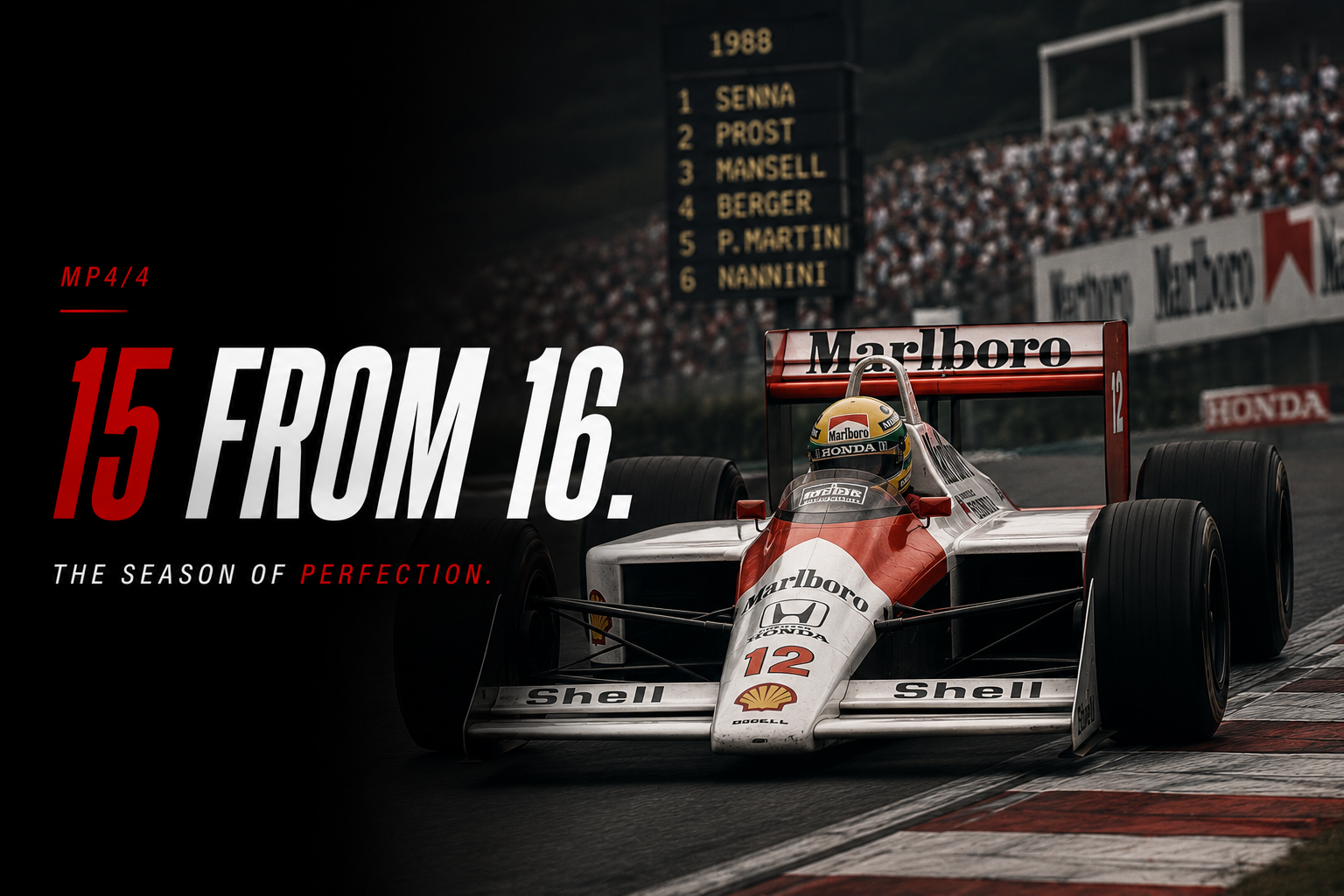

“The MP4/4 was not just a racing car. It was a statement about what was possible.” – Ron Dennis
15 From 16
There is a number that sits at the centre of Formula 1‘s historical conversation about dominance, and it is not the four consecutive championships that Vettel won with Red Bull, nor the seven that Hamilton accumulated with Mercedes, nor even the five that Schumacher took with Ferrari.
It is 15 from 16.
Fifteen wins from sixteen races. That is what McLaren achieved in the 1988 Formula 1 season with the MP4/4, a win percentage of 93.75% that has never been matched in the sport’s history and, given the competitive regulations of the modern era, is unlikely ever to be matched again.
The car that produced those results was extraordinary. The two men who drove it were extraordinary. And the tension between them, conducted in the same garage across a season of almost total dominance, produced one of the most compelling human stories the sport has ever told.
What Made the MP4/4
The MP4/4 was the product of a collaboration between two of the most significant figures in Formula 1’s technical history.
Gordon Murray designed the chassis, a compact, low-slung construction that was revolutionary in its packaging and its aerodynamic efficiency. John Barnard had laid the groundwork in previous McLaren designs, but the MP4/4 represented a step forward in how the relationship between the car’s aerodynamics and its mechanical components was conceived and executed.
The power came from Honda, whose turbocharged 1.5 litre V6 engine was producing somewhere between 650 and 700 horsepower in race trim, with significantly more available in qualifying specification. The Honda engine was not just powerful – it was reliable in a way that its rivals were not, and reliability in a season of 16 races is as valuable as outright pace when the margins are as small as they were in 1988.
The combination of Murray’s chassis and Honda’s engine produced a car that was faster than its rivals in almost every measurable dimension, and it arrived in the hands of the two fastest drivers in the world at the time.
Senna and Prost
The pairing of Ayrton Senna and Alain Prost at McLaren in 1988 was the most combustible and most brilliant driver combination the sport has ever seen.
Prost was the reigning world champion, a driver of extraordinary technical intelligence whose smooth, precise style extracted maximum performance from a car without ever appearing to stress it. He understood racing as a chess match, planned his moves in advance, and rarely made errors under pressure. He was, by any reasonable measure, the best driver in the world entering 1988.
Senna was different. Where Prost was calculated, Senna was committed to a degree that occasionally looked reckless from the outside but was, as he demonstrated repeatedly, entirely within his control. His qualifying pace was supernatural, his wet weather driving produced performances that drivers and engineers described in terms that went beyond technical assessment, and his desire to win was not professional ambition but something closer to compulsion.
They were, in short, equally fast by different means, and they were in the same car, competing for the same championship, with no meaningful hierarchy between them and no disposition toward deference on either side.
The Season
The 1988 season unfolded in a way that was simultaneously predictable and extraordinary.
The MP4/4 was faster than everything else – that was predictable from early testing. What was extraordinary was the internal battle between Senna and Prost, which produced a championship fight of genuine intensity despite the fact that the two of them were lapping the rest of the field with a regularity that made the championship feel like an internal McLaren affair.
Senna won eight races, Prost won seven. The championship was decided at the penultimate race in Japan, where Senna won after stalling at the start and being pushed by marshals, an incident that generated controversy but did not ultimately alter the outcome. He took the title by three points.
The one race McLaren did not win was the Italian Grand Prix at Monza, where both McLarens retired and Gerhard Berger took victory for Ferrari, a result that the Tifosi celebrated with an enthusiasm that the broader context of the season made entirely understandable. It was one of sixteen races. It was also the only moment all year where anyone other than a McLaren driver stood on the top step of the podium.
What It Means Now
The MP4/4’s place in Formula 1 history is secure and uncontested. No car has approached its win percentage in a season of comparable length, and the regulatory environment of the modern era, with its budget caps, cost controls, and deliberate attempts to produce competitive balance, makes the conditions that produced 1988 essentially impossible to replicate.
But the car’s significance goes beyond the statistics. The 1988 season represents the point at which Formula 1’s greatest rivalry reached its peak, the moment when the two best drivers in the world were in the same car, pushing each other to performances that neither would have produced alone, in a machine that was sufficiently dominant to reveal exactly what each of them was capable of without the excuse of inferior equipment.
What it showed was that even in identical cars, they were different. Prost was exceptional and Senna was something else, something that the sport’s conventional framework of comparison struggled to contain.
The MP4/4 gave the sport the conditions to find that out. That is why it matters as much as the wins.
The Monaco Postscript
It is impossible to discuss the MP4/4 without mentioning Monaco, because Monaco is where the season’s most human moment occurred.
Senna was leading the Monaco Grand Prix by a significant margin, driving at a pace that was, by the assessment of everyone watching, beyond what the circuit and the car should have allowed – and then, at Portier, he crashed. Alone, in the lead, with no external pressure to explain the error.
He went back to his apartment in Monaco and sat alone for hours before his team found him. The explanation he offered later, that he had pushed beyond a limit he had not previously found and paid the price, was one of the most honest self-assessments any driver has ever offered about the nature of what he did for a living.
The MP4/4 was the most dominant car ever built. Senna was its most compelling driver – and Monaco in 1988 was the moment that reminded everyone that even in the fastest car, with the fastest driver, the limit was always there.
