
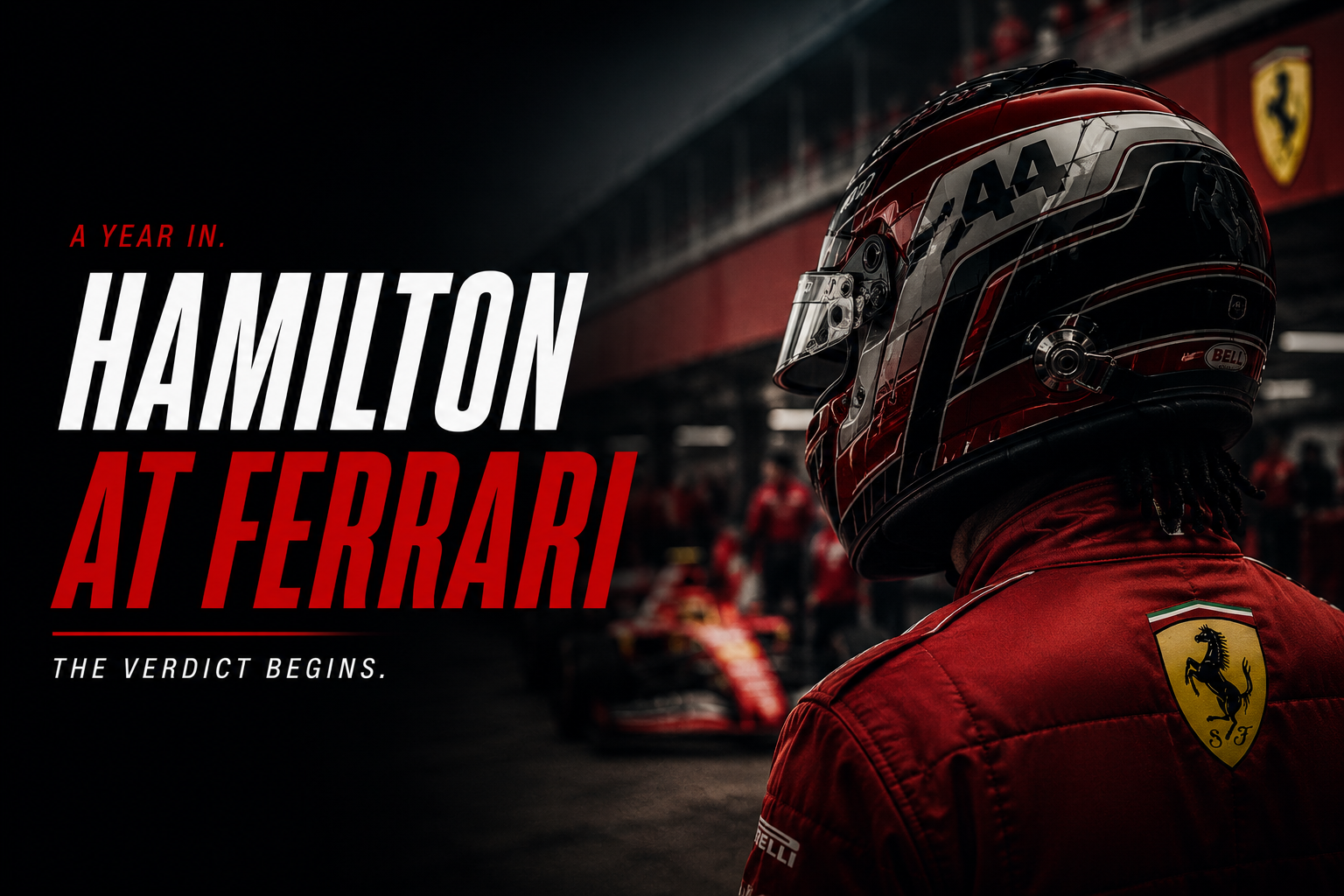

“I have always believed that if you dream big enough and work hard enough, anything is possible.” – Lewis Hamilton
A Year In. The Verdict Begins.
When Lewis Hamilton announced he was leaving Mercedes for Ferrari in February 2024, the reaction was somewhere between disbelief and euphoria depending on which side of the argument you stood on.
For the romantics, it was the move the sport had always deserved. The greatest driver of his generation, in the most iconic car in the sport’s history, with everything still to play for and nothing left to prove anywhere else. For the sceptics, it was a gamble dressed up as destiny, a driver in the final chapter of his career leaving the team that had defined his success for one that had spent years promising more than it delivered.
One year on, both arguments still have merit. That, in itself, tells you something about where Hamilton and Ferrari actually are.
What the Move Was Always About
Hamilton’s decision to leave Mercedes was not made in a moment of frustration or impulse. It was the product of a man who had won everything there was to win at one team and had arrived at a conclusion that the only remaining challenge worth pursuing was the one nobody had managed to give him yet.
A world championship with Ferrari.
Seven titles, 103 race wins, every record that mattered, and yet the one thing missing from Hamilton’s career was the title that Schumacher won five times in a row between 2000 and 2004. Ferrari represents something in Formula 1 that no other team can replicate, a history, an identity, a weight of expectation that transforms winning from an achievement into something closer to destiny fulfilled.
He wanted that. He wanted to be the man who brought Ferrari back to the top of the sport. Whether that ambition was realistic was always the question, and it remains the question now.
The First Season in Red
The 2025 season at Ferrari was not the fairytale that the romantics had scripted.
Hamilton arrived at a team in transition, with new leadership under Frederic Vasseur, a car that showed genuine pace in some conditions and frustrating inconsistency in others, and a teammate in Charles Leclerc who had no intention of making the adjustment easy. Leclerc is one of the fastest drivers on the grid and Ferrari is his team in a way that it has not yet become Hamilton’s, and that dynamic played out across the season in ways that were sometimes productive and sometimes uncomfortable.
There were moments that justified the move. Performances in qualifying that reminded everyone why Hamilton’s speed has never been in question. Race craft in the closing stages of grands prix that produced results the car alone did not deserve. The relationship with the Ferrari engineers, which took time to build but developed through the season into something that both sides described as genuinely positive.
There were also moments that raised the questions again. Results that fell short of what the machinery suggested was possible. A championship that was competitive but not quite competitive enough in the moments that mattered. The sense, never quite stated explicitly but present in the paddock’s conversation, that the partnership was finding its feet rather than hitting its peak.
The Leclerc Dynamic
The relationship between Hamilton and Leclerc is the subplot that defines everything else at Ferrari.
Both are race winners, both are capable of leading a championship challenge, and both arrived at 2025 with reasons to believe that this was their moment. Hamilton brought the experience, the racecraft, and the weight of everything he had already achieved. Leclerc brought the home crowd, the team’s institutional loyalty, and a raw pace that had been evident since his first season in red.
They have coexisted without the open warfare that characterised the Senna-Prost partnership at McLaren, which is itself an achievement given what is at stake. But coexistence is not the same as harmony, and the moments where their interests diverged produced exactly the kind of tension that Ferrari’s history suggests is never far below the surface.
How that dynamic develops in 2026, in a regulation reset that gives both of them a fresh start, is one of the season’s most compelling questions.
2026 and the Real Test
If 2025 was the adjustment year, 2026 is where the verdict begins to form.
The new regulations have given Ferrari an opportunity that a stable regulatory environment would not have provided. A reset means that the accumulated knowledge and development advantage that certain teams had built under the previous rules is partially erased, and teams that have invested heavily in understanding the new formula can close gaps that would otherwise have taken years to close.
Ferrari have the resources and the motivation – Hamilton has the experience of navigating regulation changes, having been at Mercedes through the 2014 turbo hybrid transition that defined an era. The combination, in theory, gives them everything they need to compete at the front in 2026.
Whether theory translates into Sunday afternoons is the only question that matters in Formula 1, and the early 2026 results will begin to answer it with a clarity that the first year of adjustment could not provide.
Dream Move or Career Gamble?
The honest answer, one year on, is that it is still both.
The dream is real. Hamilton at Ferrari is everything the sport’s romantic imagination suggested it would be, a figure of genuine historical significance in the car that carries the sport’s most significant history. When it works, when Hamilton is at the front in red, it produces something that feels like it was always meant to happen.
The gamble is also real – Ferrari remains a team with a complicated relationship between its ambitions and its execution, between what it promises and what it delivers. Hamilton has committed the final chapter of his career to a partnership that has not yet produced the championship that both parties came together to win.
The verdict is not in.
It will not be in until the championship is decided and the final calculation is made about whether the move gave Hamilton what he came for.
One year on, the question is still open. That is either the most compelling thing about it or the most concerning, depending entirely on your perspective.
