
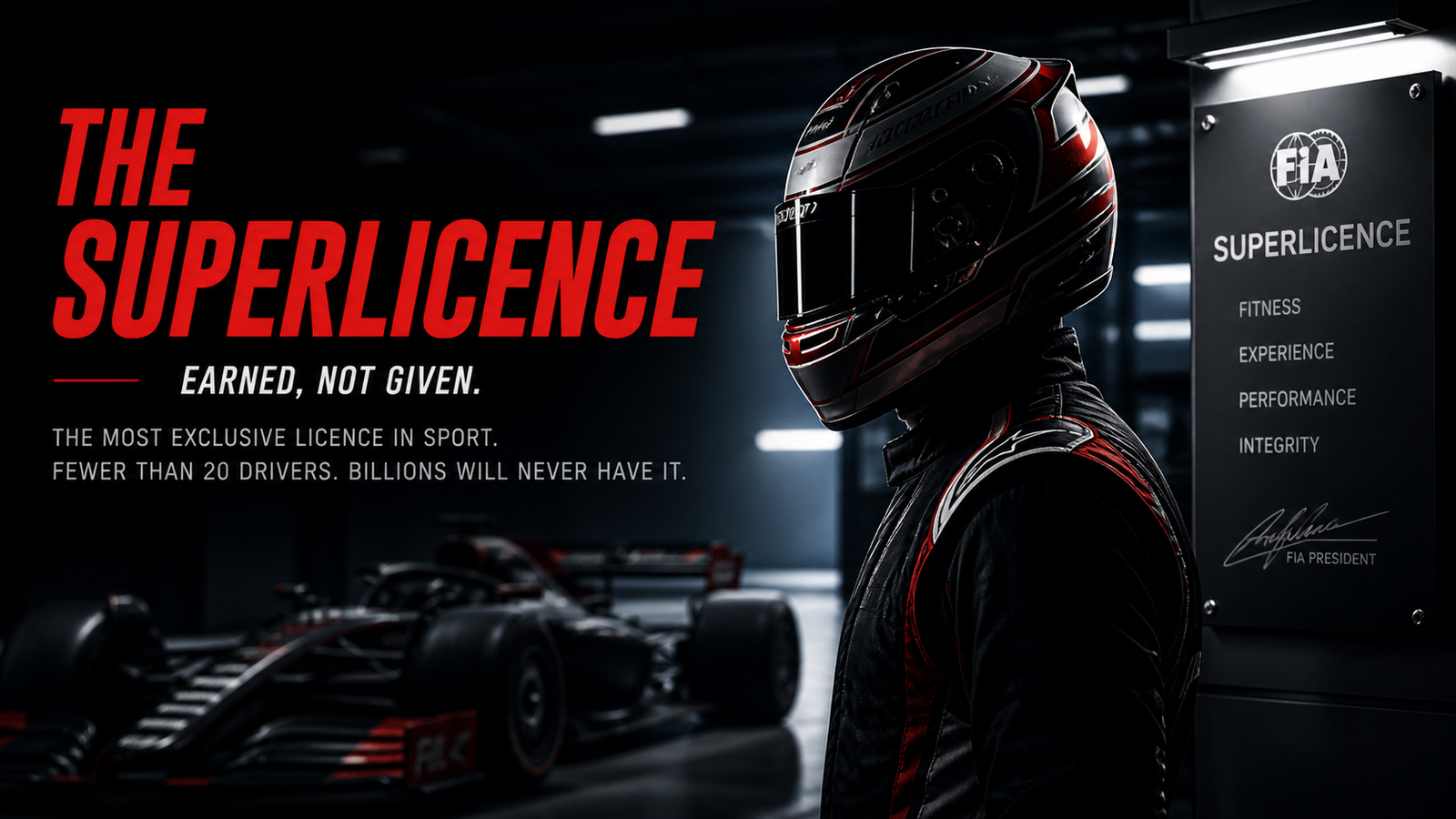

“Formula 1 is the ultimate test. The superlicence exists to make sure you are ready for it.” – FIA
The Most Exclusive Licence in Sport
There are approximately eight billion people on the planet. Fewer than twenty of them hold a valid Formula 1 superlicence at any given time.
The superlicence is the FIA’s mechanism for ensuring that the drivers competing in the world’s most demanding motorsport series have demonstrated, through a structured and verifiable process, that they are ready for what Formula 1 requires. It is not a formality, it is not something that money alone can buy – though money is certainly required to pursue the career that leads to one. It is a qualification that demands results, experience, and a progression through the sport’s junior categories that cannot be shortcut regardless of who is funding the journey.
Understanding the superlicence is understanding something important about how Formula 1 protects both its competitors and its integrity.
What the Superlicence Is
The FIA superlicence is the highest grade of racing licence issued by the sport’s governing body, and it is a mandatory requirement for competing in a Formula 1 world championship event.
Without one, you cannot start a grand prix. Without one, no team can enter you as a driver regardless of the commercial arrangements in place or the wishes of the team’s owners. The superlicence sits above the commercial layer of the sport and cannot be overridden by it, which is one of the things that makes it genuinely significant rather than merely administrative.
The licence must be applied for each year and can be revoked or suspended for serious breaches of the sporting regulations. Holding one in a previous season does not automatically guarantee holding one in the next, though for drivers with established careers the renewal process is largely procedural.
How You Earn One
The superlicence points system is the primary route to qualification for new drivers, and it is built around performance in the FIA’s recognised junior formulae.
To be eligible for a superlicence, a driver must have accumulated at least 40 superlicence points from their results in junior categories over the preceding three seasons, with a maximum of 40 points available from any single season. They must also hold a standard FIA racing licence, have completed at least 80% of a Formula 2 season or equivalent and be at least 18 years of age.
The points available from different series reflect the FIA’s assessment of their relevance and competitiveness as preparation for Formula 1. Formula 2 offers the most points, with 40 available for winning the championship, reflecting its status as the direct feeder series to the top level. Formula 3, Formula Regional, and other recognised series offer progressively fewer points, creating a hierarchy that incentivises progression through the established pathway.
Winning Formula 2 is the clearest and most direct route to superlicence eligibility, which is why the Formula 2 championship is watched so closely by Formula 1 teams and why its champion almost always finds a route to the grid within a season or two of their title.
Why the System Exists
The superlicence points system in its current form was introduced in 2016, replacing a more discretionary approach that had allowed drivers to reach Formula 1 without the structured junior category progression that the current system demands.
The motivation was partly safety and partly competitive integrity. Formula 1 cars are the fastest, most technically complex racing cars in the world, and the consequences of placing an unprepared driver in one are not limited to their own wellbeing. The drivers around them, the marshals at the circuit, and the integrity of the championship itself are all affected by the competence of everyone on the grid.
The previous system had produced cases where drivers with significant financial backing but limited competitive credentials had found their way onto the Formula 1 grid, raising questions about whether the sport was compromising its standards for commercial reasons. The points system was designed to make those compromises structurally more difficult by creating an objective threshold that had to be met regardless of other considerations.
It has not eliminated the role of money in Formula 1 driver careers, which is a separate and more complex issue. But it has created a floor below which competitive credentials cannot fall, and that floor has held.
The Exceptions and the Complications
The system has provisions for exceptional circumstances, and those provisions have occasionally been tested in interesting ways.
Drivers who are deemed sufficiently experienced in other forms of motorsport can apply for a superlicence on the basis of that experience rather than the points system alone, with the FIA assessing each case individually. This route has been used by drivers transitioning from IndyCar, from sportscars, and from other racing disciplines where the level of experience is genuinely comparable to what the junior formula pathway produces.
The age requirement has also produced occasional debate. The minimum age of 18 was introduced after Max Verstappen made his Formula 1 debut at 17 in 2015, a debut that produced no safety concerns but prompted the FIA to establish a clearer lower boundary for future cases. The regulation change was not a criticism of Verstappen‘s ability, which was evident from his first race, but a recognition that 17 was younger than the system had been designed to accommodate.
What It Means for the Current Grid
Every driver on the 2026 Formula 1 grid has earned their superlicence through a process that required genuine competitive achievement in the junior categories.
The rookies, Antonelli and Hadjar, both progressed through Formula 2 and accumulated the points required through championship performances that demonstrated they were ready for the step up. Their superlicences were not granted as a courtesy or as a commercial arrangement – they were earned through results that the system recognised as sufficient preparation for what Formula 1 demands.
That matters because it means that when you watch a Formula 1 race, you are watching twenty drivers who have all cleared a bar that the vast majority of racing drivers in the world will never reach. The competition is not just between them – it is the product of a selection process that has filtered an enormous pool of talent down to the twenty who demonstrated, through the most demanding junior pathway in motorsport, that they belong there.
The superlicence is not glamorous, nor does it generate headlines or produce memorable moments. But it is the foundation on which everything else in Formula 1 is built, and understanding it is understanding something real about why the sport is what it is.
