
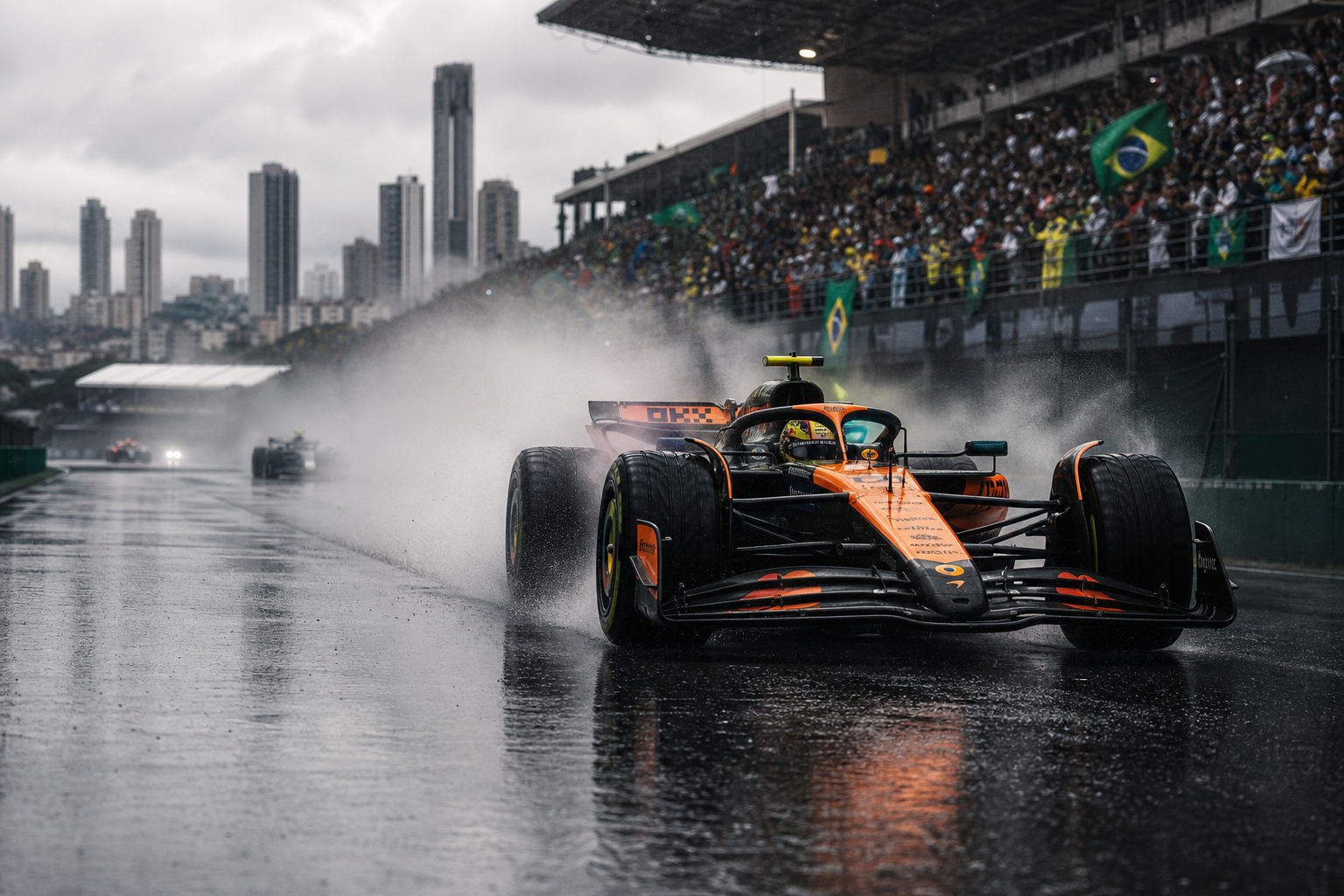

The 2026 São Paulo Grand Prix delivered everything Interlagos promises when the weather turns: a pole lap of absolute composure from Lando Norris, a 19-place recovery drive from Max Verstappen that will sit in the archive for years and a Mercedes points haul large enough to settle the Constructors’ World Championship. By the time the chequered flag fell on lap 71, McLaren had their race winner, Red Bull had the drive of the year, Mercedes had their first team title since 2021 and Lewis Hamilton had marked his 400th Grand Prix start on a circuit that already knows his name.
1. Interlagos context: championship glory and Brazilian passion
Formula 1 arrived at the Autódromo José Carlos Pace with the Drivers’ World Championship already settled in Mexico City, but with the Constructors’ crown still live and the midfield order wide open. For a track that has written as many championship endings as any in the sport, the backdrop could hardly have been better.
The youngest world champion keeps his number
Kimi Antonelli arrived in São Paulo fresh from being crowned the youngest Drivers’ World Champion in Formula 1 history, after a tense points-clinching performance in Mexico. The 20-year-old admitted the reality still had not set in: two days of non-stop messages and celebration had left him running on adrenaline, and he joked that he had sweated off the race-week illness by partying rather than resting.
Antonelli also confirmed he will keep his race number 12 for the remainder of his career rather than take the traditional champion’s number 1. He explained the decision as part humility, part tribute to Ayrton Senna and part superstition. Every time he had raced with number 1 in the junior categories, the season had turned sour. Number 12, by contrast, had carried him here.
Keeping number 12 keeps me grounded. It honours Ayrton and it has been lucky for me my whole career. Number 1 has never been good to me.
Kimi Antonelli
While Antonelli celebrated his maiden title, team-mate George Russell arrived in Brazil looking for a reset. A grim run of operational setbacks across the triple-header had pushed the Englishman to the brink, and he was open about needing to escape and recharge before heading to a circuit where he took his breakthrough maiden win in 2022. A five-place grid penalty for an internal combustion engine change was not the start he wanted.
Hamilton reaches 400 starts on his honorary home soil
The weekend also carried a milestone that only one other driver has ever reached. Lewis Hamilton entered his 400th Grand Prix, joining Fernando Alonso as the only drivers in Formula 1 history to pass that marker. The setting could not have been more fitting: Interlagos is where Hamilton won his first Drivers’ World Championship in 2008, where he produced his iconic 2021 comeback drive and where he was granted honorary Brazilian citizenship.
The milestone sat alongside unresolved friction at Ferrari. Hamilton confirmed that team principal Frédéric Vasseur had returned to Europe, and Charles Leclerc had stayed with his family following the birth of his first child, so no in-person debrief had taken place after Mexico’s first-lap tangle. Hamilton reiterated his commitment to the team but was clear on the need for boundaries. Ferrari cannot throw away 1-2 finishes if they are serious about 2027.
Paddock tributes and a Racing Bulls commitment
The paddock paused to mark the passing of Alan Jones at the age of 80. Jones, the 1980 World Champion with Williams and Australia’s last F1 world champion before Oscar Piastri, was remembered across the pit lane. Piastri paid an emotional tribute, recalling the personal privilege of having driven Jones’s 1980 championship-winning Williams chassis, and praising the Grove team’s golden era alongside Sir Frank Williams and Sir Patrick Head.
In team news, Racing Bulls signed team principal Alan Permane to a five-year contract extension, locking in his leadership through at least 2031 as the Faenza squad braces for a tighter midfield fight with Alpine, Audi and Haas.
Home heroes and an FP1 rookie brigade
The grandstands had plenty to cheer. Alongside full-time Audi driver Gabriel Bortoleto, 18-year-old Ferrari Academy talent Raphael Camára made his official Formula 1 race debut with Haas, stepping in to replace Esteban Ocon for the weekend. Two Brazilian drivers on home soil is a sight Interlagos has not seen often, and Camára handled the attention with notable calm.
Free Practice 1 added a dense rookie contingent: Donny Fornaroli at McLaren (in for Piastri), Luke Browning at Williams (in for Albon), Gabriele Minì at Alpine (in for Gasly), Colton Herta at Cadillac (in for Perez), Dino Beganovic at Ferrari (in for Leclerc) and Freddie Slater at Audi (in for Hülkenberg).
2. Practice report: red flags and early escalation
FP1: Norris sets the pace as Turn 1 bites
Free Practice 1 saw Lando Norris set the early benchmark for McLaren with a 1:11.717. The 2025 World Champion and defending São Paulo winner looked immediately at home around the 4.309 km circuit. The session was defined by widespread braking instability at Turn 1, where a mix of cool track temperatures, bumps and tailwinds caught out Antonelli, Hamilton, Alonso, Herta and Camára.
The session was interrupted after 15 minutes when Audi development driver Freddie Slater, standing in for Hülkenberg, suffered an immediate mechanical breakdown on his seventh lap and brought out the red flags. Alpine junior Gabriele Minì impressed with the seventh-fastest time (1:12.310) to finish as the highest-placed rookie, ahead of Bortoleto in eighth.
FP2: Antonelli dominates, Hülkenberg sidelined
FP2 belonged to the freshly crowned champion. Antonelli laid down a 1:10.763, two and a half tenths clear of Norris, with Max Verstappen third for Red Bull. The lap did not come without discomfort: Antonelli reported severe bottoming through the middle sector and let the team hear about it on the radio.
Nico Hülkenberg had a disastrous Friday as the technical problem that halted Slater’s FP1 persisted into FP2, keeping him in the garage for the entire day. Leclerc struggled with brake feel on the Ferrari, complaining of erratic rear behaviour and clipping past Camára through Turn 1. Hamilton, Alonso, Lawson, Perez and Russell added further Senna S lock-ups to the tally.
FP3: penalties stack and Hamilton’s cockpit fills with smoke
Saturday morning’s FP3 ran under heavy cloud with rain building for qualifying. The hour was heavily shaped by the penalty landscape: Russell carried a five-place drop for an engine change, Hamilton and Leclerc each took ten-place grid penalties for power unit components over quota, and Verstappen and Perez were consigned to the back of the grid for engine replacements.
Despite the penalty, Verstappen topped FP3 with a 1:11.622, battling drivability quirks that included a steering wheel pulling hard to the right and a sharp rear snap at Turn 4. Antonelli was second, two tenths back, with Norris third. Hamilton’s session ended early: after reporting severe engine-braking vibrations, he radioed that smoke was filling his cockpit and parked the Ferrari before he could run a soft-tyre qualifying simulation.
| Session | Top driver | Best lap | Gap to second | Headline |
|---|---|---|---|---|
| FP1 | Lando Norris (McLaren) | 1:11.717 | – | Field-wide Turn 1 lock-ups. Slater Audi breakdown (red flag). Minì leads the rookies in P7. |
| FP2 | Kimi Antonelli (Mercedes) | 1:10.763 | +0.250s vs Norris | Antonelli dominant. Hülkenberg sidelined all session. Leclerc brake complaints. |
| FP3 | Max Verstappen (Red Bull) | 1:11.622 | +0.120s vs Antonelli | Verstappen fastest despite drivability quirks. Hamilton cockpit smoke failure. Grid penalties confirmed. |
3. Wet qualifying: red flags, grid reshuffles and Norris’ pole mastery
Qualifying opened under treacherous wet conditions that turned Interlagos into a survival exercise. Standing water accumulated quickly and rain intensity fluctuated without warning, forcing a direct trade between ultimate risk and catastrophic error.
Q1: extreme rain and barrier strikes
Q1 began in full wet conditions with wet tyres mandatory. Veteran Fernando Alonso produced a masterclass in early car control, exploiting Honda’s wet-weather delivery to top the sheet in his Aston Martin. Alonso noted that heavy rain erased the usual straight-line deficit and let chassis handling set the laps.
Behind him, chaos. Oliver Bearman suffered a major off at Turn 12. Bortoleto clipped the wall at Turn 12, damaging his Audi’s alignment and ending his hopes of advancing. Camára survived a heavy barrier hit and kept his Haas moving. At the chequered flag, severe track evolution had eliminated Franco Colapinto, Pierre Gasly, Lance Stroll, Valtteri Bottas, Sergio Perez and a heartbroken Bortoleto.
Q2: red flag drama and a Piastri knockout
Q2 saw conditions shift toward intermediate tyres as a dry line started to form. Hülkenberg, making up for the lost Friday, posted a sensational lap to jump into provisional contention. The session was then halted by a session-ending red flag when Camára suffered a heavy impact with the outer barrier.
The timing caught out several contenders. Piastri was stranded without completing his final flyer and dropped out. Knowing they faced back-of-grid penalties anyway, both Hamilton and Verstappen elected not to burn extra wet tyres.
Q3: Norris’ composure, Russell’s radio and the penalty reshuffle
Q3 began under a renewed deluge, forcing drivers onto intermediates on a rapidly deteriorating surface. Alonso set the opening benchmark but times tumbled quickly as Liam Lawson and Hülkenberg briefly jumped into front-row contention.
Russell mounted a fierce bid for pole with a blistering lap to take provisional P1, then was audibly furious when Mercedes told him to back off on his final attempt with incoming rain.
Mate, you told me to back off. I want to be P1!
George Russell on team radio
Norris responded with supreme composure. A clean lap without a single lock-up or snap gave him a 1:11.700 and pole position: his third consecutive pole at Interlagos and the 20th of his Formula 1 career. Antonelli produced an astonishing final sector in torrential spray to go second-fastest on track, with Russell third. Grid penalties then reshuffled the formation dramatically, promoting Lawson and Hülkenberg to a wet second row.
| Driver | Team | On-track Q3 | Penalty | Final grid |
|---|---|---|---|---|
| Lando Norris | McLaren | P1 (1:11.700) | None | P1 (pole) |
| Kimi Antonelli | Mercedes | P3 | None | P2 |
| Liam Lawson | Racing Bulls | P4 | None | P3 |
| Nico Hülkenberg | Audi | P5 | None | P4 |
| Isack Hadjar | Red Bull | P6 | None | P5 |
| Oliver Bearman | Haas | P7 | None | P6 |
| George Russell | Mercedes | P2 | +5 places | P7 |
| Fernando Alonso | Aston Martin | P8 | None | P8 |
| Charles Leclerc | Ferrari | Q2 (P13) | +10 places | P14 |
| Lewis Hamilton | Ferrari | Q2 (No time) | +10 places | P20 |
| Max Verstappen | Red Bull | Q2 (No time) | Back of grid | P21 |
4. The 71-lap São Paulo Grand Prix
Sunday delivered the classic Interlagos spectacle: a 71-lap epic contested under constantly shifting weather, with slick surfaces, drying lines, sudden downpours and relentless overtaking from the back of the field to the front.
Phase 1: the start and an opening-lap barrage
When the lights went out, Antonelli produced a textbook launch from P2, diving aggressively into the Senna S to steal the lead from pole-sitter Norris. Norris, struck by wheel-spin off the line, slipped to third as Lawson launched an audacious inside move at Turn 1 to put the Racing Bulls into second.
Further back, the opening lap produced two extraordinary charges. Hamilton sliced through midfield spray to gain 11 positions by the end of lap 1, climbing from P20 on the grid to the fringe of the points. Verstappen, from P21, was equally ruthless and let his wet-weather car placement do the talking.
Phase 2: the Verstappen recovery
Inside the opening ten laps, Verstappen’s recovery drive had settled into a wet-weather clinic. Using wider karting lines through Turn 10 to find grip where others slid, he put together a sequence of passes on the midfield to climb from P21 to seventh by the end of lap 7. It would get better from there.
Lawson’s aggressive early stint, meanwhile, wore down his intermediates on the drying surface. Norris swept past at Turn 1 to reclaim second place inside the first handful of laps, with Hadjar following through for third.
Phase 3: leader errors and mid-race chaos
Russell’s turbulent weekend then took another painful turn. Mercedes brought him in for a tyre change and the stop unravelled in the pit lane itself: he lost the rear on cold tyres on the way out of the box, spun and scraped his front wing on the pit wall before the crew could recover the car and send him back on track. From the outside it looked like it would drop him out of contention entirely; in the end it cost him track position rather than a result.
Race leader Antonelli was controlling a comfortable gap ahead of Norris until the mid-race chaos found him too. A sudden rear-end snap on braking at Turn 1 sent the Mercedes into a long spin. Antonelli radioed in confusion that something had felt weird at the rear, and from there the lead quietly slipped away: Norris was through soon after, and a subsequent wide moment at the same corner allowed Hadjar and the surging Verstappen past, demoting him to fifth.
Verstappen eventually dispatched team-mate Hadjar with a late-braking move into Turn 4 and moved into second. From P21 on the grid, the Red Bull now sat second on the road.
Phase 4: strategy, slick-tyre gambles and a pit lane incident
Rain returned in varying intensities and pit strategy turned decisive. Mercedes brought Antonelli in for intermediates and the release went wrong: on a slippery pit-lane surface the Mercedes briefly lost grip and crossed into the path of Franco Colapinto’s Alpine, who was already running down the fast lane. The stewards saw enough to investigate (Doc 80) and handed down a five-second time penalty for the unsafe release.
Hamilton’s own race had its signature moment much earlier. Attempting to pass Oliver Bearman at Turn 5, he was squeezed off the track by Bearman’s defensive line, gave the position back cleanly, and the stewards took no further action (Doc 65). Later in the race, it was Bearman himself who drew a five-second unsafe release penalty: Haas let him out directly into the path of Leclerc’s Ferrari in the pit lane, squeezing the Ferrari toward the pit wall (Doc 78).
Midfield battles raged. Leclerc and Lawson fought a tense wheel-to-wheel exchange, with the Ferrari making contact with the Racing Bulls at Turn 12 before eventually taking the position five corners later. Though the contact was minor, the stewards ruled that it directly enabled the overtake and added a five-second time penalty for Leclerc (Doc 79). Hülkenberg executed a clean up-and-under on Arvid Lindblad at Turn 5 to secure the final point for Audi.
Phase 5: chequered flag and classification
As torrential rain returned for the final five laps, Norris kept absolute focus at the front. He crossed the line with complete composure for back-to-back São Paulo wins. Verstappen crossed in second to complete one of the great wet-weather comeback drives of the modern era, up 19 places from his starting slot. Hadjar held on for a superb third, his third podium for Red Bull.
Most significantly, Mercedes brought their cars home in fourth (Russell) and fifth (Antonelli). The combined haul formally sealed the 2026 Formula 1 Constructors’ World Championship for the Brackley squad: their first team title since 2021, and their ninth Constructors’ crown in all.
| Pos | Driver | Team | Grid | Change | Points |
|---|---|---|---|---|---|
| P1 | Lando Norris | McLaren | P1 | 0 | 25 |
| P2 | Max Verstappen | Red Bull | P21 | +19 | 18 |
| P3 | Isack Hadjar | Red Bull | P5 | +2 | 15 |
| P4 | George Russell | Mercedes | P7 | +3 | 12 |
| P5 | Kimi Antonelli | Mercedes | P2 | -3 | 10 |
| P6 | Oscar Piastri | McLaren | P10 | +4 | 8 |
| P7 | Liam Lawson | Racing Bulls | P3 | -4 | 6 |
| P8 | Charles Leclerc | Ferrari | P14 | +6 | 4 |
| P9 | Lewis Hamilton | Ferrari | P20 | +11 | 2 |
| P10 | Nico Hülkenberg | Audi | P4 | -6 | 1 |
5. Post-race analysis: Mercedes’ ninth crown and what is left to play for
Mercedes clinch a ninth Constructors’ title
For Mercedes, this title is the end of a four-year climb back. After the hybrid-era dominance of 2014 to 2021, the Brackley and Brixworth programme faced a long operational rebuild, and the 2026 W17 has been the vehicle for the return. Team Principal Toto Wolff and his senior engineering group dedicated the title to the thousands of people across the two factories who kept the development line moving.
It was a lot of fun out there, but extremely difficult. I felt like I was nearly crashing on almost every lap. 71 laps in these conditions was mentally draining. But to come through four tough years as a team and take the Constructors’ Championship today is really, really great. Everyone at Brackley and Brixworth deserves this so much.
Kimi Antonelli
Driver reactions
In terms of focus needed, every single lap today was probably one of the hardest of the entire year. It wasn’t about finding the last tenth of a second. It was about not putting a wheel wide, not locking tyres and keeping the car on the circuit. To come out with a win here again in Brazil is incredibly rewarding.
Lando Norris, race winner
Starting 21st and finishing second in a crazy race like that: I’m very happy with the podium. Every lap was a battle to stay on the correct line. We had fantastic pace in the wet and scored big points. I can’t complain too much.
Max Verstappen, Driver of the Day
Hamilton’s own race told a very different story. From P20 on the grid he climbed into the top 10 by the end of lap 1, fought his way through the midfield in the spray, and ultimately took a pair of points in ninth, a lap down. On his 400th Grand Prix weekend at a circuit that gave him his first world title, a hard-earned top-10 finish in a difficult car was not the headline the Scuderia wanted, but it was the result their execution deserved on the day. Maranello knows there is work left to do before Las Vegas.
Strategic implications heading into Las Vegas, Qatar and Abu Dhabi
With the Constructors’ crown settled, attention now shifts to the battle for second between Ferrari, Red Bull and McLaren across the final three rounds. McLaren’s new front-wing aerodynamic update at Interlagos clearly gave Norris a step in wet-weather front-end authority. Red Bull, on this evidence, still has the raw pace to challenge anyone.
In the midfield, Racing Bulls protect a comfortable fifth in the Constructors’ standings over Alpine, Haas and Audi, with Lawson’s seventh-place finish adding valuable points. Three rounds remain: Las Vegas on 22 November, Qatar on 29 November and Abu Dhabi on 6 December. The 2026 São Paulo Grand Prix will be remembered as a masterclass of wet-weather drama, a career comeback drive for Verstappen and a long-awaited team title for Mercedes at the cathedral of Brazilian motorsport.
FAQ: 2026 São Paulo Grand Prix
Who won the 2026 São Paulo Grand Prix?
Lando Norris won from pole position for McLaren, his back-to-back victory at Interlagos and his second consecutive São Paulo Grand Prix win.
How did Max Verstappen finish from P21?
Verstappen finished second after a 19-place recovery, benefitting from exceptional wet-weather pace to pass Piastri, Albon, Hadjar and Russell inside the first seven laps and move into second by lap 35.
Did Mercedes clinch the 2026 Constructors’ Championship in Brazil?
Yes. Russell’s fourth-place and Antonelli’s fifth-place finish gave Mercedes a lead of 142 points over Ferrari with 129 points still available across the final three rounds, mathematically sealing their ninth Constructors’ Championship.
What was Lewis Hamilton’s 400th Grand Prix result?
Hamilton started P20 after a ten-place grid penalty, climbed into the top 10 by the end of lap 1 and finished ninth to score two points on his 400th Grand Prix weekend.
Which drivers received penalties at the 2026 São Paulo Grand Prix?
Three in-race penalties were applied. Oliver Bearman (Haas) received a five-second time penalty for an unsafe release into Charles Leclerc’s path in the pit lane. Kimi Antonelli (Mercedes) received a five-second time penalty for an unsafe release that crossed the path of Franco Colapinto. Charles Leclerc (Ferrari) received a five-second time penalty for causing a collision with Liam Lawson at Turn 12. All three penalties are reflected in the official final classification.
Official FIA race documents
Primary references used to compile this report, published by the Stewards of the Meeting at the 2026 São Paulo Grand Prix:
- FIA 2026 São Paulo GP document index (full set of race weekend decisions)
- Doc 81: Final Race Classification (71 laps, 305.879 km)
- Doc 80: Car 12 (Antonelli), unsafe release into path of Car 43 (Colapinto), five-second time penalty
- Doc 79: Car 16 (Leclerc), causing a collision with Car 30 (Lawson) at Turn 12, five-second time penalty
- Doc 78: Car 87 (Bearman), unsafe release into path of Car 16 (Leclerc), five-second time penalty
- Doc 65: Car 44 (Hamilton), alleged leaving the track at Turn 5, no further action (position given back after being squeezed off by Car 87)
