
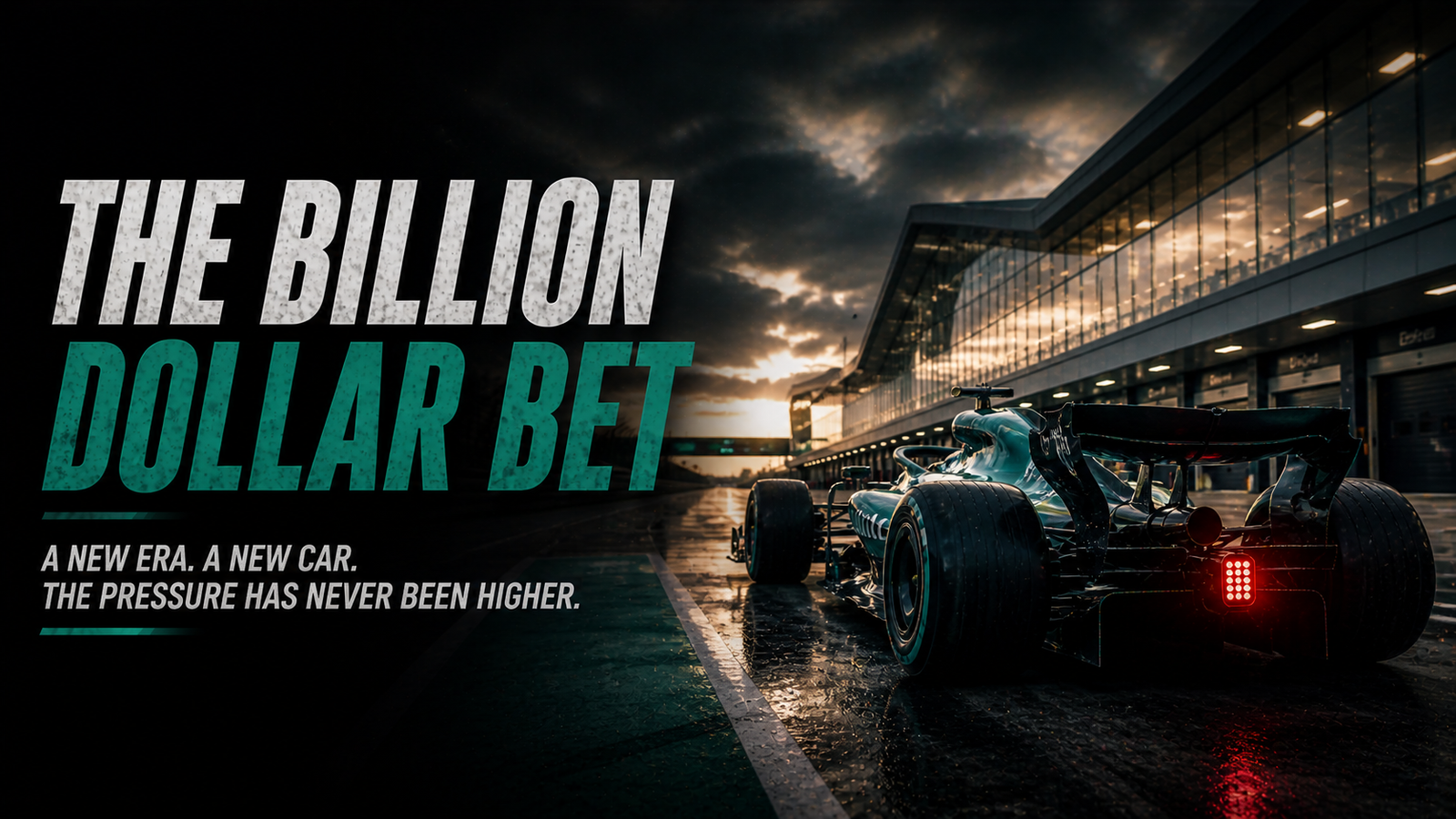

“I still have the hunger. I still have the passion. And I still believe I can win.” – Fernando Alonso
The Most Expensive Experiment in the Midfield
There is no team in Formula 1 whose 2026 story carries more weight, more money, and more unanswered questions than Aston Martin.
Lawrence Stroll did not buy a struggling midfield operation in 2018 and spend over a billion pounds rebuilding it from the ground up because he expected mediocrity. He expected a championship contender – he built the infrastructure of a championship contender, he hired the personnel of a championship contender.
What he has not yet had is the results of one.
2026 was supposed to be the year that changed. New regulations, a new campus, Adrian Newey through the door, and Fernando Alonso still in the car believing that this project can deliver what his talent has always deserved. The ingredients were compelling – the reality, as it so often is in Formula 1, has been more complicated.
The Hope
To understand the hope, you have to understand what Aston Martin built.
The Silverstone campus that replaced the old Racing Point facility is genuinely world-class. A new wind tunnel, a new factory, a new simulator, a new personnel pipeline designed to attract the kind of talent that previously would have gone straight to Mercedes, Red Bull, or Ferrari. The physical infrastructure is not an excuse or an aspiration. It is real, it is operational, and it is the kind of facility that changes what is technically possible for a team.
Adrian Newey‘s arrival added a dimension that no amount of capital expenditure alone could buy. His track record at Williams, McLaren, and Red Bull is the most decorated in the sport’s history. Teams he has designed cars for have won twelve Constructors’ Championships. His presence at Aston Martin does not guarantee anything, but it changes the probability distribution of outcomes in ways that no rival on the grid has been able to ignore.
Alonso’s continued belief in the project is the third element of the hope. He is 44 years old, operating at a level that drivers half his age cannot match, and he is here because he genuinely believes this car can win. That belief is not sentiment – it’s the calculated assessment of a man who has spent his entire career reading technical programmes and understanding which ones have real potential and which ones are well-funded ambition without the execution to match.
The Suffer
2025 was supposed to be the bridge year. The year where the new infrastructure started producing results whilst the full investment paid off in 2026.
It did not feel like a bridge, it felt like a wall.
The AMR25 was inconsistent in ways that frustrated everyone inside the team and confirmed the doubts of those outside it. Fast in some conditions, exposed in others, unable to translate the theoretical capability of the Silverstone facility into the lap time advantage that the investment should have been producing. Alonso extracted everything the car had and occasionally produced results that made it look better than it was, which is both a testament to his ability and an indictment of the gap between expectation and reality.
The leadership changes added to the instability – Mike Krack’s departure as Team Principal, Andy Cowell’s brief tenure and subsequent transition to Chief Strategy Officer, and Newey’s elevation to Team Principal, all happened against a backdrop of a team that was trying to perform at the front while simultaneously restructuring the people responsible for getting them there.
That is a difficult combination. The teams that win championships tend to have stability at the top – Aston Martin in 2025 had the opposite, and the results reflected it.
The 2026 Car
The AMR26 is the first car that can genuinely be described as a product of everything Aston Martin have built.
The full campus is operational, the wind tunnel is running and Newey’s influence on the design direction is beginning to materialise, though the full expression of his technical vision will take time to work through the development cycle. The Honda power unit partnership, one of the sport’s most anticipated technical collaborations, adds a manufacturer with a specific and relevant expertise in the new power unit formula to an already significant technical operation.
The early season results have been watched more closely than those of almost any other team. Every qualifying position, every race result, every comparison against the teams Aston Martin have identified as their benchmarks, has been processed through the filter of whether the investment is finally paying off.
The honest answer, at this point in the season, is that the picture is not yet complete. There are signs of genuine pace in specific conditions. There are also familiar frustrations with consistency across varied circuits. The regulation reset has given Aston Martin an opportunity that a stable regulatory environment would not have provided. Whether they are taking it is a question that the next ten races will begin to answer more definitively.
What’s Next
The timeline that Lawrence Stroll always described was never a single season. It was a programme.
The 2026 season is not Aston Martin’s last chance. It is, however, the season where the gap between investment and result becomes harder to explain away. The new regulations were supposed to be the great leveller, the moment when a team with Aston Martin’s infrastructure and personnel could genuinely challenge the established order rather than chase it.
Alonso’s timeline is the variable that makes everything more urgent. Every season that passes without a car capable of challenging for the championship is a season closer to the end of a career that deserves a better conclusion than it has so far received. He is patient, he is professional, and he has never publicly wavered in his belief that the project will deliver. But patience has limits, and everyone in the paddock knows it.
Newey’s influence will grow, the car will develop, the results will come – or they will not come quickly enough, and the questions will get louder.
Aston Martin’s 2026 story is not finished. It is, in many ways, only just beginning to be told.
