
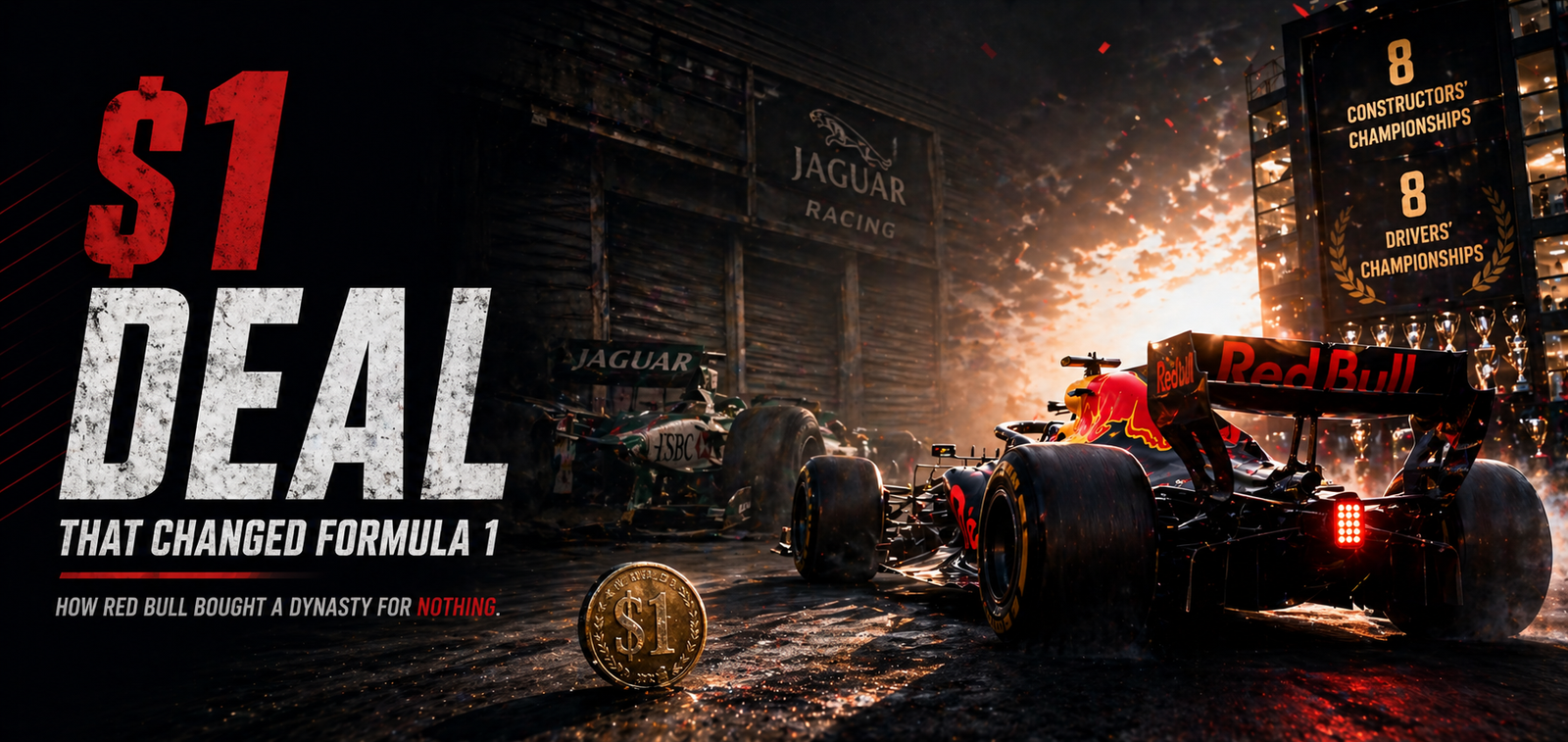

“I always say the secret to this team is that we never stopped believing.” – Dietrich Mateschitz
A Dollar. A Dying Team. A Decision That Changed Everything.
In January 2005, Red Bull completed the purchase of the Jaguar Racing Formula 1 team from Ford Motor Company for a fee widely reported as one US dollar.
One dollar for a factory, a workforce, a technical operation and a place on the Formula 1 grid. Ford had spent the better part of half a billion dollars trying to make Jaguar Racing work and had produced precisely nothing of note. They wanted out. Red Bull, an energy drinks company that had been sponsoring extreme sports and motorsport for years, wanted in.
The deal looked eccentric at the time. What it turned out to be was one of the most consequential transactions in the sport’s history.
The Team Nobody Wanted
Jaguar Racing’s Formula 1 story is one of the sport’s more instructive cautionary tales about the gap between resources and results.
Ford acquired the Stewart Grand Prix team in 1999, rebranded it as Jaguar and proceeded to spend enormous sums of money producing cars that finished in the midfield on a good day. The problem was never entirely financial. It was cultural and structural. Too many decision-makers, too much corporate interference, not enough of the singular focus that Formula 1 rewards above almost everything else.
By 2004, Ford had seen enough. The team was losing money, losing races and losing the argument internally that the investment was worth continuing. They were effectively giving the operation away to anyone willing to take it on.
Dietrich Mateschitz, Red Bull’s co-founder and the man who had turned an obscure Thai energy drink into a global phenomenon through sheer marketing brilliance, saw something different. He saw an undervalued asset in a sport that was about to become significantly more valuable. He also saw an opportunity to do something that most energy drink brands could only dream of. Not just sponsor a Formula 1 team. Own one.
The Pieces Fall Into Place
The first few years were not pretty.
Red Bull Racing finished seventh in the Constructors’ Championship in 2005, their debut season. They were a midfield team with a new identity, a new livery and a working culture that was visibly more relaxed and creative than the corporate environments that had preceded them. The energy drink branding, the music at the garage, the general sense that these people were enjoying themselves, made them distinctive in a paddock that took itself very seriously.
What was happening beneath the surface was more important than the results suggested.
In 2005, Red Bull also acquired the Minardi team, rebranding it as Toro Rosso, creating a junior operation to develop young drivers. The structure they were building was not about immediate results. It was about creating a pipeline, a culture and eventually a technical foundation that could compete at the front.
That technical foundation arrived in the form of Adrian Newey.
Newey joined Red Bull from McLaren in 2006 and his arrival changed everything. One of the most gifted aerodynamicists the sport has ever produced, he brought with him not just technical genius but a way of thinking about car design that would come to define the most dominant period in Formula 1 since the Schumacher-Ferrari era.
The Dynasty Begins
The results did not arrive immediately, but when they did, they arrived decisively.
Sebastian Vettel won Red Bull’s first Drivers’ Championship in 2010, holding off Fernando Alonso in one of the most dramatic season finales the sport had seen in years. It was not supposed to happen that quickly. A team that had paid a dollar for their operation five years earlier was now champion of the world.
Then they did it again. And again. And again.
Four consecutive Constructors’ and Drivers’ Championships from 2010 to 2013, with Vettel winning all four drivers’ titles. The 2011 and 2013 seasons in particular were displays of dominance that left the rest of the grid searching for answers they struggled to find. Newey’s cars were faster, more efficient and more consistently developed than anything their rivals could produce.
The dynasty that Mateschitz’s dollar had started was now the most powerful force in Formula 1.
The Verstappen Era
After a quieter period between 2014 and 2018, where the shift to turbo hybrid power units briefly levelled the playing field, Red Bull rebuilt again.
Max Verstappen arrived in 2015 as a 17-year-old who looked immediately as though he had been in Formula 1 for years. His development within the Red Bull system was rapid and sometimes spectacular, occasionally reckless, always compelling. By 2021, with a car finally capable of matching Mercedes, he delivered the championship in circumstances that remain among the most controversial in the sport’s recent history.
Three more titles followed. Four in a row, echoing the Vettel era and arguably even more dominant in terms of raw pace. The 2023 season in particular was as close to perfection as a Formula 1 team has produced outside of McLaren’s 1988 campaign.
All of it traceable, in one unbroken line, back to a January afternoon in 2005 and a purchase price of one dollar.
What the Deal Actually Bought
The dollar bought a grid slot and a set of assets. What Mateschitz built around it was something that cannot be purchased at any price.
A culture. An identity. A willingness to take risks, back young talent and operate with a creativity and boldness that more corporate organisations struggle to replicate. The Red Bull Racing that won four championships with Vettel and four with Verstappen is not the team that Ford gave away. It is something that was constructed deliberately, patiently and with a clarity of vision that most teams in any sport never achieve.
Dietrich Mateschitz passed away in October 2022, having seen his dollar turn into eight Constructors’ Championships and eight Drivers’ titles. He did not live to see Verstappen’s fourth, but the foundation he built made it inevitable.
One dollar. One decision. Twenty years of consequences.
Formula 1 has never seen a return on investment quite like it.
How Red Bull Compares to Other Unlikely Success Stories
The Jaguar purchase sits in a very specific category of F1 history. Teams that arrived from nowhere or from the wreckage of something else and built something remarkable. The closest parallel is probably the Brawn GP story, where a team that nearly ceased to exist entirely won the championship in its only full season. Different circumstances, same basic truth: F1 rewards clarity of purpose above almost everything else.
Red Bull had that clarity from the start. Mateschitz knew what he wanted the team to represent. He wanted it to feel like a Red Bull product. Fast, bold, a bit irreverent. That identity never wavered even when the results weren’t there in the early years. Most teams that struggle in their first few seasons start second-guessing everything. Red Bull kept building.
The driver academy is part of that story too. Vettel came through a feeder programme. Verstappen was signed at 16 and placed in a structured development path. The pipeline produced champions because it was designed to produce champions, not just to fill seats.
What Happens Next
Red Bull’s dominance has eased since 2023. The 2024 season showed the rest of the grid catching up and the 2025 regulations brought fresh uncertainty. Newey’s departure for Aston Martin was significant. Any team loses something when one of its most important minds walks out the door.
The question now is whether the culture Mateschitz built is strong enough to survive the technical transition. History suggests it probably is. This is an organisation that rebuilt after the hybrid era reset the competitive order. It has done it before.
Watching where the driver market shapes up heading into 2027 will tell us a lot about Red Bull’s confidence in their own trajectory. Teams that believe in themselves recruit accordingly.
Key Takeaways
- Red Bull purchased Jaguar Racing from Ford in January 2005 for a reported fee of one US dollar, inheriting a factory, staff and a grid slot.
- Ford had spent close to half a billion dollars on the Jaguar project and left with nothing to show for it. Red Bull turned the same assets into eight Constructors’ Championships.
- Adrian Newey’s arrival from McLaren in 2006 was the single most important technical decision in the team’s history. The car designs that followed defined an era.
- The Toro Rosso acquisition in 2005 gave Red Bull a driver development pipeline that produced both Vettel and Verstappen as world champions.
- Dietrich Mateschitz’s death in 2022 closed a chapter, but the structures he put in place continued producing results. The organisation outlasted its founder’s vision intact.
Frequently Asked Questions
Why did Ford sell Jaguar Racing for just one dollar?
Ford wanted to exit Formula 1 and had few buyers willing to take on the costs and liabilities of a struggling team. A nominal one dollar sale allowed them to transfer the operation quickly while Red Bull assumed responsibility for the workforce, facilities and ongoing costs. The real value was in the grid slot, not the dollar figure itself.
How much did Red Bull actually spend after buying the team?
The purchase price was symbolic. Red Bull then invested heavily in infrastructure, staff and car development over several years before results came. Estimates vary but the team’s annual budget grew into the hundreds of millions by the time they were winning championships. The dollar was the entry fee, not the total cost.
Was Adrian Newey really that important to Red Bull’s success?
Yes. Newey joined in 2006 and the team’s trajectory changed almost immediately. His RB5 in 2009 was already one of the fastest cars on the grid. The RB6 through RB9 cars that won four consecutive championships were widely regarded as the best-designed machines of their generation. His influence on the team’s technical culture ran deeper than any single design.
How does the Red Bull purchase compare to other bargain deals in F1 history?
It’s genuinely hard to match. Brawn GP’s story is the closest in spirit, where Ross Brawn bought the Honda team for a nominal sum and won the championship that same year. But Red Bull’s long-term return across two decades of titles makes the Jaguar deal the more consequential transaction in terms of lasting impact on the sport.
What is Red Bull’s outlook after Adrian Newey’s departure?
Newey leaving for Aston Martin in 2024 was a genuine blow. Red Bull have strong technical staff remaining but replacing someone of his calibre is not straightforward. The 2025 and 2026 seasons will be the real test of whether the team’s depth is sufficient to stay competitive through another regulatory transition without their most celebrated designer.
