
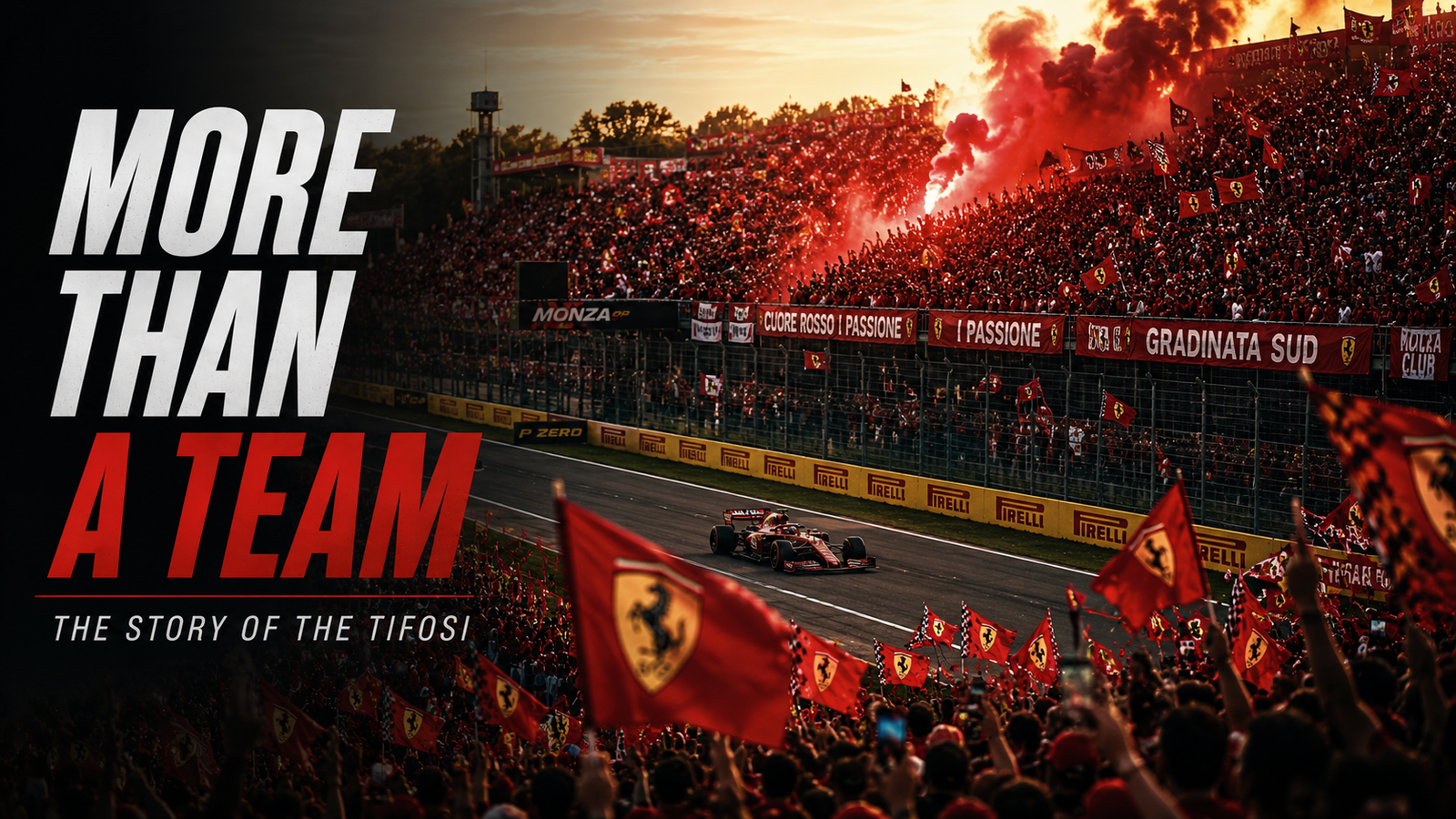
“When Ferrari wins, all of Italy wins. That is the weight we carry.” – Luca di Montezemolo
The Red Army
Every Formula 1 team has supporters. Ferrari has something else.
The Tifosi, the name given to Ferrari’s most devoted fans, are a phenomenon that exists outside the normal framework of sporting support. They are not simply people who prefer one team over another, who have chosen Ferrari as their team in the way that a football supporter chooses their club based on geography or family tradition or a single formative moment.
The Tifosi are an identity. Ferrari support, for those who carry it seriously, is something closer to a cultural allegiance than a sporting preference, a connection to a history, a mythology and a set of values that the team represents beyond the results it produces on any given Sunday afternoon.
No other team in Formula 1 generates anything comparable. Understanding why requires understanding what Ferrari actually is and why it means what it means to the people for whom it means everything.
What Ferrari Is
Ferrari was founded by Enzo Ferrari in 1939, though the racing team that grew into the Formula 1 constructor began competing in the world championship from its very first season in 1950. The connection between the road car company and the racing team is more direct and more genuine than the equivalent relationship at most manufacturers, because Enzo Ferrari built road cars primarily to fund his racing operation rather than the other way around.
That inversion of the normal manufacturer logic produced a team whose identity was rooted in racing rather than commerce, in the track rather than the showroom and that identity has never fully changed despite the commercial transformation that Ferrari has undergone in the decades since Enzo’s death in 1988.
The prancing horse on the Ferrari badge, the Cavallino Rampante, carries a history that predates the team itself, taken from the personal emblem of Francesco Baracca, a First World War flying ace whose mother gave permission for Enzo to use it after her son’s death. The connection between the badge and Italian national identity, between Ferrari’s success and something that feels like collective pride rather than individual sporting allegiance, was built into the team’s identity from before it had won a single race.
The Monza Effect
There is no better illustration of the Tifosi effect than Monza.
The Italian Grand Prix at the Temple of Speed, as the Autodromo Nazionale Monza is known, is the race where the Tifosi are most visible, most vocal and most overwhelming in the emotional intensity they bring to the circuit. When Ferrari performs well at Monza, the noise from the grandstands produces a physical sensation that drivers and team personnel describe in terms that go beyond crowd enthusiasm into something that feels like participation.
When Ferrari wins at Monza, the scenes that follow are unlike anything else in the sport. The fans who flood the circuit after the chequered flag, the red flags and scarves and shirts that fill the podium area, the noise that accompanies a Ferrari driver standing on the top step in front of his home crowd, these are not the celebrations of sports fans who are pleased their team has won. They are the celebrations of people for whom this result means something that sport does not normally reach.
Hamilton‘s potential victory at Monza in 2026, in his first full season in red, is one of the most anticipated storylines of the year for reasons that go well beyond the championship points it would produce.
Why the Tifosi Are Different
The question of what makes Ferrari’s fanbase different from the devoted supporters that other teams attract is worth examining rather than simply asserting.
Part of the answer is historical depth – Ferrari has been in Formula 1 since the beginning and the generations of fans who have supported the team across that history have created a continuity of allegiance that newer teams cannot replicate regardless of their success. A McLaren fan who began following the sport in the Senna era is second or third generation compared to the families whose Ferrari support goes back to the 1950s.
Part of the answer is national identity – Ferrari is Italian in a way that transcends the normal relationship between a company and its country of origin. In Italy, Ferrari’s results are not reported as sporting news. They are reported as national news, events that produce responses across Italian culture, politics and public life that would be extraordinary in any other sporting context. The Tifosi in Italy are not a subsection of the sporting public. They are, to a significant extent, the public.
Part of the answer is mythology – Ferrari has produced more stories, more dramas, more moments that exist in the collective memory of the sport than any other team and mythology is self-perpetuating. The stories draw people in, the people create new stories and the mythology grows with each generation of fans who inherit it and add to it.
The Effect on the Team
The Tifosi’s power is not limited to the grandstands, it reaches into the team itself in ways that shape how Ferrari operates and how the people within it feel the weight of what they are doing.
Ferrari drivers speak about the experience of wearing the red suit, of standing on a podium with the prancing horse on their chest, in terms that suggest the symbolic weight of the moment is genuinely felt rather than performed for the camera. Hamilton’s comments about joining Ferrari, about what it meant to him as a driver who had spent his career measuring himself against the sport’s history, reflected an awareness of that weight that went beyond professional ambition.
Team principals at Ferrari carry a burden that their counterparts at other teams do not. When things go wrong at Mercedes or McLaren, the scrutiny is intense and the pressure is real. When things go wrong at Ferrari, it becomes a matter of national conversation in Italy, a subject of newspaper editorials and television debates that no other constructor’s results would generate.
That pressure can be destructive – Ferrari’s history contains episodes where the weight of expectation produced decisions under pressure that cooler circumstances would not have generated. But it can also be motivating in ways that purely commercial pressure cannot replicate and the teams that have performed best at Ferrari have generally been the ones that found a way to channel the Tifosi’s passion rather than being overwhelmed by it.
What It Means for 2026
The 2026 season is, for Ferrari and their fans, the one that carries the particular weight of Hamilton’s presence.
He is the driver the Tifosi have always wanted to see in red, not because he is the most Italian of champions but because he is the most historically significant driver of his generation and his presence validates something about Ferrari’s continued relevance at the very top of the sport.
If Hamilton and Leclerc can deliver the championship that the resources and the personnel of the current team should be capable of producing, the scenes that would follow at Monza or wherever the title is clinched, would produce something that the sport has not seen for a generation.
The Tifosi have been waiting. They are patient in the way that people are patient when they believe the outcome is inevitable and the only question is when. But patience has a limit and Ferrari’s fans have tested that limit more than once in the years since their last constructors’ title.
2026, with the regulation reset and Hamilton in the car and Leclerc at the peak of his powers, feels like the moment they have been building toward. Whether it delivers is the question the season will answer. That it matters, that the answer carries a weight beyond the championship points, is something that no other team in Formula 1 can say with the same conviction.
That is the Tifosi effect. And in Formula 1, it is like nothing else.
The Rivals Who Felt It Too
It’s one thing to talk about how the Tifosi affect Ferrari. It’s another to look at how they’ve affected everyone else on the grid over the decades.
Drivers who have beaten Ferrari at Monza describe the experience in complicated terms. Winning is the job. But doing it in front of a sea of red, with 100,000 people going completely silent the moment your car crosses the line ahead of the Ferraris, is a specific kind of loneliness that doesn’t exist at any other circuit. Damon Hill spoke about the weight of racing against Ferrari in an era when the team’s emotional pull was almost as powerful as its machinery. You can read more about that period in Damon Hill: The Champion Nobody Expected.
Teams like Brawn GP, who arrived from nowhere and beat everyone including Ferrari, earned a strange kind of respect from the Tifosi precisely because the upset was so complete. There’s no half-measures with Ferrari’s fans. They know quality when they see it, even when it hurts them. The story of how a team with almost nothing beat the most resourced outfits in the paddock is worth understanding if you want context for how Ferrari’s dominance periods feel from the outside. The Brawn GP Miracle: How a Broke Team Won Everything in One Season covers exactly that.
The Tifosi don’t just react to Ferrari. They shape the atmosphere every other team has to operate in. That’s a kind of power most fanbases never get close to.
Fan Culture Beyond the Grandstands
The Tifosi aren’t only at Monza. They travel. They show up in red at circuits that have nothing to do with Italy, turning corners of Silverstone or Spa into temporary extensions of the Italian grandstands.
Online, Ferrari’s fanbase is one of the loudest and most organised in the sport. The debate around Ferrari content, around how the team is covered and whether the coverage is fair, is a permanent fixture of F1 social media. If you want a sense of who’s actually producing good F1 content rather than just noise, The F1 Creators Actually Worth Your Time is a decent place to start.
What makes the Tifosi’s online presence different from other fanbases is the emotional register. Ferrari fans don’t do detached analysis very well. They feel it. Every race, every qualifying session, every team radio message. That intensity is exhausting to some people and completely magnetic to others. It’s a big part of why Ferrari draws casual viewers into becoming proper fans. You start watching because Hamilton joined. You stay because you’ve caught the feeling.
Key Takeaways
- The Tifosi are a cultural identity, not just a fanbase. Ferrari support in Italy operates at a national level that no other constructor gets close to.
- Monza is the clearest expression of what the Tifosi effect actually looks like. The atmosphere there is categorically different from every other race on the calendar.
- The pressure the Tifosi create reaches inside the team. It shapes decisions, motivates drivers and can, in the wrong circumstances, produce exactly the kind of reactive thinking that costs championships.
- Hamilton’s arrival at Ferrari has given the Tifosi a new focal point. The combination of his history and Leclerc’s talent is the most compelling Ferrari lineup in years.
- The 2026 regulation reset makes this the most genuinely open title fight Ferrari has had since the Schumacher era. The Tifosi know it. The expectation is enormous.
Frequently Asked Questions
What does Tifosi actually mean?
Tifosi is an Italian word that translates roughly as fans or supporters, but it carries a stronger connotation than the English equivalent. It comes from the word tifo, which originally referred to typhus fever and the implication is that the passion these fans carry is almost like an illness. In F1 it refers specifically to Ferrari’s most devoted supporters, particularly those who follow the team at Monza and beyond.
Why do Ferrari fans flood the track at Monza after the race?
It’s a tradition that goes back decades. After the Italian Grand Prix, Monza’s organisers allow fans onto the circuit so they can gather at the podium area and celebrate with the drivers. When Ferrari wins, the scenes are extraordinary. Tens of thousands of people in red fill the infield. It doesn’t happen at any other circuit on the calendar in the same way.
Has the Tifosi pressure ever hurt Ferrari’s performance?
Yes, arguably. Ferrari’s history contains several periods where the weight of expectation from fans and Italian media contributed to rushed decisions, premature driver changes and strategic gambles that backfired. The 2010s in particular saw Ferrari make calls under pressure that calmer teams wouldn’t have made. The pressure is real and it cuts both ways.
How long has Ferrari been in Formula 1?
Ferrari has competed in every Formula 1 World Championship season since the first one in 1950. That’s an unbroken run no other constructor can match. It’s the single biggest reason the Tifosi’s connection to the team has such historical depth. Multiple generations of the same families have supported Ferrari across that entire period.
Why did Hamilton joining Ferrari matter so much to the Tifosi?
Hamilton is the most decorated driver in F1 history by race wins and championship titles. For the Tifosi, his decision to join Ferrari rather than retire or stay elsewhere was a signal that Ferrari remains the sport’s most prestigious seat. It also gives them a genuine title contender at a moment when the regulations are resetting, which makes the timing feel significant in a way that goes beyond one driver’s career move.
Tifosi Meaning in F1: What the Word Actually Means
The word tifosi is the plural of tifoso, an Italian noun derived from tifo, which itself comes from the Greek word for typhus. The connection is not incidental. In nineteenth-century Italian, tifo was used to describe the feverish, almost delirious state that gripped supporters of a sporting cause, a passion so intense it resembled illness. A tifoso is therefore not simply a fan but someone consumed by their allegiance, someone for whom the result of a race or a match produces a physiological response rather than a casual emotional one.
In an F1 context, the term is used almost exclusively to describe Ferrari supporters. While the word exists across Italian sport and applies to football ultras and cycling devotees alike, Formula 1 has exported it into global usage as a Ferrari-specific label. When broadcasters, journalists and drivers refer to the Tifosi, they mean one thing: the red-clad, flag-waving, emotionally invested mass of people who follow Scuderia Ferrari with a devotion that the word fever was always meant to capture.
Why the Name Stuck to Ferrari Specifically
The reason the term attached itself to Ferrari rather than to Italian sport generally is rooted in the team’s unique position in Italian national life. Ferrari is the only Italian constructor that has competed continuously in Formula 1 since the championship began in 1950 and for much of that period it was the primary vehicle through which Italian sporting identity expressed itself on a global stage. The Tifosi were not named by a marketing department. The label emerged organically from the Italian press and public to describe something that already existed: a collective, almost tribal attachment to a team that felt like a national institution rather than a private company.
The Tifosi Beyond Monza: Ferrari Fans at Every Circuit
The Italian Grand Prix at the Autodromo Nazionale Monza is the obvious focal point, but reducing the Tifosi to a single race misrepresents the scale of their presence across the calendar. At the Monaco Grand Prix, Ferrari supporters occupy the grandstands in numbers that rival any other team’s following despite Monaco’s status as a neutral, cosmopolitan venue. At Barcelona, the red sections of the crowd have historically been as large as those supporting local hero Fernando Alonso during his peak years. At Silverstone, a circuit with no obvious Italian connection, Ferrari merchandise consistently outsells that of every other team in the paddock retail areas.
The global distribution of Ferrari support reflects something the word tifosi alone does not fully capture: the fanbase is not geographically bounded by Italy. Ferrari’s road car heritage, its presence in film, fashion and popular culture and the mythology of drivers like Gilles Villeneuve and Michael Schumacher have created generations of Tifosi in Brazil, Japan, the United Kingdom and the United States who have never set foot in Maranello and may not speak a word of Italian. What they share with the fans at Monza is the fever, the tifo, that the word was always meant to describe.
Hamilton, Leclerc and What the Tifosi Expect in 2026
The 2026 season has placed the Tifosi in an unusual position. For the first time in the sport’s history, Lewis Hamilton wears the red suit alongside Charles Leclerc and the dynamic between a driver who is already a legend of the sport and a driver who has become a symbol of Ferrari’s future has produced a fanbase response that is more complicated than simple enthusiasm. Hamilton arrived at Ferrari carrying seven world championships and a reputation built entirely outside the red garage and the Tifosi’s acceptance of him has been conditional in the way that Ferrari support is always conditional: results matter, but so does the manner in which a driver carries the weight of the badge.
Leclerc, by contrast, has become something close to a Tifosi figure himself, a driver whose emotional investment in Ferrari’s success appears genuine rather than contractual and whose reactions to both victory and failure have resonated with a fanbase that values passion as much as pace. The question of how the Tifosi navigate a season in which their two drivers may compete directly for the same championship points is one that has no clean historical precedent, because the combination of personalities, nationalities and histories involved in 2026 is genuinely new. What is not new is the expectation: the Tifosi want a world championship and they have been waiting for one since 2008.
Scuderia Ferrari and the Tifosi: A Relationship Built on Mutual Pressure
Scuderia Ferrari is the only Formula 1 team that publicly acknowledges its fanbase as a structural part of its identity. Other teams speak about their supporters in the language of marketing. Ferrari speaks about the Tifosi in the language of obligation, a word that appears repeatedly in the statements of team principals, drivers and senior figures when they describe what it means to represent the team. That obligation runs in both directions.
The Tifosi provide Ferrari with something no other team receives: a guaranteed emotional atmosphere at every race, a global media presence that amplifies Ferrari’s results beyond their sporting significance and a commercial loyalty that has sustained the team through periods of failure that would have eroded the fanbases of less mythologised competitors. In return, the team carries a weight of expectation that shapes decisions in ways that are not always visible from outside the garage. The pressure to perform at Monza, at Imola, at every race where the red flags are densest, is a real operational factor rather than a romantic abstraction and it is one of the things that makes Ferrari genuinely different from every other constructor in the paddock.

