
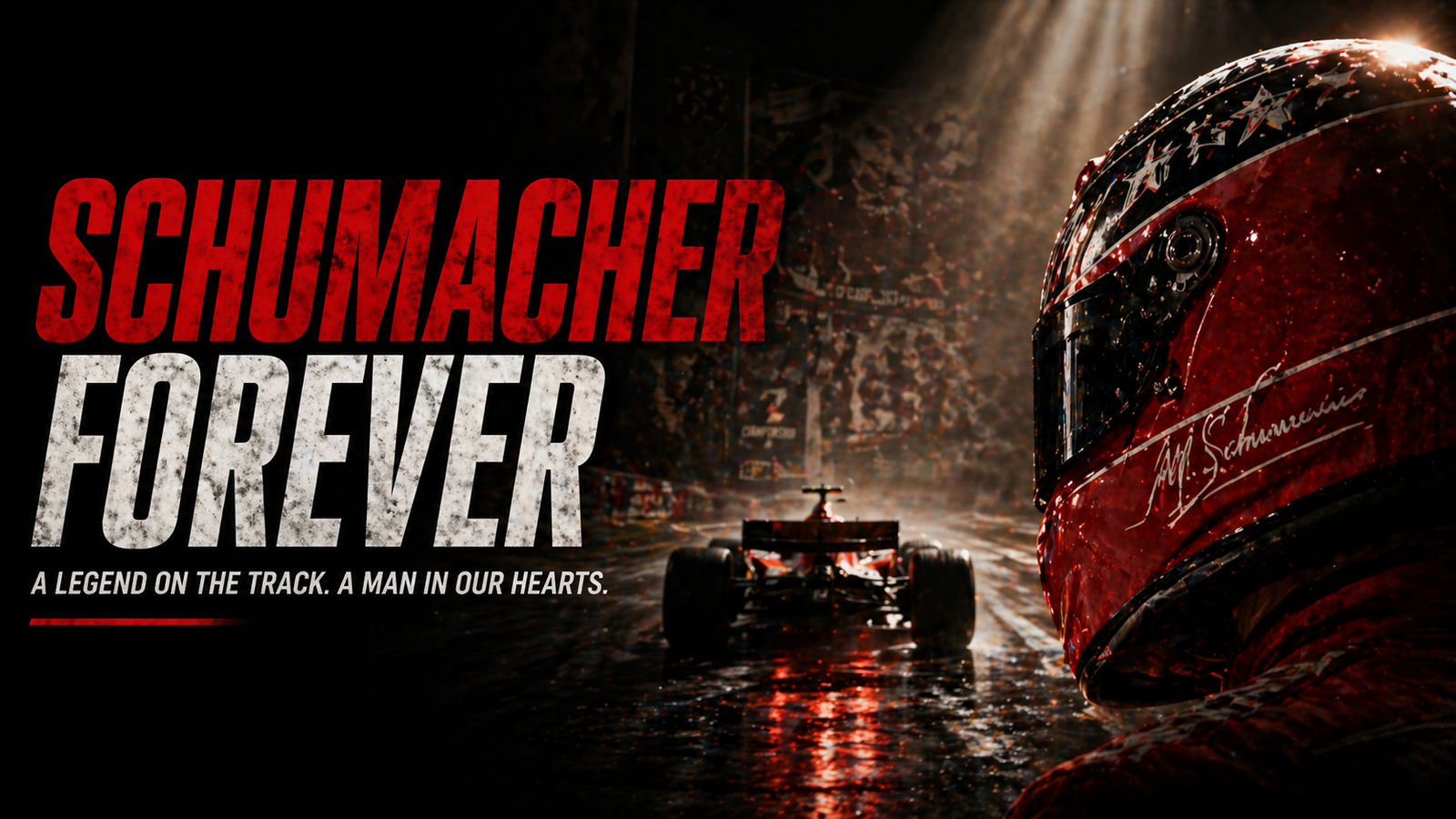

“He was not just a champion. He was Formula 1.” – Ross Brawn
A Name That Still Stops the Room
Say Michael Schumacher’s name in any Formula 1 context and the conversation changes.
Not because of what he achieved, though the achievements are staggering. Not because of the records, though the records stood for years and some still do. But because of what happened on a ski slope in the French Alps in December 2013, and the silence that has surrounded his condition in the years since.
Schumacher is 55 years old. He suffered a severe traumatic brain injury in a skiing accident at Meribel on the 29th of December 2013. He was placed in a medically induced coma. He was gradually brought out of it in 2014. What has happened since then is known, in detail, only to his family and his medical team.
The world, which loved him and in some cases hated him and in all cases could not look away from him, has been waiting for over a decade for news that has not come in the form anyone hoped for.
This is the story of who he was, what happened, and why it still matters.
The Career That Built the Legend
Michael Schumacher won seven Formula 1 world championships. He won 91 races. He took 68 pole positions. For a significant portion of his career, particularly the five consecutive championship seasons with Ferrari from 2000 to 2004, he was not just the best driver in Formula 1. He was in a category that the sport’s normal framework of comparison struggled to contain.
He arrived in Formula 1 in 1991 with a single weekend at Jordan before being taken by Benetton, the team that would give him his first two championships in 1994 and 1995. The manner of those early titles, particularly 1994 and the collision with Damon Hill that decided it, established a version of Schumacher that his supporters celebrated and his critics never forgave.
He was ruthless. He was sometimes beyond the boundary of what the sport’s rules permitted. He was also, in terms of pure driving ability, something that Formula 1 had not quite seen before.
The Ferrari years from 1996 onwards were the construction of a dynasty. It took four years to produce the first championship, but when it arrived in 2000 it was followed by four more in succession. The partnership with Ross Brawn, with technical director Rory Byrne, with a team that was rebuilt from the ground up around his specific requirements, produced the most sustained period of dominance the sport had seen since the Senna-Prost McLaren era.
By the time he retired for the first time in 2006, the records were already extraordinary. The return with Mercedes from 2010 to 2012 added a human dimension to a legend that had previously been defined almost entirely by results.
29th December 2013
Schumacher was skiing with his son Mick at the Meribel ski resort in the French Alps. He fell and struck his head on a rock. He was wearing a helmet. Without it, the medical assessment given afterwards was that he would not have survived the initial impact.
He was airlifted to hospital in Grenoble and placed in a medically induced coma to reduce pressure on his brain and allow the swelling to subside. The severity of the injury was such that his medical team described the situation in the early days as critical.
For months, the world waited for updates that came rarely and said little. In June 2014, it was announced that he had been brought out of his coma and transferred to a rehabilitation facility. In September 2014, he was moved to his family home in Switzerland to continue his recovery.
Since then, almost nothing has been confirmed publicly about his condition.
The Silence
The decision by Schumacher’s family, led by his wife Corinna, to maintain strict privacy around his condition is one that has been respected by those closest to him and challenged by those who feel the public has a right to know more about a figure of his significance.
The family’s position has been consistent. His recovery is private. His care is private. What is known will be shared when and if the family chooses to share it.
In 2021, a documentary called Schumacher was released on Netflix, produced with the family’s cooperation. It offered emotional insight into his life and career but carefully avoided any detailed discussion of his current condition. Corinna’s statement in the documentary, that he was there but different, was the closest thing to a public update that had been offered.
In 2023, a German journalist and a media company were convicted of attempted extortion after allegedly obtaining photographs of Schumacher and attempting to sell them. The case illustrated the intensity of public interest and the lengths to which some were willing to go to satisfy it, and it reinforced the family’s determination to protect his privacy absolutely.
Why the World Still Cares
The interest in Schumacher’s condition is sometimes discussed as if it requires explanation or justification. It does not.
He was the defining figure of Formula 1 for a significant portion of the sport’s most commercially successful era. He was the reason millions of people watched, argued, and cared about the championship in a way they had not before and, in some cases, have not since. His dominance produced reactions across the full spectrum, devotion and frustration in roughly equal measure, and both extremes are forms of engagement that the sport depends on.
But the care that persists is not purely about celebrity or sporting achievement. It is about a man who was recognisably human in ways that his results sometimes obscured. The relationship with his son Mick, who followed him into Formula 1 and who has spoken publicly about his father with a love and protectiveness that is difficult to watch unmoved. The relationship with Corinna, whose public statements have been models of dignity under circumstances that most people cannot begin to imagine. The sense of a family navigating something private in the full glare of a world that will not look away.
Mick Schumacher
Mick Schumacher’s Formula 1 career, with Haas and then as a Mercedes reserve driver, was conducted in the most scrutinised circumstances any driver has faced since his father was on the grid.
Every lap was measured against a standard that no young driver could reasonably be expected to meet immediately. Every result was processed through the filter of his surname. The burden of that comparison, which he handled with a composure that spoke well of both his character and the environment his family created around him, was one of the more remarkable human stories of the recent era.
He has spoken about his father in terms that make clear the loss that the family is living with daily, the absence of a father who was present and vital and then, suddenly and irreversibly, different. Those words carry more weight than any racing result.
What Remains
Michael Schumacher’s legacy in Formula 1 is secure and complete. The championships, the records, the moments that defined the sport for a generation, none of that requires his recovery to be validated.
What the world hopes for, quietly and persistently, is something simpler and more human than sporting legacy.
It hopes that the man behind the records, the father, the husband, the person who loved karting as a child and never stopped loving the feeling of a car at its limit, is somewhere in there, experiencing something that resembles the life he built and deserved.
That hope has not dimmed in over a decade, and it probably never will.
Formula 1 misses him, the world misses him – and the silence from the Alps, which has gone on longer than anyone wanted, has made the missing more present rather than less.
