
“The rules of Formula 1 are not fixed. They are a conversation between what is possible and what is desirable.” – Charlie Whiting
Why the Rules Never Stand Still
Formula 1 is often described as the pinnacle of motorsport. What is less often discussed is that the pinnacle keeps moving.
The technical regulations that govern the cars, the sporting regulations that govern how races are run and the financial regulations that govern how teams spend their money have all been in a state of near-constant evolution since the sport began. The changes are not arbitrary. Each one is the product of competing pressures from safety concerns, competitive balance, commercial interests, road car relevance, and the fundamental desire to produce the best racing possible.
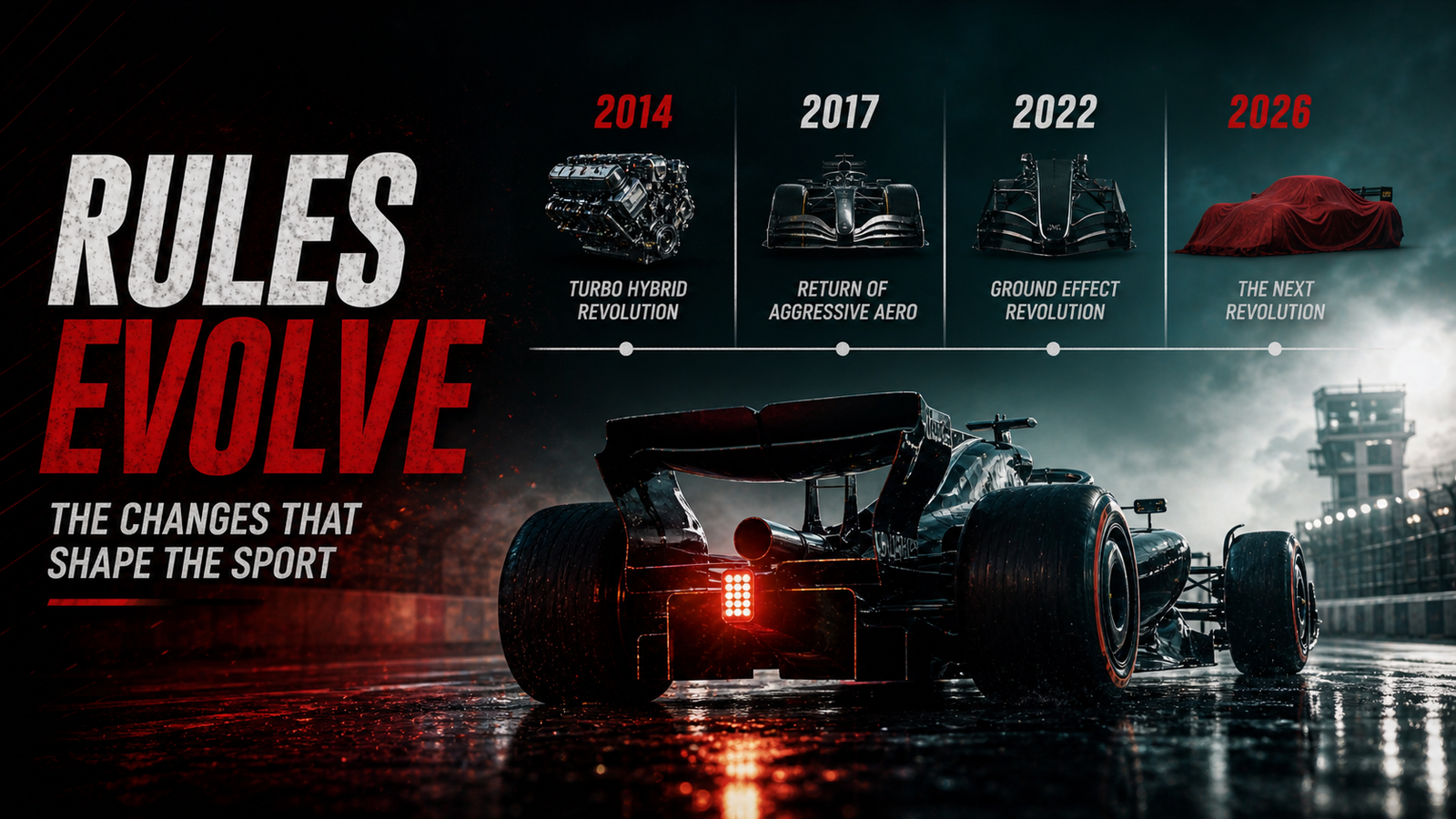
From 2014 to 2026, Formula 1 has gone through three distinct regulatory eras and a series of significant adjustments within each of them. Understanding those changes is the key to understanding why the championship looks the way it does today.
2014: The Turbo Hybrid Revolution
The 2014 regulation change was the most significant the sport had seen since the ground effect era of the late 1970s.
Out went the naturally aspirated V8 engines that had powered Formula 1 since 2006. In came a complex new power unit formula built around a 1.6 litre turbocharged V6 internal combustion engine combined with two energy recovery systems, the MGU-K which recovered kinetic energy under braking, and the MGU-H which recovered heat energy from the turbocharger.
The result was a power unit of extraordinary complexity that produced more power than the V8s it replaced while using significantly less fuel. It was, from an engineering standpoint, a remarkable achievement. From a sporting standpoint, it created a period of dominance unlike anything since the Schumacher-Ferrari years.
Mercedes had invested more heavily in the new power unit formula than any rival, and the advantage they carried into 2014 was substantial. Lewis Hamilton won the championship. Nico Rosberg finished second – the rest of the field was not particularly close. That pattern continued, with variations, for the next seven years.
The 2014 regulations also introduced significant changes to the cars’ aerodynamic regulations, with narrower front wings and a stepped nose design that produced cars that were, by general consensus, among the ugliest the sport had seen. That issue was addressed incrementally in subsequent years.
2017: The Return of Aggressive Aerodynamics
The 2017 regulation change was driven primarily by a desire to make the cars faster and more visually dramatic.
Wider cars, wider tyres, more aggressive aerodynamic packages, and a general philosophy of giving teams more freedom to generate downforce. The result was cars that were significantly faster than their predecessors, with lap records falling at almost every circuit on the calendar. They were also considerably harder to follow in traffic, as the increased aerodynamic complexity meant that cars generated more dirty air that disrupted the vehicles behind them.
This created a tension that would define the regulatory conversation for the next several years. Faster cars were more impressive – but faster cars that could not race closely were less entertaining. The 2017 regulations made Formula 1 look spectacular and in many races, produced processional racing that frustrated fans and prompted serious questions about what the sport was actually trying to achieve.
2019: The Simplified Front Wing
The 2019 aerodynamic changes represented an attempt to address the dirty air problem without a full regulatory overhaul.
Simplified front wings, designed to reduce the outwash effect that was channelling dirty air toward the cars behind, were introduced alongside other aerodynamic adjustments. The theory was sound, the practice, however, was less convincing. Teams found ways to recover the downforce they had lost through other means, and the dirty air problem persisted in a different form.
It was an instructive episode in the difficulty of making targeted regulatory changes in a sport where the engineers are always at least one step ahead of the rulemakers.
2022: The Ground Effect Revolution
The 2022 regulation change was the most ambitious overhaul since 2014, and arguably more structurally significant.
The philosophy shifted fundamentally. Instead of generating downforce primarily through complex aerodynamic surfaces above the car, the 2022 regulations mandated a return to ground effect principles, creating downforce by channelling air through carefully shaped tunnels beneath the floor of the car. The theory was that ground effect downforce is less sensitive to the turbulent air produced by the car ahead, which would allow cars to follow more closely and produce more overtaking.
The theory proved largely correct, with an important complication. The early 2022 cars suffered from porpoising, a violent oscillating motion caused by the interaction between the ground effect downforce and the car’s suspension. The phenomenon was uncomfortable for drivers, damaging for components, and took most of the season to bring under control.
Once it was controlled, the 2022 regulations delivered on much of their promise. Racing was closer, overtaking was more frequent, and the championship became genuinely competitive in a way it had not been during the Mercedes dominance years. Red Bull emerged as the dominant force, but the field behind them was closer than it had been in years.
The 2022 regulations also introduced a budget cap for the first time, limiting what teams could spend on car development. This was arguably as significant as the technical changes, representing a structural attempt to improve competitive balance that no aerodynamic regulation could achieve on its own.
2023 and 2024: Incremental Adjustments
The years following the 2022 overhaul were characterised by incremental adjustments rather than fundamental change.
Floor edge regulations were tightened to address performance advantages that certain teams had found. Porpoising rules were introduced and then debated. Tyre specifications evolved. Sprint race formats were expanded and then modified.
None of these changes altered the fundamental competitive picture significantly. Red Bull dominated 2023 to a degree that recalled the most one-sided periods of the Schumacher and Hamilton eras. The 2024 season was more competitive, with McLaren eventually winning the Constructors’ Championship, but the regulatory framework remained broadly stable.
2026: The Next Revolution
The 2026 regulations represent the most comprehensive overhaul since 2022, and in terms of the power unit changes, arguably since 2014.
A new aerodynamic philosophy reduced overall downforce compared to the 2022 generation of cars while changing how that downforce is generated. Active aerodynamics, elements that physically move to adjust the car’s aerodynamic properties at different points on the circuit, were introduced for the first time in the modern era.
The power unit changes were even more significant. The fifty-fifty split between internal combustion and electrical power represents a step change from anything previously seen in Formula 1. The MGU-H, one of the most complex and expensive components of the 2014-2025 power unit, was removed, simplifying the overall architecture while dramatically increasing the electrical power contribution.
The result is a car that looks different, behaves differently, and demands different things from everyone involved in making it work. The early season has confirmed that the transition is genuine and that the competitive order has been meaningfully disrupted.
Whether that disruption produces the sustained competitive balance the regulations intended is a question that 2026 and the seasons immediately following it will answer. The history of Formula 1 regulation changes suggests that the teams with the greatest resources and the clearest technical vision will eventually pull away. The question is always how long it takes, and how much racing the field produces whilst the answer becomes clear.
The Pattern
Step back from the individual changes and a pattern emerges.
Formula 1 regulations tend to cycle between periods of relative stability, where one or two teams dominate and the pressure for change builds, and periods of disruption, where a significant overhaul resets the competitive order and creates a window of genuine uncertainty before the dominant forces reassert themselves.
2014 created Mercedes dominance. 2022 disrupted it and created Red Bull dominance – 2026 has disrupted that in turn.
The sport has learned, across these cycles, that no regulation change creates permanent competitive balance. The teams with the best engineers, the best resources, and the clearest vision will always find their way to the front. The value of the regulation changes is not that they prevent this. It is that they delay it long enough to produce the uncertainty and excitement that keeps Formula 1 worth watching.
