
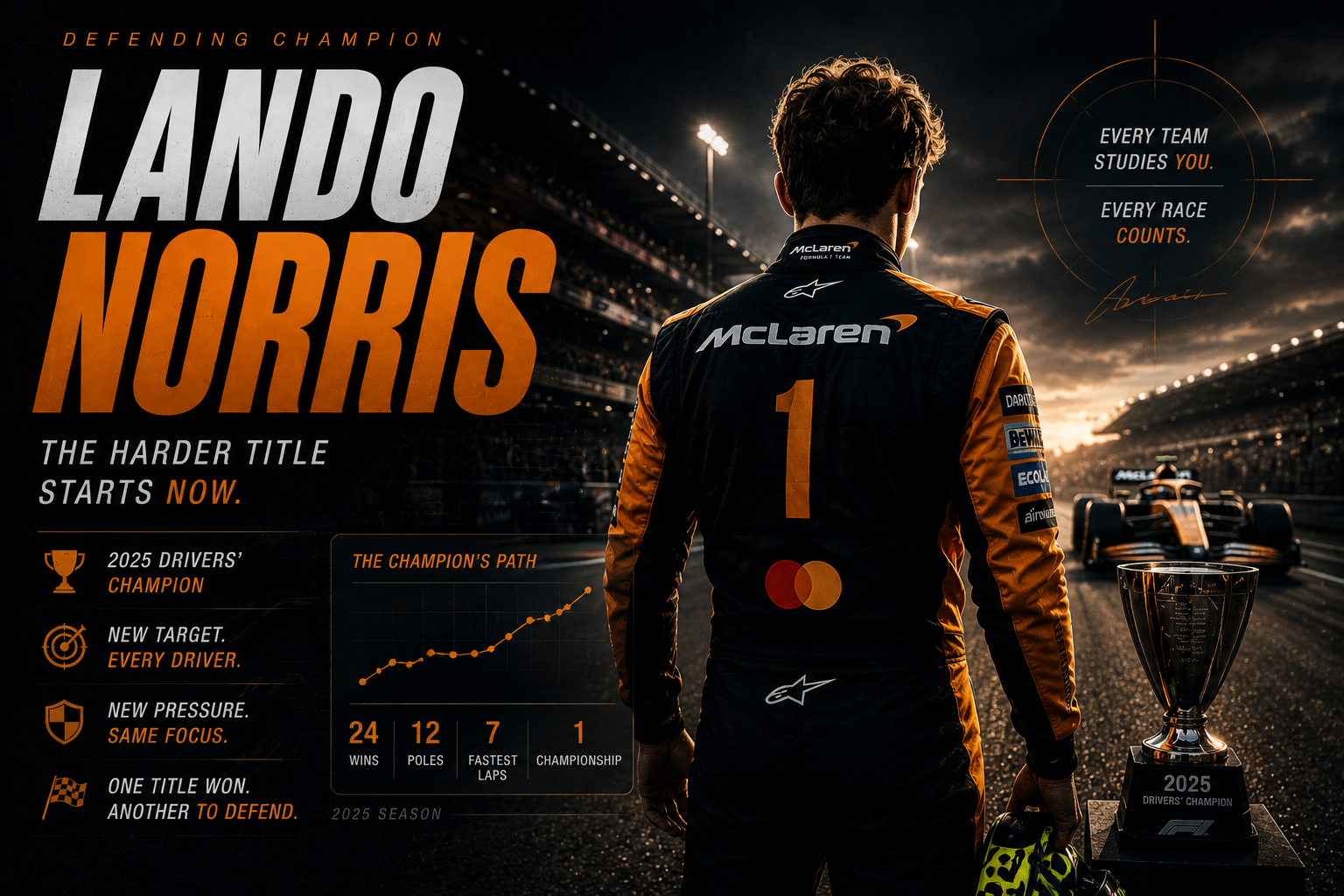

“The hardest title to win is the second one. Everyone knows how you did it the first time.” – Mika Hakkinen
From Contender to Champion to Target
There is a specific transformation that happens to a Formula 1 driver when they win their first world championship, and it is not entirely comfortable.
Everything changes. The narrative changes, the expectations change, the way rivals prepare for you changes, and the psychological framework within which you operate changes in ways that cannot be fully anticipated until you are living inside them. You are no longer the driver chasing the championship – you are the championship, and every other driver on the grid is chasing you.
Lando Norris won the 2025 Drivers’ Championship with McLaren, ending a title drought for the Woking outfit that had lasted since Hamilton‘s extraordinary final lap victory in Brazil in 2008. It was a deserved title, earned through consistency, racecraft, and a partnership with Oscar Piastri that produced the most balanced and effective driver pairing in the championship.
Now he is the defending champion in a regulation reset year, with a target on his back and a grid full of drivers who have spent the winter studying exactly how he won and exactly how to stop him doing it again.
The question is whether he can carry the weight of that.
How He Won It
The 2025 championship was not won in a single moment or through a single dominant performance. It was accumulated, race by race, through a season that demonstrated the qualities that separate champions from very good drivers.
Norris‘s ability to score points in races where the car was not at its best was the defining characteristic of his title campaign. There were weekends where Ferrari or Mercedes had the faster package and Norris found a way to limit the damage, to finish second or third when a lesser driver might have finished fifth or sixth, and those saved points became the margin of victory when the championship was decided.
His racecraft in wheel-to-wheel situations matured significantly across 2025. The Norris who occasionally looked impulsive in his earlier seasons, developed into something more measured, more capable of reading a race situation and making decisions that served the championship rather than the individual moment – that development was not accidental. It was the product of a driver who understood what winning a championship required and worked methodically toward it.
The relationship with Piastri, which many predicted would become fractious as the championship developed, remained productive throughout. Both drivers raced each other hard when the opportunity arose and accepted team decisions when the championship mathematics required it. That equilibrium, rare and valuable in a sport where intra-team tension destroys titles, was central to McLaren’s success.
The 2026 Challenge
The regulation reset that defines 2026 is both an opportunity and a threat for Norris and McLaren.
On the opportunity side, McLaren’s technical operation has demonstrated in recent seasons that it can adapt quickly to new regulations and that the culture within the team supports the kind of rapid development that a new regulatory era demands. The 2022 reset, which McLaren navigated better than most, produced a trajectory that eventually led to the 2024 Constructors’ Championship and the 2025 Drivers’ title. There is no structural reason why the 2026 reset cannot produce a similar outcome.
On the threat side, every regulation change creates a window in which the established order can be disrupted, and the teams that were behind under the previous rules have the most to gain from a reset that erases accumulated development advantage. Red Bull, Mercedes, and Ferrari have all invested heavily in the 2026 formula with specific intent to challenge McLaren’s recent dominance, and the opening races have suggested that the competitive picture is genuinely more open than it was in the final seasons of the previous regulatory era.
Norris in a car that is not the fastest faces a different championship challenge from Norris in a car that is – which of those situations he is actually in will become clearer as the European season develops.
The Verstappen Comparison
The question that follows any new champion in Formula 1 is whether their title was the product of ability or circumstance, and Norris has not been immune to it.
The honest assessment is that both played a role, as they do for every champion. The McLaren was fast in 2025, faster than its rivals in the specific conditions that mattered most across the season. Norris maximised what it offered – whether he would have won in a Ferrari or a Mercedes that year is unknowable, and the question is therefore less useful than it appears.
What is knowable is how he performs in 2026 with the pressure of defending a title, in a car whose relative competitiveness is less certain than it was in his championship year, against a grid that is specifically prepared for him. That performance will tell you more about what kind of champion Norris is than the 2025 season alone can.
Verstappen‘s four championships were won under different levels of competitive pressure, and the seasons where the Red Bull was not the fastest car revealed something about his ability that the dominant seasons could not. Norris will get his equivalent test in 2026, and the result will define how his career is ultimately assessed.
What the Season Needs From Him
To defend his title, Norris needs to demonstrate things that his first championship did not fully require.
He needs to show that he can lead a championship fight from the front, not just chase it from behind. The psychology of protecting a points lead is different from the psychology of building one, and drivers who are exceptional at the latter are not always as comfortable with the former.
He needs to show that the McLaren can be developed through the season in ways that keep it competitive as rivals bring their major upgrade packages. The defending champion’s car is the most studied car in the paddock, and the teams that finish the season stronger than they started are often the ones that were not the benchmark at the beginning.
He needs to show that the composure and consistency that defined his 2025 campaign was not a peak that coincided with a single favourable set of circumstances, but a foundation that he carries into every season regardless of the pressure surrounding it.
The defending champion has everything to lose and everything to prove. For Lando Norris, the 2026 season is the real test of what kind of champion he actually is.
