
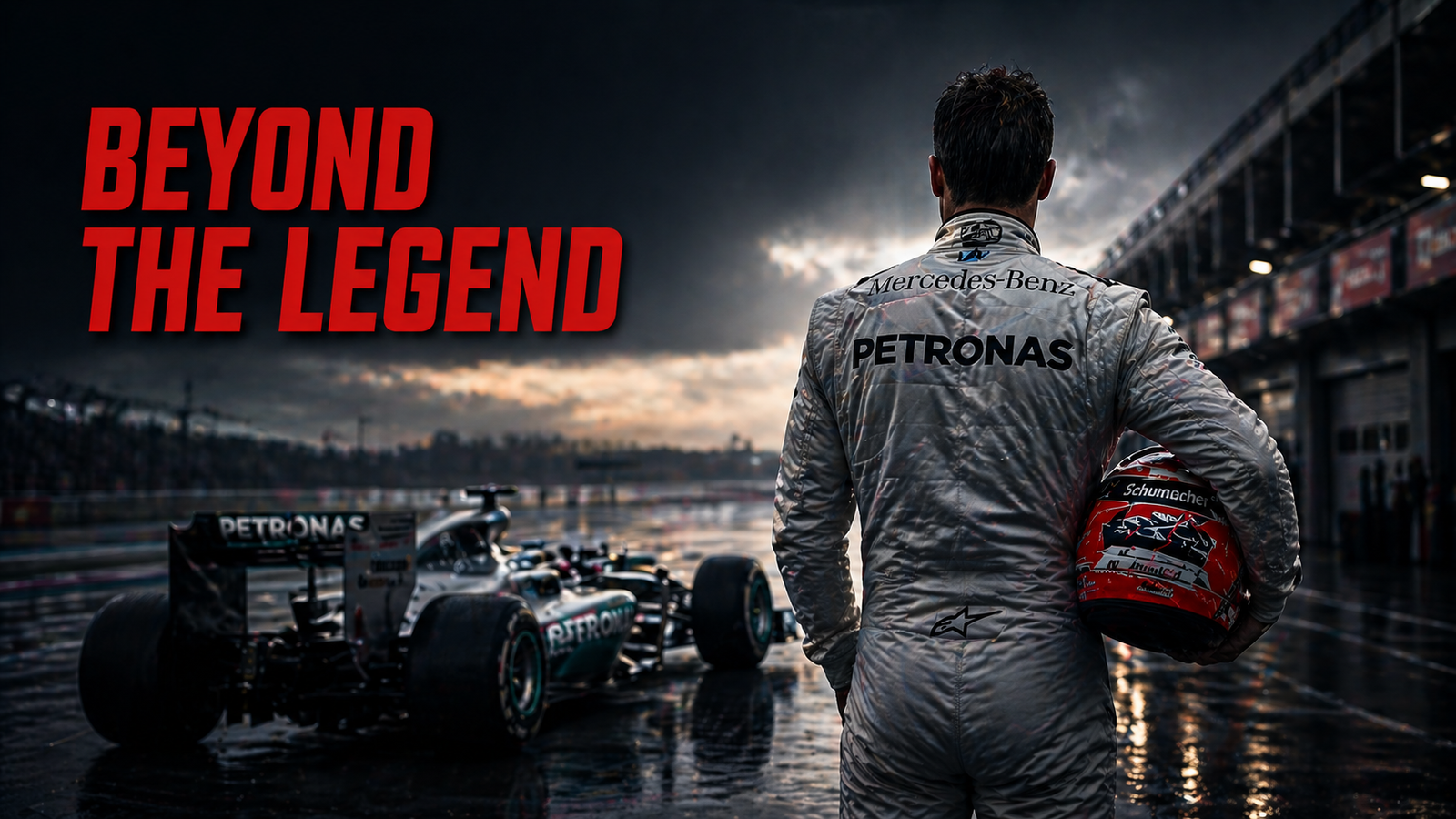

“What drives me is the passion for the sport. The day I stop feeling that, I will stop.” – Michael Schumacher
The Return Nobody Expected and Nobody Could Quite Explain
When Michael Schumacher announced he was returning to Formula 1 in 2010, the reaction was somewhere between disbelief and euphoria.
He had been retired for three years. He was 41 years old. He had seven world championships, 91 race wins, and a legacy so complete that most people assumed he had nothing left to prove and no rational reason to come back.
They were probably right on both counts. He came back anyway.
What followed over the next three seasons at Mercedes was not the fairytale second chapter that his fans had hoped for. It was something more complicated, more human, and in many ways more revealing than anything that had come before it. The dominant Schumacher, the one who made Ferrari the most powerful force in the sport for half a decade, had been relatively easy to understand. He won, repeatedly and emphatically, and winning told you everything you needed to know.
The second stint told you something different. It told you who Michael Schumacher actually was when the results were not there to define him.
Why He Came Back
The official explanation was straightforward. Felipe Massa suffered a serious head injury at the 2009 Hungarian Grand Prix, and Ferrari needed a replacement for the remainder of that season. Schumacher was the obvious call, a Ferrari man through and through, still sharp, still motivated.
He tested the car and his back, injured in a motorcycle accident earlier that year, did not cooperate. The substitute drive went to Luca Badoer and then Giancarlo Fisichella instead. Schumacher’s return was postponed.
But the process of preparing for that comeback had reignited something. The simulator work, the physical preparation, the renewed contact with the machinery he had spent his entire adult life mastering. He had remembered what it felt like, and retirement felt less final than it had before.
When Mercedes built their new factory team around the Brawn GP operation for 2010, and when Nico Rosberg was announced as one driver, the other seat had one obvious candidate. Schumacher took it.
The Gap Between Expectation and Reality
The 2010 season was a shock to everyone, including, by most accounts, Schumacher himself.
The Mercedes was not a dominant car, which was understandable for a new operation finding its feet. What was less understandable, at least to outside observers, was that Schumacher was regularly being outqualified and outraced by his teammate. Nico Rosberg was good. He was not supposed to be faster than the greatest driver of his generation.
Schumacher finished the season eighth in the championship. He did not win a race. He did not stand on a podium. There were flashes, moments where the old instincts surfaced and reminded you of what you were watching, but they were flashes rather than the sustained brilliance that had characterised everything that came before.
The explanations were various. The tyres were different. The cars were different. Modern Formula 1 demanded a different driving style that rewarded smooth, consistent inputs over the aggressive, committed approach that had defined his earlier career. He had been away for three years. He was 41.
All of these things were true. None of them fully explained the gap.
What the Second Stint Actually Revealed
Here is what those three seasons with Mercedes showed, stripped of sentiment.
Schumacher’s dominance at Ferrari was the product of an extraordinary combination of factors that would never fully reassemble. His talent, obviously. But also Newey’s absence from Ferrari’s rivals during certain periods, the specific technical regulations that suited his driving style, the team built entirely around his preferences, the partnership with Ross Brawn whose strategic mind complemented Schumacher’s racing instincts in a way that produced something greater than the sum of its parts.
At Mercedes, without Brawn in a direct operational role, without a car built around him, without the accumulated institutional knowledge of a team that had spent years learning exactly what he needed, he was a very good driver rather than an unstoppable one.
That distinction matters, because it reframes the achievement rather than diminishing it. What Schumacher built with Ferrari was not simply the product of individual genius. It was the product of a complete system, assembled over years, functioning at the highest possible level. Recreating that from scratch, at 41, in a different car with a different team in a different era, was always going to be closer to impossible than anyone admitted publicly.
The Moments That Mattered
Within the broader narrative of struggle, there were moments that reminded you why the return had felt worth attempting.
His defensive drive in Monaco in 2012, holding off Alonso in the closing laps in conditions that demanded absolute precision, was the kind of performance that only a certain type of driver produces. The younger drivers on the grid that day were watching someone operate at a level of racecraft they had not yet reached, even if the stopwatch no longer reflected the gap in experience.
His qualifying lap in Monaco in 2012 was, by many technical assessments, one of the finest single laps of that era. It was deleted for a minor infringement, which meant it counted for nothing in the official record and for everything in the paddock’s private assessment of whether he still had it.
He still had it. It just existed now within the constraints of a car and a context that could not fully express it.
The Teammate Question
Perhaps the most revealing aspect of the second stint was Rosberg.
Rosberg is a very good Formula 1 driver. He proved that conclusively by winning the 2016 world championship against Hamilton, one of the sport’s all-time greats, and doing so in a way that demonstrated tactical intelligence, consistency and mental resilience.
But Rosberg beating Schumacher over three seasons is a result that requires honest examination. It tells you something about where Schumacher was in his career. It also tells you something about how much the sport had changed, how much the specific demands of a modern Formula 1 car had shifted toward a profile that no longer perfectly matched what Schumacher did naturally.
He adapted. He worked. He was, by all accounts from within the Mercedes garage, a consummate professional who gave everything he had. It simply was not enough to beat a younger driver on the same machinery operating at the peak of his own development.
What It Means for the Legacy
The second stint does not diminish what came before it. Nothing could.
Seven world championships. 91 wins. Five consecutive titles. The construction of the most dominant team Formula 1 had seen since the McLaren of Senna and Prost. These are facts, and facts are not retroactively altered by three difficult seasons in a silver car.
What the second stint adds to the legacy is texture. It shows a man who loved the sport enough to risk his reputation returning to it when logic suggested he should stay retired. It shows a competitor who continued working, pushing and trying in circumstances that would have broken the spirit of drivers with thinner skin and smaller hearts. It shows, in the gap between what he was and what he became, exactly how rare the conditions were that produced the greatest dynasty Formula 1 has ever seen.
The hidden side of Schumacher was not weakness. It was humanity.
And in some ways, that is more interesting than the victories.
