
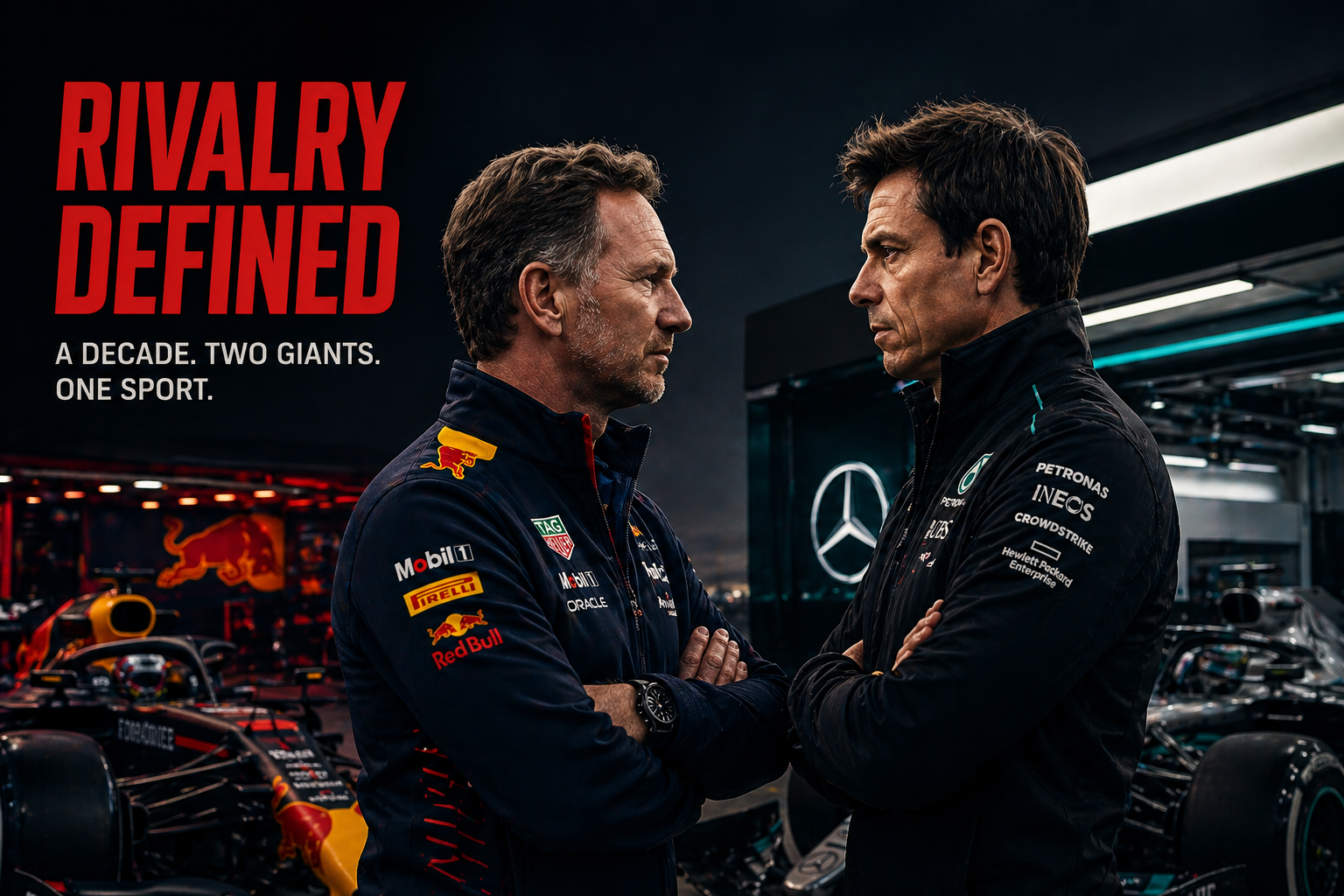

“In competition, there are no friends. Only rivals who haven’t beaten you yet.” – Niki Lauda
Two Men. One Sport. A Decade of War.
For the best part of ten years, Christian Horner and Toto Wolff defined Formula 1 as much as any driver or car.
They were the faces of the sport’s two most dominant forces, the architects of the rivalry between Red Bull and Mercedes that produced some of the most compelling racing the modern era has seen. Their relationship was professional, adversarial, occasionally personal, and never less than fascinating to observe from the outside.
It wasn’tt just a rivalry between two team principals – it was a rivalry between two philosophies, two cultures, two very different ideas about what Formula 1 should look like, and who should be running it.
Now, with Wolff still at Mercedes and Horner navigating a Red Bull operation that looks different from the one he built, the era that defined their conflict has quietly passed. What remains is the legacy of what they built, what they said, and what it revealed about the sport they both love and would both do almost anything to win.
How It Started
The rivalry didn’t begin with animosity, it began with competition.
Red Bull’s rise under Horner through the Vettel years from 2010 to 2013 established them as the team to beat, and when Mercedes found their feet in the turbo hybrid era from 2014, Wolff was the man leading the challenge. Two intelligent, ambitious, media-savvy operators running the two fastest cars on the grid – conflict was structural before it was personal.
The dynamic shifted as the stakes increased. Words exchanged in press conferences became pointed, statements about rival teams became less diplomatic. Both men understood that the psychological battle extended beyond the pitwall and into the public narrative, and both were skilled enough to use that battlefield deliberately.
Horner was sharper in public, quicker with a line, more willing to provoke. Wolff was more measured, more corporate in his presentation, but no less willing to fight when the situation called for it. The contrast in styles made the exchanges compelling in a way that pure technical rivalry never quite matches.
The 2021 Season
If there was a single season that defined the rivalry at its most intense, it was 2021.
The championship fight between Verstappen and Hamilton went to the final lap of the final race in Abu Dhabi, and the decisions made in those closing minutes, the safety car procedure, the lapped cars, the final restart, produced one of the most controversial endings in the sport’s history. Horner celebrated, whilst Wolff’s reaction was one of barely contained fury.
What followed was months of official protests, public statements, and a level of institutional tension between the two teams that went well beyond sporting disappointment. The FIA‘s handling of the Abu Dhabi finale led to significant governance changes. Race director Michael Masi was removed. The relationship between Red Bull and Mercedes at a senior level reached its lowest point.
Both men said things in the aftermath that they probably chose their words on carefully. Both felt the result was either a deserved victory or a fundamental injustice, depending entirely on which garage you were standing in.
The Shift in Power
What changed the dynamic as much as anything was not a personal resolution but a sporting one.
Red Bull’s dominance from 2022 onwards, and particularly the extraordinary 2023 season where Verstappen won 19 of 22 races, shifted the conversation. Mercedes struggled to find the performance they had built their identity around. Wolff’s public comments became less about Horner and more about rebuilding. Horner’s became less defensive and more confident.
When you are winning by that margin, the rivalry becomes asymmetric. It is harder to sustain a feud when one side is dominant and the other is searching for answers.
The personal dimension did not disappear, but it faded from the foreground. Both men remained watchful of each other, both remained competitive in the way that serious operators always are. But the period of peak intensity, the era when every press conference felt like a continuation of the previous week’s argument, had passed.
What the Rivalry Revealed
Strip away the theatre and what the Horner-Wolff dynamic showed was something important about how modern Formula 1 actually works.
The team principal has become as central to the sport’s narrative as the drivers. The decisions made in the boardroom, the contracts negotiated, the personnel hired and lost, the public positions taken in moments of controversy, all of it shapes outcomes as directly as anything that happens on track.
Horner built Red Bull from a beverage company’s racing project into the most successful team of their generation. Wolff turned Mercedes into a dynasty that dominated the sport for eight years. Both achievements are extraordinary. Both were the product of intelligence, ambition, and a competitive instinct that neither man has ever been willing to switch off.
The feud between them was a byproduct of that. Two people who wanted the same thing and were not prepared to accept less than all of it.
Where It Stands Now
Wolff remains at Mercedes, rebuilding around Russell and Antonelli, with the 2026 regulations representing the next significant opportunity to restore the team to where he believes they belong.
Horner remains at Red Bull, managing the post-Newey transition, supporting Verstappen through what may be a more competitive championship than the past three seasons suggested was possible.
They will continue to watch each other. They will continue to compete. The rivalry has not ended so much as entered a new phase, one defined less by open conflict and more by the quiet, sustained pressure of two organisations that have not forgotten what the other is capable of.
That, in its own way, is more interesting than the arguments ever were.
