
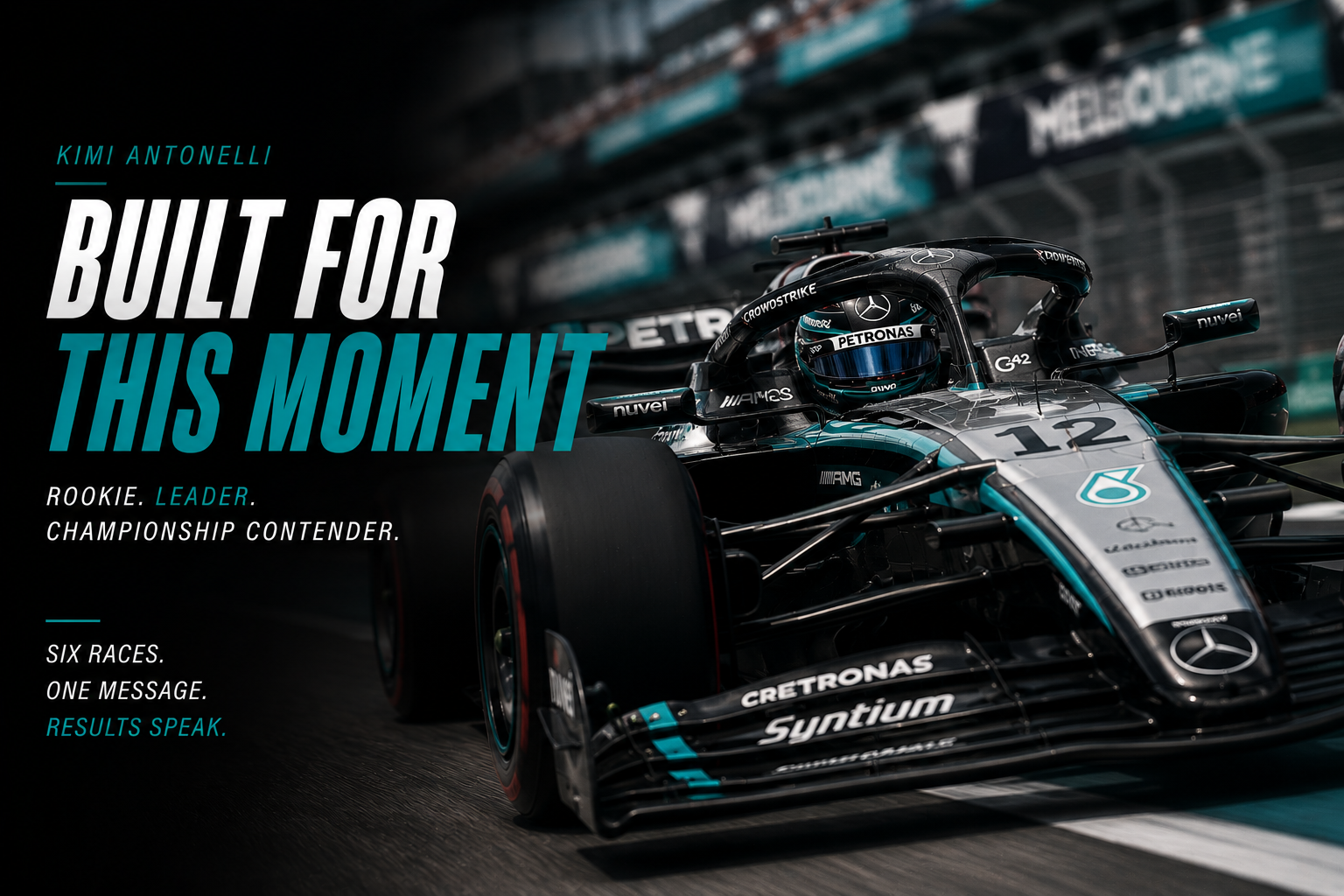

“The best way to silence the doubters is to let the results do the talking.” – Niki Lauda
The Hype Was Justified
There is a specific kind of pressure that arrives with a Formula 1 debut that no junior category can fully prepare a driver for, and there is an even more specific kind that arrives when the seat you are filling belonged to Lewis Hamilton.
Kimi Antonelli walked into both of those situations simultaneously at the start of the 2026 season, and the question that the paddock, the media, and the fanbase were asking before the lights went out in Melbourne was not whether he was talented enough, because the evidence from his junior career suggested clearly that he was, but whether he was ready for the weight of all of it at eighteen years old.
Six races in, the answer is as unambiguous as answers get this early in a Formula 1 career. Antonelli is not just surviving the weight of the seat – he’s making it look like it was made for him.
Where He Came From
Antonelli’s route to Formula 1 followed the path that Mercedes had constructed around him with a deliberateness that reflected how seriously the team took his development.
Formula 4, Formula 3, Formula 2, each step taken at a pace that was fast without being reckless, each championship producing results that moved the conversation forward without generating the kind of premature hype that damages young drivers before they are ready for its consequences. His 2024 Formula 2 season, in particular, demonstrated a composure and a consistency that made the step to Formula 1 feel inevitable rather than surprising.
Mercedes were careful with him in a way that teams are not always careful with their most promising junior drivers. They understood that the trajectory mattered as much as the results, that a driver who arrives in Formula 1 with the right foundation develops differently from one who arrives having been rushed through a process that left gaps in their preparation.
The foundation they built showed from the first race.
Australia: The Beginning
Antonelli’s debut weekend in Melbourne produced a second place finish behind his teammate George Russell, a result that would have been celebrated as exceptional for most rookies and was treated, in Antonelli’s case, as confirmation of what Mercedes had already believed.
The performance that accompanied the result was arguably more significant than the result itself. His qualifying pace, which put him alongside Russell on the front row, demonstrated immediately that the step from Formula 2 to Formula 1 had not exposed any meaningful gap in his raw speed. His race management, the tyre handling, the radio communication with his engineers, the decisions made in real time under conditions that no simulator session can fully replicate, all of it was cleaner and more controlled than a driver in his first grand prix has any right to be.
He did not look like a rookie – he looked like someone who had been doing this for years, which is simultaneously a compliment and a reminder of how exceptional the preparation had to be to produce that impression.
China: The Win
If Australia suggested that Antonelli belonged at this level, China confirmed it.
His victory in Shanghai was not a fortunate one, not the product of a safety car at the right moment or a rival’s retirement gifting him a result he had not earned. It was a controlled, measured, dominant performance from pole position that left the rest of the field chasing a gap that only closed when he chose to manage it rather than extend it.
The manner of it was what the paddock talked about. Drivers who win their first grand prix usually show some sign of the occasion getting to them, a moment of overcaution, a radio message that reveals the nerves beneath the performance. Antonelli showed none of that. He drove the race the way an experienced champion drives a race in a dominant car, which is to say efficiently, without drama, and with a clarity of purpose that made the whole thing look straightforward.
It was not straightforward, it was extraordinary.
What Six Races Has Shown
Across the first six rounds of the 2026 season, Antonelli has demonstrated qualities that go beyond the raw pace that was always assumed to be there.
His consistency across varied circuits has been the most telling indicator. Australia and China are very different challenges, and the ability to adapt quickly to different circuit characteristics is one of the qualities that separates the drivers who win championships from the drivers who win individual races. His performance in the subsequent rounds has continued to show that adaptability, with qualifying and race pace that has placed him in the top three consistently regardless of the circuit’s specific demands.
His relationship with his engineers has developed with a speed that surprises people who expected a longer adjustment period. The feedback he provides is specific, technical, and actionable in a way that takes most drivers a full season to develop at the Formula 1 level. The Mercedes engineers have spoken about it in terms that suggest they were pleasantly surprised by how quickly the communication loop became productive.
And then there is the championship – Antonelli leads it. At eighteen years old, in his first Formula 1 season, in the most scrutinised seat on the grid, he leads the championship. That is not a statement that requires embellishment.
The Questions That Remain
Acknowledging what Antonelli has achieved in six races does not require pretending that six races settles everything.
The championship is long. Eighteen more rounds remain, and the pressure that builds as a championship becomes real, as the points gap becomes something that rivals are specifically targeting, is different from the pressure of a debut season where the expectations, however high, are ultimately framed around development rather than title contention.
How Antonelli handles that shift, the moment when the championship is no longer a pleasant surprise but an active target with everything that brings, will tell us something that the first six races cannot yet reveal.
Russell alongside him is a complicating factor that will grow rather than diminish as the season progresses. A teammate who is a race winner and a proven operator at the highest level is not going to accept a supporting role gracefully, and the intra-team dynamic at Mercedes will become more complex as the championship narrative develops.
There is also the question of whether the teams that have trailed in the opening rounds will close the gap through development as the season moves into its European phase. The power unit advantage that Mercedes appear to carry is real, but power unit advantages are targets, and targets get worked on.
The Verdict at Six Races
Hype, in Formula 1, is the most dangerous gift a young driver can receive. It arrives before the results, creates expectations that the results then have to meet, and leaves no room for the normal process of development and error that every driver needs to go through.
Antonelli received more hype than almost any rookie in recent memory. He has not just met the expectations it created – he has exceeded them in a way that makes the hype look, in retrospect, like an underestimate.
Six races in, the verdict is not that the hype was justified. It is that the hype did not go far enough.
