
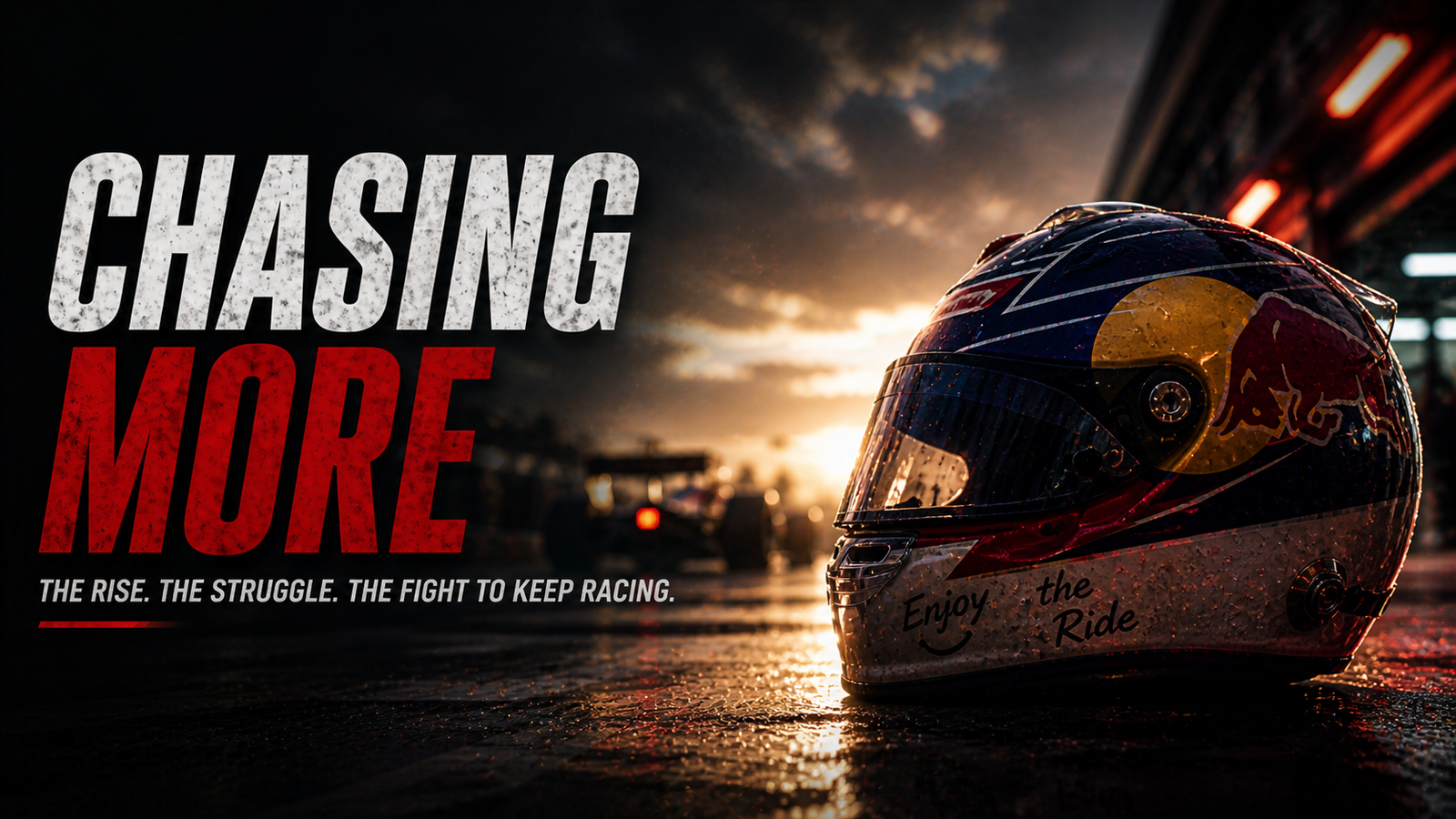

“I just want to keep racing. That’s all I’ve ever wanted.” – Daniel Ricciardo
The Smile That Hid the Struggle
There are drivers in Formula 1 whose personality becomes as much a part of their story as their results. Daniel Ricciardo is the most compelling recent example of that phenomenon and also one of its most instructive casualties.
He arrived in the sport with a natural charisma that the paddock had rarely seen. The smile, the shoey, the genuine warmth in a sport that can feel clinical and corporate, made him one of Formula 1’s most loved figures at a time when the sport was growing its audience and needed personalities that transcended the results sheet.
The results were extraordinary too, for a significant period. Eight race wins, including some of the most memorable performances of the hybrid era. A driving style built on late braking and commitment that made him genuinely exciting to watch. A stint at Red Bull alongside Verstappen that produced one of the era’s most fascinating intra-team dynamics.
And then something went wrong. Not catastrophically, not obviously, not in a way that produced a clean narrative. It just went wrong in the complicated, gradual way that things go wrong in Formula 1 for drivers who are very good but operating in an environment that demands something closer to perfect.
The Renault Years
Ricciardo’s decision to leave Red Bull for Renault in 2019 was one of the most debated driver moves of recent years.
He was leaving a team that had won four consecutive championships with Vettel and was rebuilding around Verstappen, for a manufacturer project that promised significant resources and a genuine path to the front. The logic was defensible – Verstappen had made it clear that Red Bull was being built around him and Ricciardo, who had matched and occasionally beaten him, was not going to be the priority.
The Renault years were not what either party had hoped for. The car was not competitive enough to showcase what Ricciardo could do and the results, whilst occasionally impressive in the context of the machinery, were not the statement performances that a move of that significance required.
He left after two seasons, his market value diminished and the narrative around his career was left subtly rewritten.
McLaren and the Difficult Years
The McLaren move in 2021 was supposed to be the reset. A front-running team, a clear developmental trajectory and a partnership with Lando Norris that promised to be one of the grid’s most entertaining pairings.
It did not work.
The specific reasons why Ricciardo struggled at McLaren remain partly technical and partly something harder to define. He took time to adapt to the car, longer than expected and longer than the team could comfortably absorb. When he did find his footing, the results were there, his 2021 Italian Grand Prix win at Monza was one of that season’s defining moments, a reminder of exactly what he was capable of when everything aligned.
But alignment was the exception rather than the rule. Norris adapted to the McLaren quickly and comfortably – Ricciardo did not. The gap between them in qualifying and race pace was real and consistent and by the end of their partnership it was telling a story that neither party wanted told.
McLaren released him before his contract expired. It was a decision that spoke to how the team assessed the situation and it left Ricciardo in a position he had not previously experienced, without a seat and with questions about whether he could still perform at the level his career had previously suggested.
The Red Bull Return and What Followed
Red Bull brought Ricciardo back into their ecosystem as a reserve driver and then gave him a race seat at their junior team, now operating as Visa Cash App RB, for 2023.
The return was watched with genuine interest and genuine sympathy in roughly equal measure. Here was a driver who had won races at the highest level, who had the ability and the personality and the history, being given what amounted to a second chance at a junior team whilst the sport he had lit up continued without him at the front.
The results were mixed. There were flashes of the old Ricciardo, performances that reminded you of the driver who had gone wheel to wheel with Verstappen and won. There were also races and weekends where the gap between where he was and where he wanted to be was visible and painful.
An injury in 2023 complicated matters further, costing him race time and momentum at a point when he needed both. Liam Lawson deputised impressively during his absence, which added a competitive pressure to his return that he did not need.
By the end of 2024, the seat was gone. The comeback that had felt possible, that had felt like it might produce the redemption arc that his talent deserved, had not quite materialised.
What It Says About Formula 1
Ricciardo’s story is not unique in its broad outlines. Formula 1 has always been a sport where the margin between success and obscurity is narrow and where careers that look secure can unravel with surprising speed.
What makes his case particularly instructive is the combination of factors involved.
The sport’s physical and psychological demands evolved during his career in ways that suited some drivers and disadvantaged others. The McLaren car required a specific technical adaptation that he could not make quickly enough. The mental weight of a career that had promised more than it delivered accumulated in ways that are difficult to quantify but impossible to ignore.
There is also the Verstappen factor. Ricciardo’s career trajectory changed the moment it became clear that Red Bull were building their operation around a generational talent. The decision to leave was rational. The consequences of that decision played out in ways that could not fully have been anticipated.
He remains one of Formula 1’s most genuinely loved figures. The affection the paddock and the fanbase have for him is real and earned. Whether that affection is eventually accompanied by a final chapter that does justice to his ability, whether there is a seat somewhere that gives him what the McLaren years did not, remains one of the sport’s more open and more human questions.
Formula 1 does not always give its most compelling personalities the endings they deserve. Ricciardo’s story, wherever it ends, will be remembered not just for the wins but for everything that happened after them.
And that, in its own complicated way, tells you as much about the sport as the victories ever did.
The Broader Pattern: Careers That Slipped Away
Ricciardo is not the first driver to find that momentum, once lost, is almost impossible to recover in this sport. The grid is unforgiving in a very specific way. It doesn’t wait. Younger drivers are always coming, always hungry, always cheaper to retain and easier to build a long-term plan around.
The comparison that comes to mind most naturally is Damon Hill. A world champion who found himself without a top seat almost immediately after his title, navigating a career that the sport’s politics had complicated beyond what his results alone should have allowed. Different circumstances, different era. But the same basic truth: F1 can discard even its most capable people with very little ceremony.
What separates Ricciardo’s case is the visibility of it. His personality made him a public figure in a way that few drivers achieve. Every difficult race weekend was watched by millions of fans who genuinely wanted him to succeed. That level of scrutiny adds a layer to the pressure that is hard to overstate. You’re not just trying to find form. You’re doing it in front of everyone who loves you.
The seat market doesn’t help either. With so many drivers out of contract at any given point in the modern era, the competition for available seats is brutal. A driver returning from a difficult spell has to beat not just their own doubts but a queue of younger alternatives who carry none of the baggage.
There’s a parallel worth drawing with how new teams enter the picture too. When you look at how a project like Cadillac has approached its driver choices, the emphasis is always on youth and long-term potential. Experience counts for something. But not as much as it used to.
Key Takeaways
- Ricciardo’s Red Bull exit in 2019 was rational on paper but triggered a chain of events that his career never fully recovered from.
- The McLaren stint exposed a real technical adaptation problem. The Monza win showed the ability was still there. The consistency wasn’t.
- Liam Lawson’s strong performances during Ricciardo’s injury absence in 2023 accelerated the timeline on a decision Red Bull were probably already moving towards.
- F1’s seat market is structured in a way that makes comebacks genuinely difficult. Sentiment counts for very little when a team is weighing up its options.
- His story reflects something true about the sport: personality and popularity earn you goodwill but they don’t earn you laps. The car and the data decide everything else.
Frequently Asked Questions
Why did Daniel Ricciardo leave Red Bull in 2019?
Ricciardo left because Red Bull were clearly building their long-term future around Max Verstappen. Despite matching and occasionally beating Verstappen during their time as teammates, Ricciardo could see that he wouldn’t be the team’s priority driver. He chose Renault believing a manufacturer project offered a genuine path to competing at the front on his own terms.
What went wrong at McLaren?
The McLaren required a very specific driving style that Ricciardo struggled to adapt to quickly. Lando Norris took to the car naturally and the performance gap between them was consistent across both seasons. Ricciardo’s Monza win in 2021 proved the ability was still there but it wasn’t enough to change the trajectory. McLaren terminated his contract before it ran out.
Did Ricciardo ever look like his old self during the RB comeback?
Yes, in flashes. There were races during the 2023 season where the late-braking commitment and racecraft that defined his Red Bull peak were clearly visible. But consistency was the problem. The injury setback cost him momentum at a critical point and Lawson’s performances during that period made the situation harder to recover from.
Is there any realistic chance of Ricciardo returning to the F1 grid?
It’s not impossible but it’s genuinely difficult. The grid is competitive and teams building for the future tend to favour younger drivers. Any return would likely depend on a specific set of circumstances: a team needing experience quickly, an injury to another driver or a project where his profile and marketability are seen as assets worth the risk. Nothing is ruled out in F1.
How does Ricciardo’s career compare to other drivers who lost momentum mid-career?
It sits in a category of its own because of the combination of genuine talent, real race wins and a very public decline. Drivers like Webber and Rosberg retired on their own terms. Ricciardo’s situation is closer to those who found the sport moving past them before they were ready to accept it. The talent was never really in question. The circumstances were.
