

“Formula 1 has always evolved. The question is whether evolution always means progress.” – Ross Brawn
A New Word for a New Problem
Formula 1 has always had its share of technical terminology that takes time to filter through to the wider audience:
- DRS
- Undercut
- Porpoising
Each era brings its own vocabulary, and 2026 has wasted no time in adding a new one to the list..
Superclipping.
If you watched the opening races of the 2026 season and noticed something odd happening on the straights, something that looked less like conventional racing and more like a video game power-up being activated, you were not imagining it. Superclipping is real, it is controversial, and it has already produced one of the season’s most talked-about incidents before the championship has barely begun.
What Superclipping Actually Is
To understand superclipping, you first need to understand how the 2026 power units work.
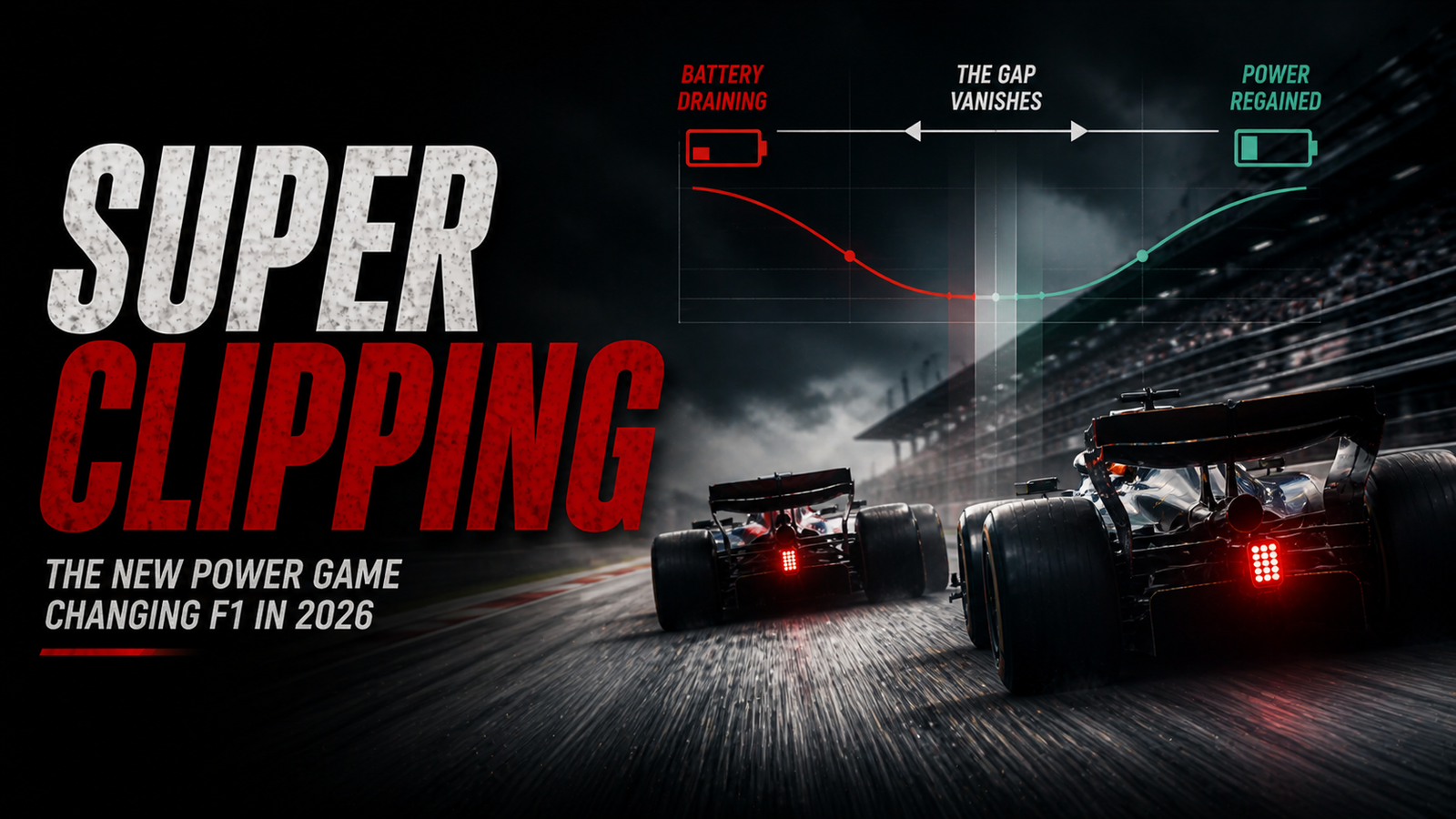
The new regulations mandate a fifty-fifty split between internal combustion power and electrical power. That electrical power is stored in a battery and deployed by the driver, but the system has limits. When a driver is running at full power on a long straight, the battery can drain – when it drains completely, the car suddenly loses a significant portion of its power output mid-straight.
The car ahead, if their battery is more depleted, will experience this power loss first. The car behind, if their battery still has charge, will close the gap at a rate that looks, frankly, absurd. The car ahead then recovers its battery, power returns, and suddenly the gap opens up again.
The result is a strange, pulsing dynamic on straights where gaps open and close in ways that have nothing to do with the drivers’ inputs and everything to do with battery state. It looks chaotic, it is chaotic – and it creates situations that are genuinely dangerous.
The Colapinto and Bearman Incident
The clearest illustration of superclipping’s real-world consequences arrived when Franco Colapinto and Oliver Bearman made contact in circumstances that would not have existed under the previous regulations.
Colapinto, running behind Bearman on a straight, found himself closing at a rate that his braking point calculations simply had not accounted for. The gap that had existed a moment earlier disappeared faster than the situation allowed him to react, and the contact that followed was the kind of incident that is easy to criticise from the outside and considerably harder to avoid from inside a cockpit travelling at high speed with a suddenly altered closing rate.
Colapinto faced criticism for the incident, with some in the paddock suggesting he should have anticipated the situation better. Others argued that superclipping creates scenarios where driver error and system behaviour become genuinely difficult to separate, and that placing full blame on the driver misses the point about what the regulations have introduced.
Both arguments have merit – neither fully resolves the underlying problem.
Is It Real Racing?
This is the question that has divided the paddock, the media, and the fanbase since superclipping became part of the 2026 conversation.
The case against it is straightforward: racing should be determined by driver skill, car performance, and team strategy. When a significant variable in the on-track battle is battery charge state rather than any of those three things, the sport is introducing an element that the drivers cannot fully control and the fans cannot easily follow. A car being passed on a straight because its battery ran out is not a racing moment; it’s a systems management moment wearing racing’s clothing.
The case for it, or at least the case for accepting it as part of the 2026 reality, is that Formula 1 has always been a combination of driver skill and technology. Managing the battery, understanding when to deploy and when to conserve, is itself a skill. The drivers who master that management will have an advantage over those who don’t. In that sense, superclipping is not a removal of skill from the equation but the introduction of a new dimension of it.
Verstappen has been among the most vocal critics, suggesting that the phenomenon makes the racing harder to follow and harder to respect as a pure contest. Others have been more measured, treating it as a teething problem that will be managed as teams and drivers develop a better understanding of their systems across the season.
What Happens Next
The FIA is aware of the issue, whether regulatory intervention follows mid-season or whether the sport waits for a more structured response in the next rules cycle remains to be seen.
In the meantime, teams are already working on strategies to manage battery deployment in ways that minimise the superclipping effect on their own cars whilst exploiting it when the opportunity arises against rivals. That is Formula 1 doing what it always does, finding the grey area in any regulation and working it until someone tells them to stop.
For fans, the honest advice is to learn what superclipping looks like so that when you see a gap close unnaturally fast on a straight, you understand what you are watching. It is not always a mistake, nor is it always a pass. Sometimes, it’s just the battery talking.
Whether this is the future of Formula 1, or a problem to be solved, is a conversation the sport is only just beginning to have.
