
“New regulations, new opportunities. That’s what makes Formula 1 so fascinating.” – Ross Brawn
The Grid Has Changed. Everything Else Is Uncertain.
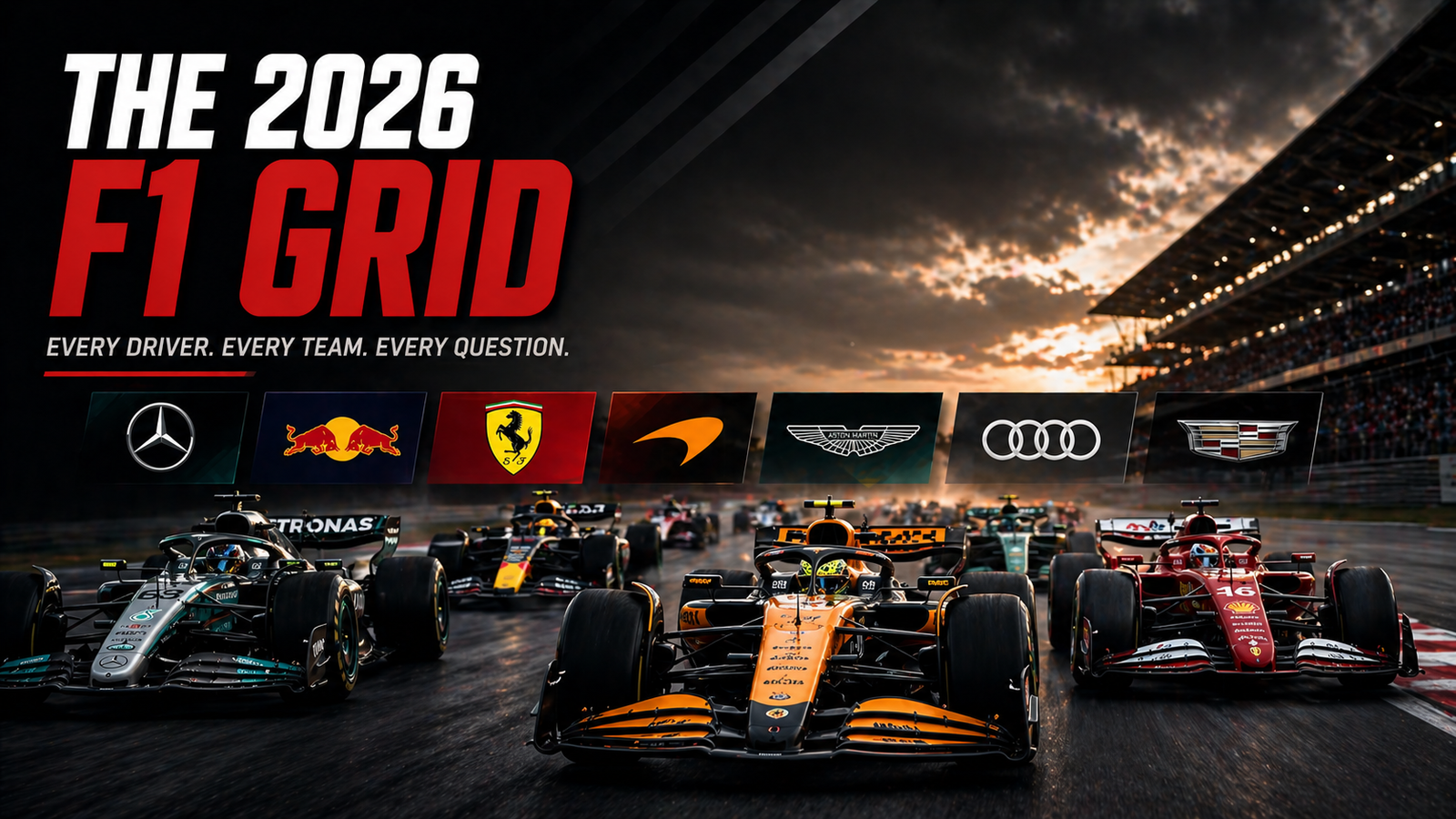
The 2026 Formula 1 season arrives with more genuine uncertainty attached to it than any campaign in recent memory. A wholesale regulation reset covering both the aerodynamic and power unit regulations means that the established order, the one that saw Red Bull dominate, then McLaren emerge, then the field compress into something genuinely unpredictable, has been wiped and restarted.
Nobody knows who has the fastest car. Nobody knows which engine philosophy works best in the real world. Nobody knows which driver pairings will thrive and which will fracture under pressure.
What we do know is who is on the grid, what they are trying to do, and what questions each of them needs 2026 to answer.
The Championship Contenders
McLaren arrive as defending Constructors’ Champions and as close to a favourite as anyone can reasonably be called in a season this open. Lando Norris and Oscar Piastri is the most balanced top-team pairing on the grid, two drivers capable of winning on any given weekend without a clear hierarchy between them. The regulation reset is the risk. Teams that are strong under one formula do not automatically carry that strength into the next. McLaren’s infrastructure investment and the stability of their current leadership group gives them the best platform to adapt, but adaptation is never guaranteed.
Ferrari come in with Lewis Hamilton alongside Charles Leclerc, which is either the most exciting driver pairing in the sport’s history or the most combustible, depending on your perspective. Hamilton’s move from Mercedes was the defining transfer story of last year, and 2026 is the first real test of whether the marriage between the sport’s most decorated driver and its most romanticised team produces something extraordinary or something complicated. Leclerc remains one of the fastest drivers on the grid on his day. The question is whether Ferrari can build a car that gives both of them what they need.
Red Bull enter 2026 without Adrian Newey for the first time in two decades, which is either entirely manageable or quietly catastrophic, and nobody outside Milton Keynes knows which. Max Verstappen remains the most complete racing driver on the planet, and his ability to extract performance from machinery that does not fully deserve it has been the defining story of the past four seasons. Whether the RB22 is genuinely competitive or whether Verstappen is once again carrying it will become apparent quickly.
Mercedes are rebuilding around George Russell, who has spent the past three years proving he belongs at the front and is now finally the clear lead driver without the complication of a seven-time world champion alongside him. The 2026 power unit regulations represent a significant opportunity for a manufacturer that has been working toward this regulatory window for years. Whether the W17 reflects that preparation or exposes how far they still have to go is the season’s most interesting early question.
The Ambitious Middle
Aston Martin have spent more money on their infrastructure rebuild than most teams will see in a decade, and 2026 is the season that investment was always building toward. Adrian Newey has taken over as Team Principal and Managing Technical Partner, his influence on the car’s development direction beginning to materialise. Fernando Alonso, at 44, is operating on a timeline only he can define, but his belief that this project can produce a championship-capable car is not irrational. Lance Stroll continues to develop in ways his early critics would not have predicted.
Audi make their full factory debut, bringing the resources of a major automotive manufacturer and the patience of a company that measures success in decades rather than seasons. Nico Hulkenberg provides the experienced baseline the team needs while Gabriel Bortoleto, the 2024 Formula 2 champion, begins what Audi fully intend to be a long and successful Formula 1 career. Their 2026 objectives are realistic. Their long-term ambitions are not.
The Newcomers
Cadillac represent the grid’s most significant storyline that has nothing to do with lap times. The American manufacturer’s entry is Formula 1’s acknowledgement that the sport’s explosion in popularity in the United States has reached a point where a fully American team is not just viable but commercially necessary. What they produce on track in year one is almost secondary to what their presence means for the sport’s direction. Almost.
The Drivers to Watch
Andrea Kimi Antonelli steps into the most scrutinised seat of the season at Mercedes, replacing Lewis Hamilton with no experience and every expectation. The 18-year-old has been managed through Mercedes’ junior programme with exceptional care, but a junior programme is not a Formula 1 season, and the gap between preparation and reality has humbled more talented drivers than most people remember.
Isack Hadjar joins Red Bull’s secondary team, having impressed sufficiently in the junior categories to earn a seat with one of the sport’s most demanding organisations. The level of scrutiny applied to Red Bull junior drivers is unlike anything else in the paddock. He will need to handle it.
Oliver Bearman gets his first full season after a series of substitute appearances that demonstrated he belongs at this level. His ability to step into unfamiliar cars under pressure and perform immediately is a quality that cannot be manufactured.
The Questions 2026 Needs to Answer
Can Hamilton win a championship with Ferrari, or does the move ultimately belong in the category of romantic gestures that fall just short?
Is Verstappen’s dominance tied to Newey’s genius, or is it simply Verstappen?
Does McLaren’s momentum survive a regulation reset, or does 2024 represent their peak for this era?
Can Antonelli handle the weight of replacing the greatest driver of his generation before he has turned 19?
Does Aston Martin’s infrastructure investment finally translate into the front-running performance Lawrence Stroll has been funding for years?
These are not questions with obvious answers. That is precisely what makes 2026 worth watching.
The Only Honest Prediction
The teams that adapt fastest to the new regulations will lead by the summer. The teams that get their power unit integration right from the opening race will have an advantage that will take rivals months to close. And somewhere in the middle of all of that uncertainty, a championship narrative will emerge that nobody predicted in March.
It always does.
