
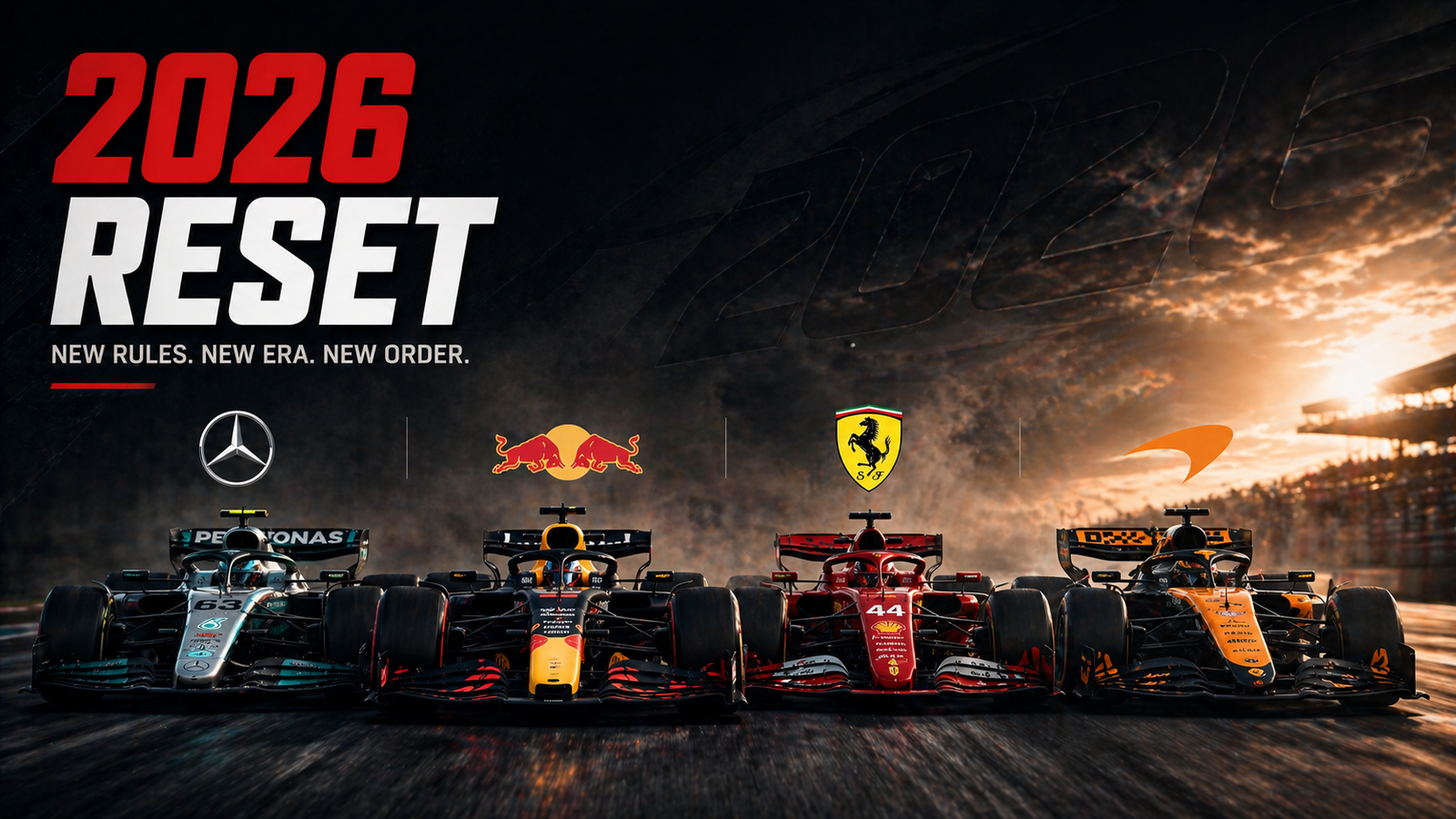

“In racing, they say that your car goes where your eyes go.” – Garth Stein
The Slate Has Been Wiped. Now What?
Every few years, Formula 1 presses reset. The regulations change, the pecking order shuffles, and teams that spent years mastering one set of rules find themselves starting again alongside rivals who were nowhere near them twelve months earlier.
2026 is the biggest reset the sport has seen in a generation.
New aerodynamic philosophy. New power unit regulations. New tyre concepts. New everything. The teams that dominated 2024 and 2025 have no guarantee that dominance carries forward, and the teams that struggled have every reason to believe the gap can close.
Four teams arrive believing they have what it takes to lead the new era. Only one of them is right.
Mercedes: The Power Unit Specialists
If any team should benefit from a power unit regulation reset, it is Mercedes. The Brackley and Brixworth operation spent the turbo hybrid era from 2014 to 2021 producing the most dominant engine in the sport’s history, and they have been working toward the 2026 regulations for years with a focus and resource commitment that their rivals have noted with quiet concern.
George Russell steps into 2026 as the clear lead driver for the first time, without the complication of a multiple world champion alongside him. That clarity of purpose matters. Russell has spent three years proving he belongs at the front. Now he gets the environment to actually compete there.
The question is whether the power unit advantage they are banking on is real or assumed. Mercedes have been here before, building toward a regulation change with confidence, only to find the gap smaller than expected. The W17 will answer that quickly.
Andrea Kimi Antonelli alongside him is either a masterstroke of long-term planning or a significant gamble, depending entirely on how the 18-year-old handles the weight of replacing Lewis Hamilton in his first full season.
Red Bull: The Verstappen Variable
Red Bull’s 2026 equation is straightforward to state and impossible to solve from the outside.
How much of what Max Verstappen achieved in four championship seasons was Verstappen, and how much was Adrian Newey?
Newey is now at Aston Martin. Verstappen is still at Red Bull. The RB22 is the first car developed without Newey’s direct influence in two decades, and nobody outside Milton Keynes has any real idea whether that matters enormously or barely at all.
What is not in question is Verstappen himself. He remains the most complete racing driver on the planet, a man who has repeatedly extracted results from cars that did not deserve them. If the RB22 is genuinely competitive, he will win races. If it is not, he will still make it look better than it is.
Liam Lawson alongside him gets his first full season in a top team and will be measured against the most demanding benchmark in the sport. That is not an enviable position. It is, however, an opportunity.
Ferrari: The Dream and the Complication
Lewis Hamilton at Ferrari is the most romantic storyline the sport has produced in years, and romanticism in Formula 1 has a complicated relationship with results.
Hamilton left Mercedes after twelve years and six of his seven championships to chase the one thing that has eluded him, a title with the sport’s most iconic team. The move was not irrational. Ferrari have the resources, the history, and the motivation. What they have historically struggled with is the execution, the strategic clarity, and the ability to give two fast drivers what they both need without the garage becoming a source of tension rather than performance.
Charles Leclerc remains one of the fastest drivers on the grid and is not going to make Hamilton’s transition easy. The dynamic between them will be one of the defining subplots of the season, productive or destructive, and possibly both at different points.
If Ferrari get it right, 2026 could be the year that defines both of their legacies. If they don’t, it will be a very public and very complicated season for everyone involved.
McLaren: The Defending Champions
McLaren arrive as the team everyone else is targeting, which is a position the Woking outfit has not occupied for a very long time.
The 2024 Constructors’ Championship was earned rather than inherited, built on a cultural overhaul, significant infrastructure investment, and two drivers who arrived at their respective peaks at exactly the right moment. Lando Norris and Oscar Piastri remain the most balanced top-team pairing on the grid, neither there to support the other, both capable of winning on any given Sunday.
The risk for McLaren is the one that faces every defending champion entering a regulation reset. The car that won last year tells you nothing about the car that will win this year. The teams that built the strongest 2026 concepts from scratch may well have done so from a position of having less to protect and more to gain.
McLaren’s response to that pressure, how quickly they adapt, how boldly they develop, will define whether 2024 was the beginning of a sustained era or a peak that coincided with a single regulatory window.
So, Who Actually Has the Edge?
The honest answer, in March, is that nobody knows.
Mercedes have the power unit narrative. Red Bull have Verstappen. Ferrari have Hamilton and the motivation of a team that believes this is finally their moment. McLaren have momentum, stability, and a driver pairing that any team in the paddock would take.
What the opening races will reveal is which of those advantages is real and which is projection. The teams that get their power unit integration right from race one will have a head start that takes months to close. The teams that arrive in Australia with genuine pace will set a psychological tone that is hard to reverse.
By the time the European season begins, the picture will be clearer. Right now, it is genuinely open in a way that Formula 1 has not been for years.
That, more than anything else, is why 2026 is worth your full attention.
