
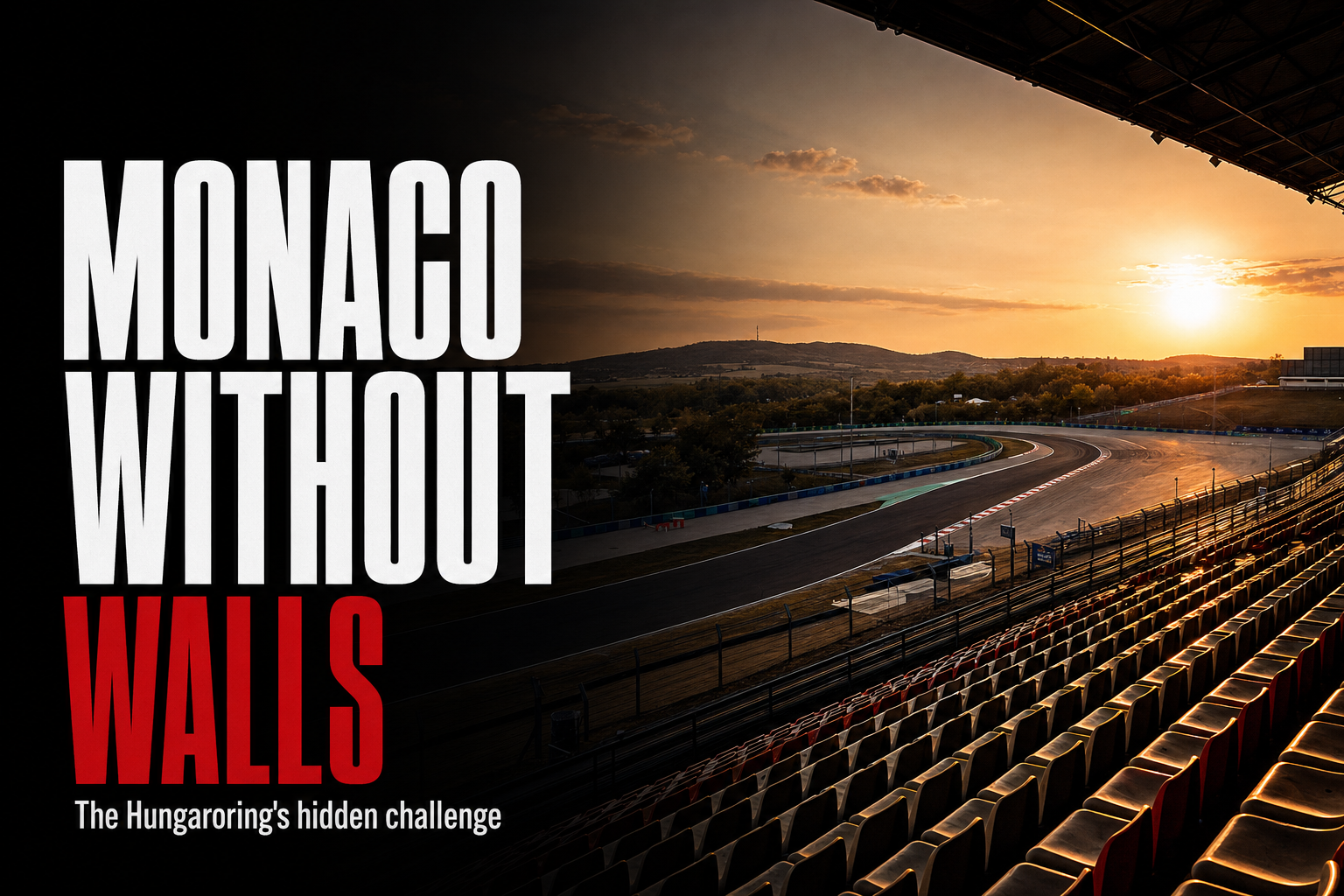

“At the Hungaroring, qualifying is everything.
The Hungaroring sits on the outskirts of Budapest in a natural bowl, surrounded by hills and packed grandstands and it looks almost gentle from above. No walls inches from the racing line. No blind crests. No corner that demands the specific courage Eau Rouge requires. What it demands instead is something drivers find equally difficult in a completely different way. It’s a circuit that gets inside your head.
The Deceptive Circuit
The phrase Monaco Without Walls captures the essential truth of the place. The same processional tendency. The same qualification-dominated racing. The same premium on precision over aggression. But without the barriers that make Monaco’s version of that challenge visually dramatic.
At the Hungaroring, overtaking is almost impossible. Qualifying position determines race outcome more reliably here than at almost any other venue on the calendar. The psychological pressure of leading in traffic whilst managing tyres and protecting a championship advantage has broken drivers who appeared to have everything under control. The challenge is internal rather than physical. That makes it harder to explain and, for the drivers who find it most demanding, no less real.
A Circuit Built in Communist Hungary
The Hungaroring was built in 1986 on the outskirts of Budapest. At the time, Hungary was still a communist country and hosting a round of the Formula 1 World Championship was a remarkable concession to Western motorsport. The circuit sits in a natural amphitheatre that gives spectators an unusually complete view of the action from many grandstand positions. You can watch a significant portion of the lap from a single seat, which is rare.
The layout is tight and twisty. A long straight from the grid leads to the first corner, followed by a sequence of medium and low-speed corners that place a premium on mechanical grip and tyre management over outright aerodynamic performance. Cars with strong low-speed performance and efficient tyre usage consistently outperform expectations here. Cars that excel at high-speed circuits find their advantages reduced or eliminated entirely.
Turn 4 and the Corner That Defines the Lap
If there’s one corner that captures what the Hungaroring is about, it’s Turn 4. A long left-hander in the circuit’s middle section, it demands a late apex, precise steering inputs and a traction phase that determines exit speed onto the following straight. Get it wrong once and you’re slow for the next few seconds. Get it wrong repeatedly and your race is compromised before you’ve even reached the pit window.
That compounding effect is what makes the Hungaroring so unforgiving. Small errors don’t disappear into the noise of a fast lap. They accumulate. A driver who’s slightly off the optimal line at Turn 4 is carrying that deficit through the rest of the lap, lap after lap, for the entire race distance.
Why Overtaking Is So Difficult
Overtaking in modern Formula 1 requires either a speed differential on a straight long enough to close a gap before a braking zone or a braking zone deep enough to allow a car to carry more speed later than the car ahead. The Hungaroring provides neither in abundance.
The straights are short. The braking zones are limited. The corners require precision that limits the ability to run different lines. And the dirty air produced by the car ahead disrupts the aerodynamic balance of the following car enough to make close racing difficult for sustained periods. The result is races decided by strategy and tyre management rather than outright speed. Teams and drivers who best manage the gaps between pit stop windows and the degradation rates the circuit produces are the ones who win here.
That’s not a criticism of the circuit. It’s a different kind of racing. Harder to follow on television, perhaps, but no less demanding on the people doing it.
Championship Significance
The Hungaroring’s place in Formula 1’s championship history is disproportionate to its visual drama. Races here have decided championships, ended seasons and produced moments that hindsight has made significantly more important than they appeared at the time.
The circuit’s position at the end of the European summer gives it specific weight. It’s typically the last race before the summer break, which means points scored or lost at Hungary arrive at a moment when the standings are clear enough for their significance to be obvious. The gap before the season resumes gives those standings time to be analysed with a thoroughness that mid-season rounds rarely receive.
Nigel Mansell’s 1989 tyre failure whilst leading is one of the clearest examples. What appeared to be a certain victory became a retirement and the points he lost proved significant later in the season. The Hungaroring has a habit of producing those moments. Outcomes that reshape championships in ways nobody anticipated when the weekend began.
Teams like McLaren and Mercedes have historically understood the circuit’s demands well, building cars that prioritise the mechanical grip and tyre efficiency that Hungary rewards. That understanding translates directly into results when the rest of the field is still trying to adapt.
What the Circuit Actually Reveals
The processional reputation doesn’t capture the complete truth of the Hungaroring. The races it produces aren’t always dramatic in the overtaking sense, but they’re consistently revealing about which cars and drivers manage sustained pressure most effectively.
A driver who can lead the Hungarian Grand Prix from pole position, managing traffic, managing tyres, managing the gap to the car behind whilst the team in second place develops a strategic threat, is demonstrating qualities that circuits where overtaking is easy don’t require to the same degree. Drivers like Fernando Alonso have made careers out of extracting maximum results from exactly this kind of circuit, where patience and precision matter more than raw pace.
The Monaco Without Walls comparison is apt but incomplete. What makes the Hungaroring specifically valuable to Formula 1’s calendar is that it tests things that Silverstone, Spa and Monza do not. A complete champion needs to perform everywhere. The Hungaroring is one of the places that reveals the gaps in a performance that everywhere else appears complete.
The Psychological Dimension
There’s something specific about leading a race at the Hungaroring that doesn’t apply at most other circuits. The inability to pull away means the car behind is always there. Always visible in the mirrors. Always a strategic threat even if it’s not a physical one. Managing that presence across 70 laps, whilst also managing tyres and responding to pit wall instructions, is a particular kind of pressure.
Drivers who thrive here tend to be the ones who can compartmentalise. Who can focus on their own lap rather than the gap. Who trust their team’s strategy calls even when the car behind is close enough to make those calls feel dangerous. That’s a mental skill as much as a physical one and the Hungaroring exposes it more clearly than almost anywhere else on the calendar.
The circuit doesn’t look like a test. That’s the point. It looks manageable right up until the moment it isn’t.
Further reading
- Hungaroring Official Website – The official circuit website provides authoritative information about the Hungaroring’s history, layout and events.
Related picks on Amazon
A few things worth a look if this article got you curious. Links are affiliate: buying through them supports the site at no extra cost to you.
- Nigel Mansell: My Autobiography – shop on Amazon
- F1 25 for PS5 – shop on Amazon
- 1:43 Scale Hungaroring F1 Model Car – shop on Amazon
- Formula 1: The Official History Book – shop on Amazon
