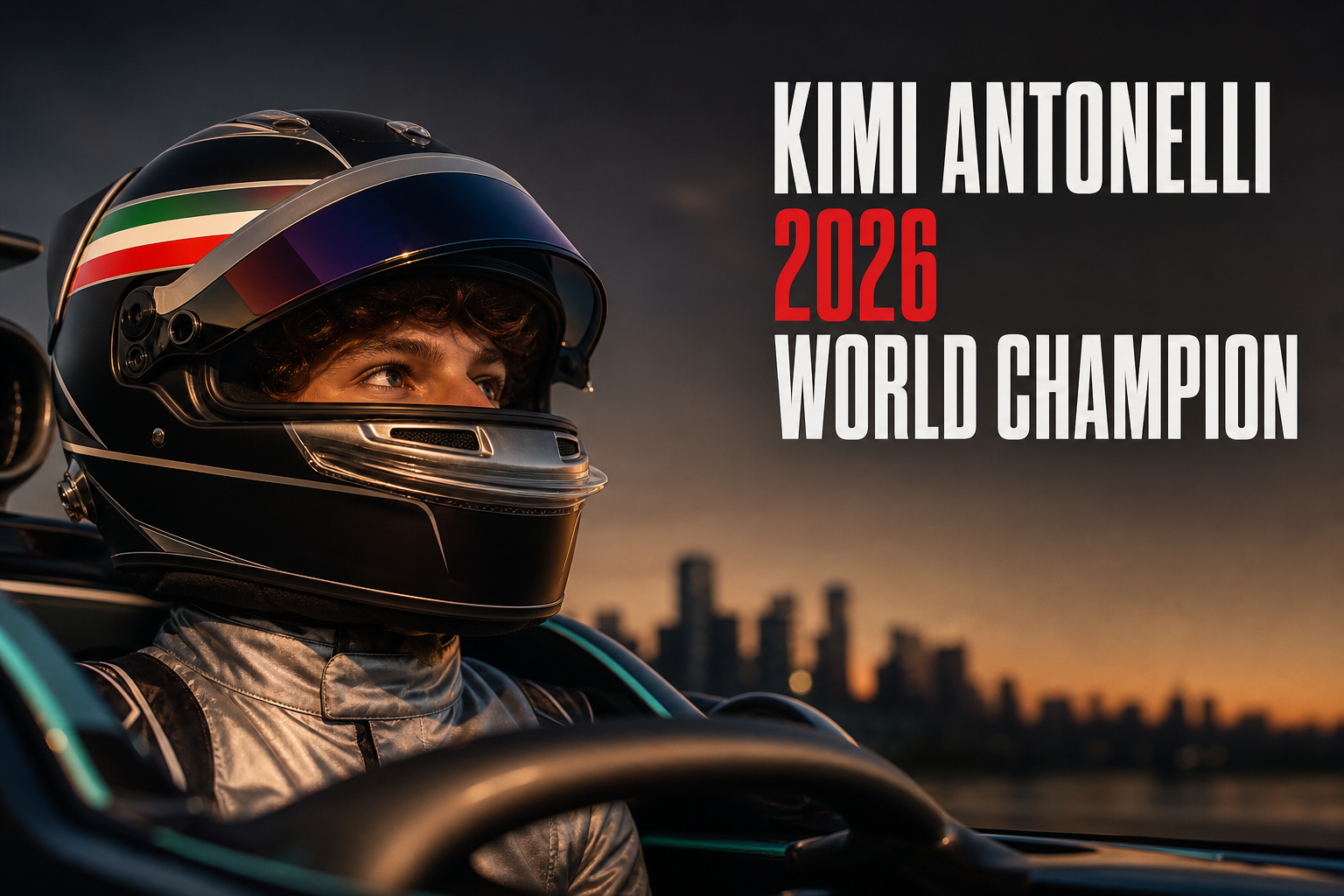

The high-altitude air at the Autódromo Hermanos Rodríguez sits thin, rare and electrified, elevated over 2,200 metres above sea level where turbochargers strain, brake temperatures skyrocket and aerodynamic downforce bleeds away into the clear Mexican sky. Across a monumental 2026 Mexico City Grand Prix weekend, this unique amphitheatre provided the backdrop for an indelible moment in sporting history. At just 20 years and 68 days old, Andrea Kimi Antonelli crossed the finish line to become the youngest Formula 1 World Champion in history, shattering a record held for sixteen years by Sebastian Vettel and ending Italy’s 73-year wait for a Drivers’ World Championship stretching back to Alberto Ascari in 1953.
While Red Bull Racing’s Max Verstappen delivered a masterclass of tactical execution from fifth on the grid to claim his sixth victory at the circuit fans have dubbed “Maxico,” the weekend belonged entirely to the young Italian prodigy in the Mercedes number 12. From Saturday’s razor-thin qualifying session, where Lewis Hamilton clinched his 105th career pole position, to the internal conflict that consumed Scuderia Ferrari, the high-speed suspension breakdown of Cadillac’s Valtteri Bottas, and a heart-in-mouth late-braking lunge that sealed Antonelli’s crown, the 2026 Mexico City Grand Prix delivered an unforgettable chapter in Formula 1 folklore.
1. High altitude, historic stakes and Saturday qualifying
The buildup to Sunday’s Grand Prix was shaped by the extreme thermal and mechanical demands unique to Mexico City. Engine cover louvres were opened to their absolute limits to cool overheating power units, while race engineers carefully calibrated brake duct apertures to prevent thermal runaway down the 830-metre front straight into Turn 1.
For home hero Sergio Pérez, celebrating his landmark 300th Grand Prix start, local supporters created a deafening wall of sound inside the famous Estadio GNP Seguros stadium section. Yet while local passion surged around Pérez, the technical battle for front-row dominance reached a fever pitch during Saturday’s qualifying session.
The 0.009-second qualifying thriller
Qualifying produced a battle of microscopic margins. Mercedes, Ferrari and Red Bull were separated by tiny fractions of a second across the 4.304-kilometre layout. Lewis Hamilton, continuing his mid-season resurgence in his debut year with Scuderia Ferrari, delivered a qualifying performance of vintage brilliance. After setting an initial benchmark of 1:17.000 in Q3, Hamilton unleashed a blistering 1:16.600 on his final flying lap to secure his 105th career pole position, and his very first in the iconic scarlet colours of Ferrari. It ended a pole position drought for Hamilton dating back to Budapest in 2023, edging out Mercedes’ George Russell by a razor-thin margin of just 0.009 seconds.
Charles Leclerc locked out third place on the grid for Ferrari, trailing Hamilton by only 0.010 seconds despite setting a purple final sector through the tight stadium complex. Max Verstappen, battling sector three traffic that disrupted his turbocharger response, qualified fourth on raw lap time before serving a one-place grid penalty, which promoted championship leader Antonelli to P4 on the official starting grid.
For Antonelli, qualifying was an exercise in extreme composure under pressure. Admitting after the session that he felt more tense than usual, Antonelli struggled with balance inconsistencies and tire warm-up issues during Q1 and Q2. Knowing he needed only a ninth-place finish in Sunday’s race to guarantee the World Championship regardless of his rivals’ results, Antonelli refused to over-drive the Mercedes W17, securing fifth on the grid.
“It’s one of the greatest feelings, honestly. I’ve been dreaming and eyeing that first pole with Ferrari. I’m still settling in and learning with new engineers this year, but what an amazing feeling to pull it off when it mattered.”
Lewis Hamilton, after securing pole
Midfield upheaval and debutant spotlight
Further down the order, Saturday brought frustration for several established stars. Aston Martin suffered a nightmare double qualifying failure when Fernando Alonso was forced to park his car in the stadium section due to an engine component issue, mirroring chronic balance and power unit glitches that affected teammate Lance Stroll. McLaren’s Oscar Piastri suffered a shock Q2 exit, ending up P13 after failing to find grip on his final push lap.
Meanwhile, 32-year-old Japanese driver Ryo Hirakawa, drafted in on Friday evening by Haas F1 Team to make his unexpected Formula 1 debut following Esteban Ocon’s sudden withdrawal, impressed paddock observers. Despite having zero practice tuning or data setup, Hirakawa delivered a clean, composed session to qualify 18th, laying the groundwork for a memorable Sunday.
2. Drama at the lights: Turn 1 to 4 ignition and Ferrari warfare
When the five red lights went out above the long straight, the drag race down to Turn 1 ignited immediate drama. Pole-sitter Hamilton launched cleanly, sweeping to the right to cover off Russell. Behind them, Leclerc leveraged a massive slipstream to attack down the inside, while Verstappen launched his Red Bull from fifth to third with predatory precision.
Into the heavy braking zone of Turn 1, Hamilton held the inside line, but Leclerc lunged around the outside, forcing both Ferraris side-by-side through the tight chicane of Turns 2 and 3. As they thundered down the secondary straight toward Turn 4, the intra-team battle escalated out of control.
The Turn 4 corner-cutting incident
Refusing to yield the corner on the outer entry, Leclerc braked extraordinarily late. Both Ferraris locked their front tires, missing the apex of Turn 4 entirely. Leclerc cut across the grass verge, rejoining the track ahead of Hamilton and taking the lead of the Grand Prix. In the background chaos, Verstappen seized the opportunity as Hamilton was pushed wide, slipping past Hamilton to claim second on the road.
The stewards acted swiftly, handing Leclerc a 5-second time penalty for leaving the track and gaining a lasting advantage. Over the team radio, Hamilton expressed immediate outrage to the pit wall.
Leclerc opted to retain track position and attempt to build a 5-second buffer over Verstappen and Hamilton to negate the penalty. However, running in dirty air caused rapid thermal degradation on Leclerc’s front tires.
Behind the leaders, the opening lap claimed further casualties. George Russell suffered a hybrid deployment glitch off the line, dropping into the midfield pack where he collided with Racing Bulls’ Isack Hadjar into Turn 4. Hadjar was sent spinning into the runoff, while Russell received a 10-second time penalty for causing a collision. Aston Martin’s weekend ended in total failure as mechanical faults forced both Alonso and Stroll to box and retire on lap one.
3. Strategic masterstroke and the Cadillac suspension crisis
With Leclerc leading on track while saddled with a 5-second penalty, the race transformed into a tactical chess match between the Red Bull and Ferrari pit walls. On lap 22, Red Bull Team Principal Laurent Mekies and Chief Engineer Gianpiero Lambiase executed a flawless tactical maneuver.
Recognizing that Leclerc was struggling with tire degradation, Red Bull called Verstappen into the pit lane on the exact same lap Ferrari called in Leclerc. Because Leclerc was required to serve his mandatory 5-second penalty before mechanics could touch the car, Ferrari’s total pit stop duration reached 4.8 seconds. Red Bull’s crew executed a lightning-fast 2.5-second stop for Verstappen. As Verstappen exited pit lane, he swept past Leclerc into Turn 1: a strategic checkmate that gave Verstappen virtual control of the race.
Bottas’s high-speed breakdown and red flag restart
Hamilton pitted a lap later, emerging behind Verstappen and Leclerc on fresh medium tires. But on lap 31, the race was brought to a sudden halt by a frightening high-speed crash.
Valtteri Bottas, driving for Cadillac, suffered a catastrophic left-front suspension failure at maximum speed at the end of the main straight. As Bottas hit the brakes for Turn 1, the suspension snapped, turning the car into an uncontrollable passenger at over 300 km/h. The Cadillac slammed heavily into the TecPro barriers. Although Bottas walked away unhurt, severe barrier damage forced race control to throw a Red Flag, bringing all cars into the pit lane for a standing restart.
During the red flag pause, the frustration inside the Ferrari garage boiled over into public view. Sitting in his car, Hamilton issued a stark warning over the team radio.
“We’ve got big problems. Big, big problems.”
Lewis Hamilton, on team radio during the red flag
4. The champion’s move: Antonelli’s decisive pass for glory
When the Red Flag lifted and the field lined up on the grid for a standing restart on lap 35, Verstappen led Hamilton, Leclerc and Antonelli. As the lights went out, Hamilton launched a fierce attack off the dirty side of the track, drawing alongside Verstappen into Turn 1. Verstappen defended with characteristic aggression, edging Hamilton toward the outer kerb on Turn 2 exit to maintain P1.
Behind them, Kimi Antonelli delivered the defining moment of his championship season. Positioned in fourth place, Antonelli knew that finishing P4 was more than enough to secure the World Championship without taking risks. Yet, demonstrating the fierce racing instinct that has captivated Formula 1, the 20-year-old Italian refused to settle.
Noticing Leclerc suffer a momentary traction loss exiting Turn 3, Antonelli tucked into the Ferrari’s slipstream, pulled to the inside down the straight and executed a late-braking dive into Turn 1. Antonelli hit the apex cleanly, held off Leclerc’s counter-charge through Turn 2 and seized P3 on the road. It was an audacious, uncompromising move that underlined his title credentials.
A late Safety Car was triggered when McLaren’s Oscar Piastri and Racing Bulls’ Arvid Lindblad collided at Turn 1, sending Lindblad into the wall. When racing resumed with three laps remaining, Verstappen managed the restart expertly, keeping Hamilton 0.8 seconds behind to take his sixth Mexico City Grand Prix victory. Hamilton finished second, while Antonelli took third to officially seal the World Championship.
5. Anatomy of a prodigy: the making of F1’s youngest World Champion
At 20 years and 68 days old, Kimi Antonelli established a historic precedent in Formula 1. He broke Sebastian Vettel’s 2010 record (23 years, 134 days) by more than three years, becoming the youngest World Champion in the history of the sport. He also became the first Italian driver to win the World Championship since Alberto Ascari in 1953, ending a 73-year wait for Italy, while carrying Ayrton Senna’s famous number 12 to title glory.
The Mercedes masterplan and Bono’s partnership
Antonelli’s championship stats reflect extraordinary consistency: 16 podium finishes in 19 races, including 9 Grand Prix victories, with a lowest on-track finish of P5. This dominance was built upon a 9-year development program initiated by Mercedes Team Principal Toto Wolff when Antonelli was just 11 years old, involving specialized physical training, psychological coaching and extensive engineering preparation.
Mercedes Race Engineer Peter “Bono” Bonington, who previously engineered Lewis Hamilton to six titles, played a pivotal role in guiding Antonelli through his rookie struggles in 2025, including a 9-race scoreless run. Bonington praised Antonelli’s mental resilience and natural composure.
“He is like a swan gliding across a pond. Smooth and effortless on the surface, no matter how fast the legs are paddling underneath. He has grown into a complete world champion, and working with him has been an absolute privilege.”
Peter “Bono” Bonington, Antonelli’s race engineer
Family emotion and paddock tribute
The emotional climax of the day belonged to Antonelli’s family. His father, Marco Antonelli, flew into Mexico City late Saturday night after his GT3 team competed at Mugello. Embracing his son behind the podium, Marco was overcome with tears.
“When he was a little boy, you saw he had something special. But to stand here today and see him as World Champion. I have no words. I just cried and said: ‘You are the champion.'”
Marco Antonelli, Kimi’s father
Reflecting on the achievement, F1 CEO Stefano Domenicali praised Antonelli as a beacon for the sport’s future.
“It’s an incredible day for Formula 1 and a great day for Italy. Kimi is an inspiration for young kids worldwide, showing that you can achieve your dreams with positivity and style.”
Stefano Domenicali, F1 CEO
6. Post-race fallout: Ferrari in-fighting and paddock reactions
While Mercedes celebrated, Scuderia Ferrari faced intense internal scrutiny. Team Principal Fred Vasseur delivered a scathing indictment of Hamilton and Leclerc’s opening-lap incident.
“It is very difficult to digest. We had the performance to finish 1-2 today. The team back in Maranello works day and night to bring upgrades. To give away a win because our drivers are fighting each other is a complete lack of respect for the 2,000 people behind this project. We will address this internally before São Paulo.”
Fred Vasseur, Ferrari Team Principal
In contrast, Hamilton took the high road in post-race interviews, opting to honor the new champion.
“I’d rather talk about Kimi. Kimi has just won the World Championship as the youngest ever. Sharing a podium with Kimi and Max, twelve world titles between us, is a truly special moment.”
Lewis Hamilton, after the race
In the midfield, Haas debutant Ryo Hirakawa earned widespread praise. Following post-race yellow-flag time penalties handed to both Alpine cars, Hirakawa was promoted to 10th place, scoring a World Championship point on his F1 debut at age 32. Audi’s Gabriel Bortoleto finished 8th, snapping an eight-race scoreless streak for the team.
As the paddock prepares for the upcoming Grand Prix at Interlagos, Kimi Antonelli enters the final four races of 2026 not as a rising star, but as the crowned Champion of the World.
Grand Prix classification and milestone summary
The table below outlines the final top ten classifications from the 2026 Mexico City Grand Prix, highlighting key race metrics and championship implications.
| Pos | Driver | Team | Grid | Time / Gap | Milestone |
|---|---|---|---|---|---|
| 1 | Max Verstappen | Red Bull Racing | P5 | Winner | 6th Mexico GP victory (“Maxico”) |
| 2 | Lewis Hamilton | Scuderia Ferrari | P1 | +0.799s | 105th career pole position |
| 3 | Kimi Antonelli | Mercedes-AMG F1 | P4 | +4.006s | Clinched 2026 World Championship |
| 4 | Charles Leclerc | Scuderia Ferrari | P3 | +10.707s | Early-stop strategy to fourth |
| 5 | Lando Norris | McLaren F1 Team | P6 | +11.778s | Steady recovery from P6 grid |
| 6 | George Russell | Mercedes-AMG F1 | P2 | +12.263s | Dropped from the front row through the race |
| 7 | Liam Lawson | Racing Bulls | P22 | +20.899s | Pit-lane start to P7, drive of the day |
| 8 | Gabriel Bortoleto | Audi F1 Team | P13 | +22.041s | Four points for Audi |
| 9 | Isack Hadjar | Racing Bulls | P7 | +22.503s | Double points finish for Racing Bulls |
| 10 | Ryo Hirakawa | Haas F1 Team | P18 | +25.373s | Scored a point on F1 debut |
Key historical championship records broken
The following overview highlights the landmark statistical records established by Kimi Antonelli during the 2026 Mexico City Grand Prix weekend.
- Youngest F1 World Champion: 20 years, 68 days old (previous: Sebastian Vettel, 2010, at 23 years, 134 days).
- First Italian World Champion in 73 years: first since Alberto Ascari in 1953.
- First number 12 World Champion since Ayrton Senna: carrying car #12 to title victory.
- 2026 season dominance: 16 podiums in 19 races, 9 Grand Prix victories, title sealed with four rounds remaining.
Data sources and further reading
Related picks on Amazon
A few things worth a look if this review got you curious. Links are affiliate: buying through them supports the site at no extra cost to you.
