
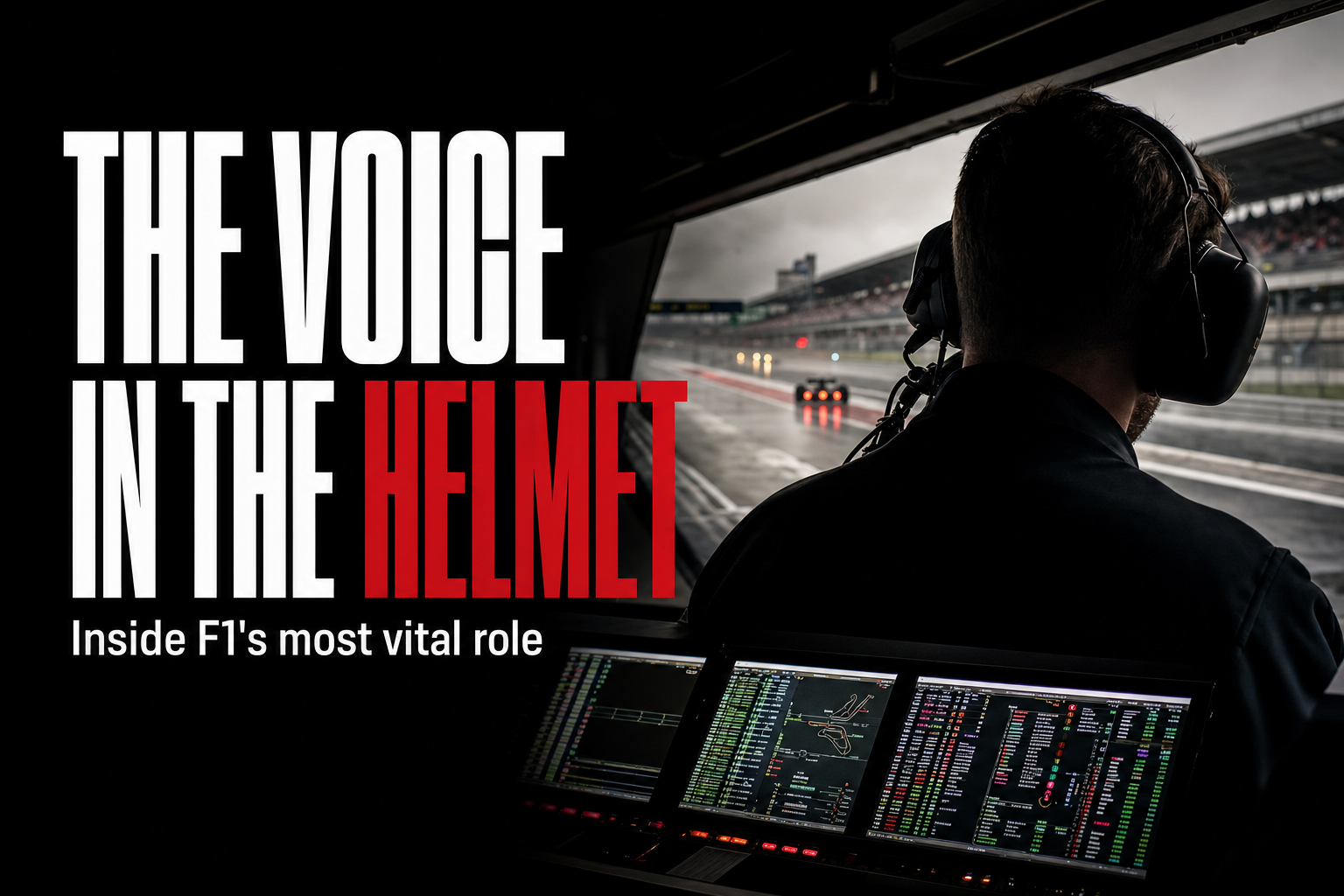

There is a person whose voice Formula 1 drivers hear more than any other across a race weekend. More than their team principal, more than their performance coaches, more than anyone at home. It’s the race engineer, talking through a radio system that connects the cockpit to the garage for two hours of racing at the absolute limit of human concentration. They’re one of the sport’s least visible figures. Their name doesn’t appear on the results sheet. Their influence on those results is as direct as anything that happens behind the wheel.
“I’ve had Bono by my side my whole time here at this team and you can hear our rapport when we’re in a race.
What a Race Engineer Actually Does
The job starts days before the race itself. In the practice sessions leading into a grand prix weekend, the engineer works with the driver and the broader technical team to develop a car setup that suits the specific demands of the circuit. That means translating what the driver is feeling behind the wheel into adjustments the mechanics can make to the car’s geometry, suspension, aerodynamic configuration and tyre management systems.
It’s an iterative process. The driver says the rear feels loose under braking. The engineer looks at the data, cross-references it with what the sensors are showing and works out whether that’s a setup issue, a tyre temperature issue or something the driver needs to adapt to. Then they go again. Practice sessions are short. The feedback loop has to be tight.
During qualifying, the engineer manages the timing of runs, the preparation between attempts and the communication of track condition information. A circuit evolves across a session as rubber builds on the racing line. Knowing when to send the driver out and when the track is at its fastest, is part of the engineer’s job. Get it wrong and the driver’s best lap is on a surface that hasn’t peaked yet.
Race Day: Data, Strategy and Driver Management
In the race, the role expands into something that combines real-time data analysis, strategic decision-making and the management of a driver who is operating at the absolute edge of their physical and mental capacity.
The strategic decisions. when to pit, which tyre compound to fit, how to manage the gap to the car ahead or behind. are made collectively by the engineer, the strategist and the team principal at the pitwall. But communicating those decisions to the driver and managing the driver’s reaction to them, is primarily the engineer’s job.
That’s where it gets complicated. A driver who disagrees with a strategic call, who believes their race is being compromised by a decision made from data that doesn’t capture what they’re experiencing in the cockpit, expresses that disagreement through the engineer. The engineer then has to either advocate for the driver’s perspective with the strategists or explain the reasoning behind the call in a way the driver accepts without losing confidence in the team. Both options require a specific kind of skill that has nothing to do with engineering qualifications.
Teams like Mercedes and Red Bull have invested heavily in the systems that support this process, but the human interface between the pitwall and the cockpit remains the race engineer. No amount of data infrastructure changes that.
The Driver-Engineer Relationship
The relationship between a driver and their race engineer is the most operationally significant personal relationship in Formula 1. That’s not a dramatic claim. It’s just what the job requires.
Engineers and drivers who work together across multiple seasons develop a communication shorthand that new partnerships take time to build. A shared understanding of what information matters, how it should be delivered and how much of it the driver needs at any given moment. That shorthand reduces the cognitive load on the driver during the race itself. Less processing time means faster decisions.
Hamilton’s partnership with Peter Bonnington, known universally in the paddock as Bono, became one of the sport’s most celebrated driver-engineer relationships during the Mercedes-AMG Petronas championship years. Hamilton’s ability to communicate precisely what the car was doing combined with Bonnington’s ability to translate that communication into actionable technical responses was a significant factor in the consistency of the championship performances it accompanied. You can hear it in the radio clips. There’s no wasted language. Both of them know exactly what the other means.
When partnerships work, the driver arrives at the car knowing that the voice in their helmet understands exactly what they need. When they don’t work, the friction between what the driver is experiencing and what the engineer is communicating compounds across a race distance in ways that the results table eventually reflects. It’s a slow leak. Hard to pinpoint. Impossible to ignore.
The Skills the Role Demands
Race engineers typically come from technical backgrounds. Degrees in mechanical or aeronautical engineering are standard. Junior engineering roles within a team follow, building the specific expertise the senior role requires. The path varies across teams but the common thread is the same everywhere: technical excellence plus the interpersonal skills that managing a driver relationship demands.
The technical knowledge is necessary. It’s nowhere near sufficient on its own.
An engineer who can’t communicate effectively with a driver under pressure, who can’t translate complex data into clear and timely guidance during a safety car restart or a tyre degradation crisis, won’t occupy the race engineer role regardless of their qualifications. The best engineers in the paddock are elite engineers and elite communicators. That combination is genuinely rare. Teams know it and they protect those people accordingly.
For anyone wanting to understand the technical vocabulary that surrounds this role, the F1 glossary at RukiF1 covers the key terms across car setup, strategy and race operations.
Why the Role Gets Overlooked
The race engineer’s contribution to a result is difficult to quantify precisely. That’s the main reason the role receives less public attention than the driver whose result it influences. Broadcast coverage captures fragments of the radio communication but rarely the full texture of what’s being managed across a race distance.
What the engineers who’ve worked with the sport’s most successful drivers are consistent about is this: the relationship between driver and engineer shapes outcomes in ways that the technical hierarchy of car performance can’t fully explain. Cars that should produce one result produce another because the communication between the cockpit and the garage is functioning at the highest level. The driver is receiving exactly the information they need at exactly the moment they need it in exactly the form that allows them to act on it.
That’s the job. It happens largely out of sight. The results don’t lie about whether it’s working.
Further reading
- Formula 1 Official — Team Operations — The official F1 site provides authoritative background on team roles and race engineer responsibilities directly from the sport’s governing body.
Related picks on Amazon
A few things worth a look if this article got you curious. Links are affiliate: buying through them supports the site at no extra cost to you.
- How to Build a Car by Adrian Newey — shop on Amazon
- Total Competition: Lessons in Strategy from Formula One — shop on Amazon
- F1 Manager 2024 for PC or Console — shop on Amazon
