
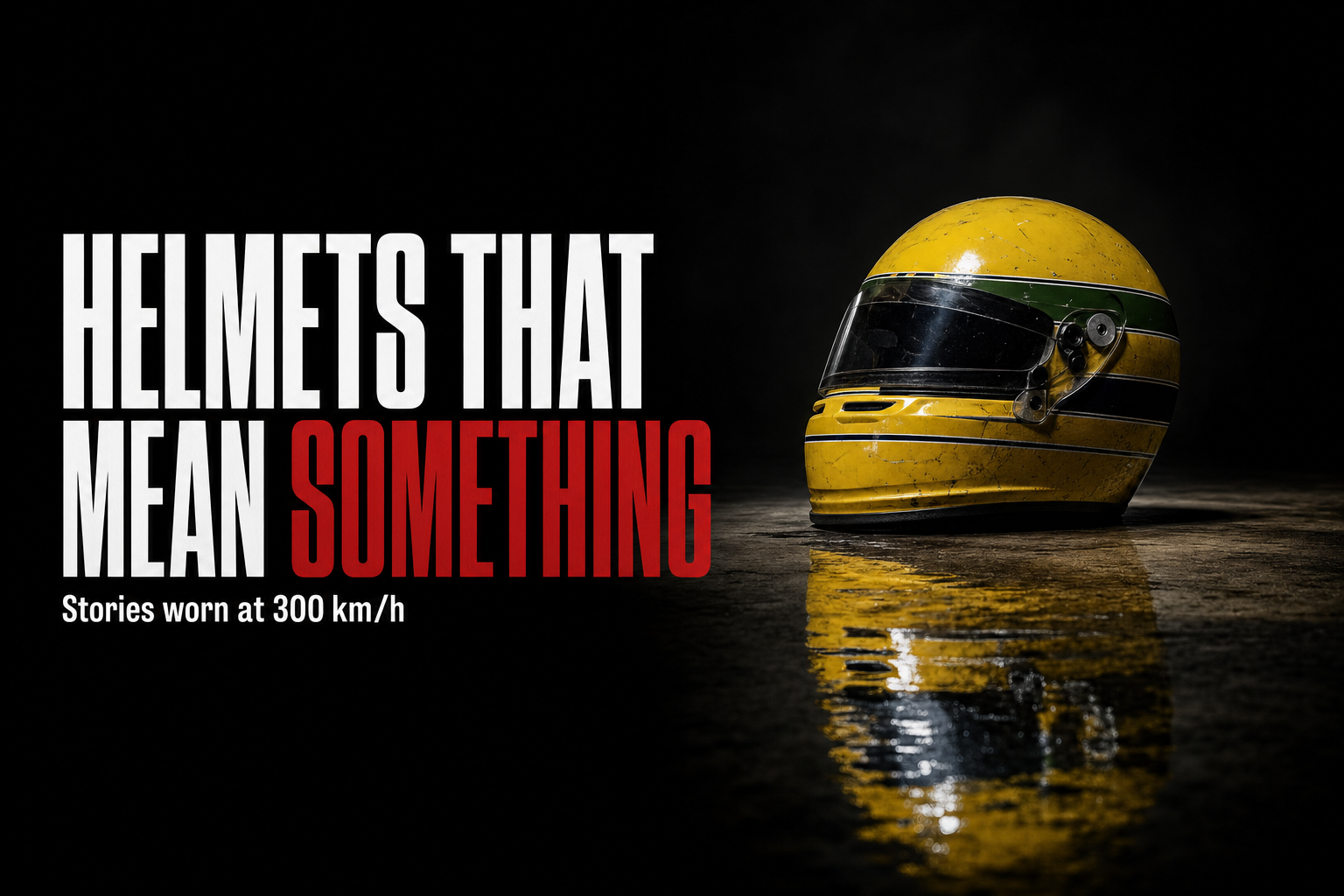

A Formula 1 helmet serves an obvious practical purpose. At 300 kilometres per hour, in a car without a roof, with barriers metres away, it’s the primary piece of safety equipment between the driver and catastrophic injury. But the helmets that fans remember aren’t remembered for their safety ratings. They’re remembered for what they said about the person wearing them.
“A helmet is the most personal thing a racing driver has. It is the one piece of equipment that is entirely theirs.
The car’s livery belongs to the team and the sponsors. The helmet belongs to the driver. What they choose to put on it and why, is one of the sport’s most personal stories, told in public at racing speed in front of millions of people who often don’t know they’re reading it.
Ayrton Senna: The Yellow That Became a Symbol
Senna’s helmet is the most iconic in Formula 1 history. The yellow base with green and blue detailing drew from the colours of the Brazilian flag and in an era when helmet designs were simpler and less commercially driven than today, that yellow stood out on the circuit with a clarity that made him instantly identifiable even at racing speeds.
After his death at Imola in 1994, the yellow helmet became one of sport’s most recognised symbols of loss. It appeared on tributes, memorials and references to Senna that have continued for three decades. The specific shade became so associated with him that it carries his memory regardless of who’s wearing it.
Drivers have incorporated that yellow into their own designs as a direct tribute. Lewis Hamilton has done it more than once and each time the reference needed no caption. Everyone already knew what it meant.
Michael Schumacher: Red, White and Five Titles
Schumacher’s helmet evolved across his career but the red and white combination that defined his Ferrari years became as associated with his dominance as the red car itself. The design was created by German artist Olaf Manthey and refined across the seasons Schumacher spent at Maranello, incorporating sponsors and adjusting details whilst keeping the fundamental visual identity that fans associated with five consecutive championships.
The helmet became one of the sport’s most commercially reproduced objects. Replicas sold across the world. But its personal significance for Schumacher was reflected in the care he took with it across his career. He treated it as a genuine expression of identity rather than simply branded equipment. That distinction matters.
Damon Hill: Carrying His Father’s Colours
Damon Hill’s helmet incorporated elements that directly referenced his father Graham’s famous design. Graham had carried the London Rowing Club colours throughout his career: dark blue with white and red stripes. Damon’s version acknowledged that legacy whilst making it his own.
The choice needed no explanation to anyone who knew the history. Two generations of drivers, two world championships, one visual thread connecting them. It’s one of Formula 1’s more quietly moving design decisions and it worked precisely because it wasn’t loud about what it was doing.
Niki Lauda: The Red Cap and What It Came to Represent
Lauda’s helmet was simple. Almost entirely without decoration beyond his name and sponsors. Red, clean, functional. It became one of the most recognisable in the sport partly because of what it represented after his 1976 accident at the Nurburgring.
The images of Lauda returning to racing just six weeks after suffering severe burns gave the red helmet a weight that no amount of elaborate design could have produced. It became a symbol of the specific kind of courage that defined his career. The simplicity of the design made it more powerful, not less. There was nothing to hide behind.
Lewis Hamilton: Purple, Yellow and the Tribute Designs
Hamilton’s helmet has gone through several significant evolutions. Early in his career he ran a yellow design influenced by his childhood hero Senna. Later, the purple and chrome combination became his signature during the Mercedes championship years, chosen for its visual distinctiveness against the red Ferraris, dark blue Red Bulls and silver Mercedes livery around him.
His tribute designs have been among the most discussed in the modern era. Helmets created specifically to honour Senna, to mark his own championship milestones, to make statements about causes beyond the sport. The Senna yellow kept coming back. Hamilton has spoken openly about his connection to the Brazilian driver throughout his career and the helmet was always the most direct way he expressed it.
The purple era is the one most fans associate with his dominant years. It was a deliberate choice to stand apart visually and it worked. You could pick him out of any onboard shot within a second.
Max Verstappen: Orange as a National Statement
Verstappen’s orange helmet is less a personal design choice than a national declaration. The Dutch racing colour has been adopted by his enormous home following as their collective identity at every circuit he races.
The sea of orange at the Dutch Grand Prix, at Spa and increasingly at circuits across the world is a direct extension of the colour Verstappen carries on his helmet. The connection between driver and fanbase is unique on the current grid. No other driver has a colour that travels with them quite like that orange does.
It’s become as associated with his era of dominance as any other visual element of the sport’s recent history. When you see orange in the grandstands, you know exactly who they’re there for.
What Makes a Helmet Mean Something
The helmets on this list share one quality. Each one carries a story that the design alone can’t tell. A tribute, a connection, a symbol of something that happened on or off the circuit and gave the colours their weight.
Senna’s yellow became grief made visible. Lauda’s red became courage made visible. Hill’s stripes became family made visible. The design was never the point. The story behind it was.
In a sport where so much of the visual identity is determined by sponsors, regulations and team requirements, the helmet remains the one space that belongs entirely to the driver. What they choose to put on it tells you something about who they are that the car never can. That’s why fans remember them long after the races are forgotten.
Further reading
- Instituto Ayrton Senna — The official foundation established in Senna’s memory, directly relevant to the article’s discussion of his helmet as a symbol of tribute and legacy.
Related picks on Amazon
A few things worth a look if this article got you curious. Links are affiliate: buying through them supports the site at no extra cost to you.
- Ayrton Senna: The Official Tribute — shop on Amazon
- 1:2 Scale F1 Replica Helmet — shop on Amazon
- Niki Lauda: My Story — shop on Amazon
- EA Sports F1 25 for PS5 — shop on Amazon
