
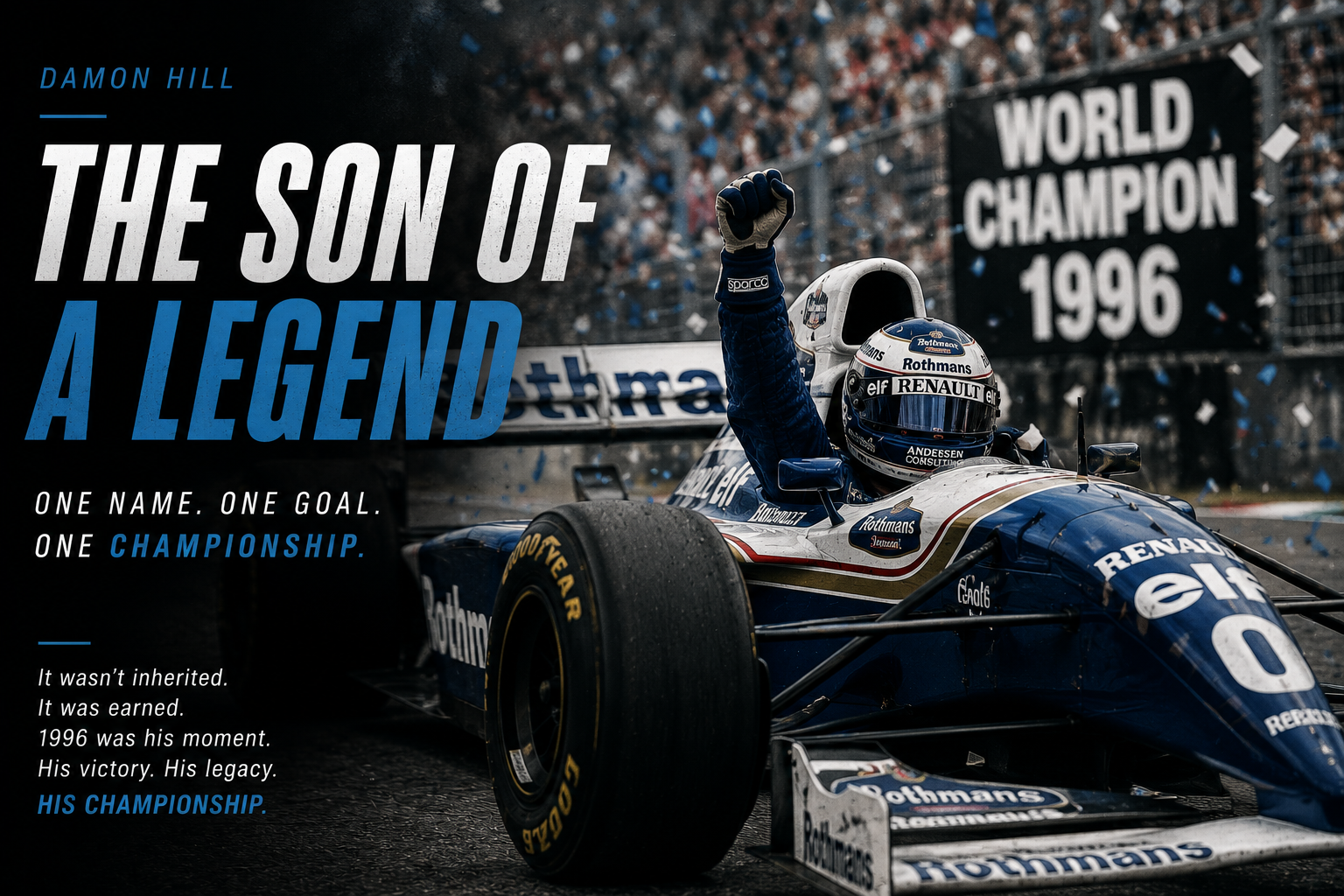

“I had to prove myself every single day. Nobody handed me anything.” – Damon Hill
The Son of a Legend
Damon Hill arrived in Formula 1 carrying a weight that no amount of talent could fully distribute.
His father, Graham Hill, was one of the sport’s most celebrated champions, a two-time world champion and five-time Monaco winner whose death in a plane crash in 1975 had left a legacy so large that his son’s relationship with it was always going to be complicated. Damon was eleven years old when his father died, and the sport that had defined his childhood and taken his father would eventually become the arena in which he answered the question that followed him everywhere.
Could he win on his own terms, or was he always going to be Graham Hill’s son first and a driver second?
The answer came in 1996. But the path to it was anything but straightforward.
The Road to Formula 1
Hill’s route to Formula 1 was unconventional by the standards of the sport’s modern development pathways, which produce drivers who have been in single-seaters since their early teens and arrive in the top category with junior championships and manufacturer backing behind them.
He began racing motorcycles, not cars, and his transition to four wheels came later than most of his contemporaries. He drove Formula Ford, Formula Three, and Formula 3000 with results that were respectable without being spectacular, and the momentum of his career was built more through persistence and the connections that his surname opened than through the dominant junior performances that attract conventional attention.
His break came through a Williams test driver role in 1991 and 1992, a position that gave him the exposure to top-level Formula 1 machinery and the relationship with the team that would eventually give him his race seat. It was not the route that a driver selected at sixteen by a manufacturer programme would have taken, and the fact that it worked says something about the different paths that Formula 1 careers can follow when the talent is real and the determination is sufficient.
The Williams Years and Senna’s Shadow
Hill’s first full season as a race driver at Williams came in 1993, alongside Alain Prost. He won his first grand prix that year, at Budapest, a victory that arrived with enough speed and control to suggest that the test driver had developed into something more significant than the role implied.
But it was 1994 that defined Hill in the sport’s memory, and it did so in circumstances that nobody would have chosen.
Ayrton Senna’s death at Imola in May 1994 placed Hill in a position that was both an opportunity and an enormous burden. He became Williams’ lead driver at a moment of genuine tragedy, the person required to represent the team’s championship challenge in the weeks immediately following the loss of someone who had been not just a teammate but one of the defining figures of the sport.
He responded with performances that silenced the doubters who had questioned whether he was capable of leading a championship fight. His season-long battle with Michael Schumacher in 1994 produced one of the most dramatic and controversial finishes in the sport’s history, the collision at Adelaide in the final race that decided the championship in Schumacher’s favour, an incident whose interpretation divided the paddock then and has never been fully settled since.
Hill’s championship in that moment, and it was his championship in every sense except the final result, demonstrated that he belonged at the front of Formula 1 in a way that no subsequent criticism of his ability has been able to fully erase.
1995 and the Near Miss
The 1996 title was not Hill’s first attempt at the championship. The 1995 season, which he entered as the main contender in the fastest car following his near-miss of 1994, ended in disappointment.
Schumacher and Benetton were dominant in ways that the Williams could not match, and Hill’s season, whilst productive in terms of wins, did not produce the championship that the winter had suggested was his to lose. The criticism of his performances in 1995, which was harsher than the results strictly justified, added to the pressure that surrounded him going into 1996 as a driver who was seen by some as perennially unable to close out the opportunity in front of him.
That narrative was wrong – but it was present, and it made what happened in 1996 more significant than a straightforward title victory would have been.
1996: The Championship
The 1996 season was Hill’s last at Williams. Frank Williams had already decided that the 1997 car would be driven by Heinz-Harald Frentzen, a decision that was known within the team before the season began and that created a dynamic that most drivers would have found impossible to manage productively.
Hill won it anyway.
Eight victories from sixteen races – a championship lead that was threatened through the mid-season by Jacques Villeneuve, his younger and faster-on-his-day teammate, but that Hill protected with a consistency and a strategic intelligence that reflected a driver operating at the peak of his abilities.
The moment that sealed it came at the Japanese Grand Prix in Suzuka, where Hill crossed the line to clinch the championship that had been the defining target of his professional life. The celebration that followed was not the explosion of relief that some champions produce. It was something quieter and more complex, the recognition of everything that had been invested in that moment and everything that it meant for a man who had spent his career proving that he deserved to be there.
What His Championship Means
Damon Hill’s 1996 world championship is sometimes discussed as a product of circumstance, the fastest car in a year when Schumacher was at Benetton rather than Ferrari, a title that arrived by default rather than through dominance.
That assessment is incomplete and in important ways, unfair.
Hill drove the fastest car in 1996, but he drove it better than his talented and highly rated teammate across the full season – winning the championship in circumstances designed to undermine him, knowing his seat was gone and racing against a team that had already moved on from him. The ability to perform at that level, in those conditions, is not default. It’s character.
His story is also a reminder that Formula 1 careers do not follow a single template. He was not a manufacturer’s prodigy, not a junior champion who arrived in the sport with every advantage arranged in advance. He was a driver who found his way to the top by a longer and more difficult route, who answered the questions about his ability in the most demanding conditions possible, and who won the championship that his father never did.
That is not a small thing. In a sport that his family had paid the highest possible price for, Damon Hill stood on top of it.
Nobody expected him to. That is exactly what makes it worth remembering.
