
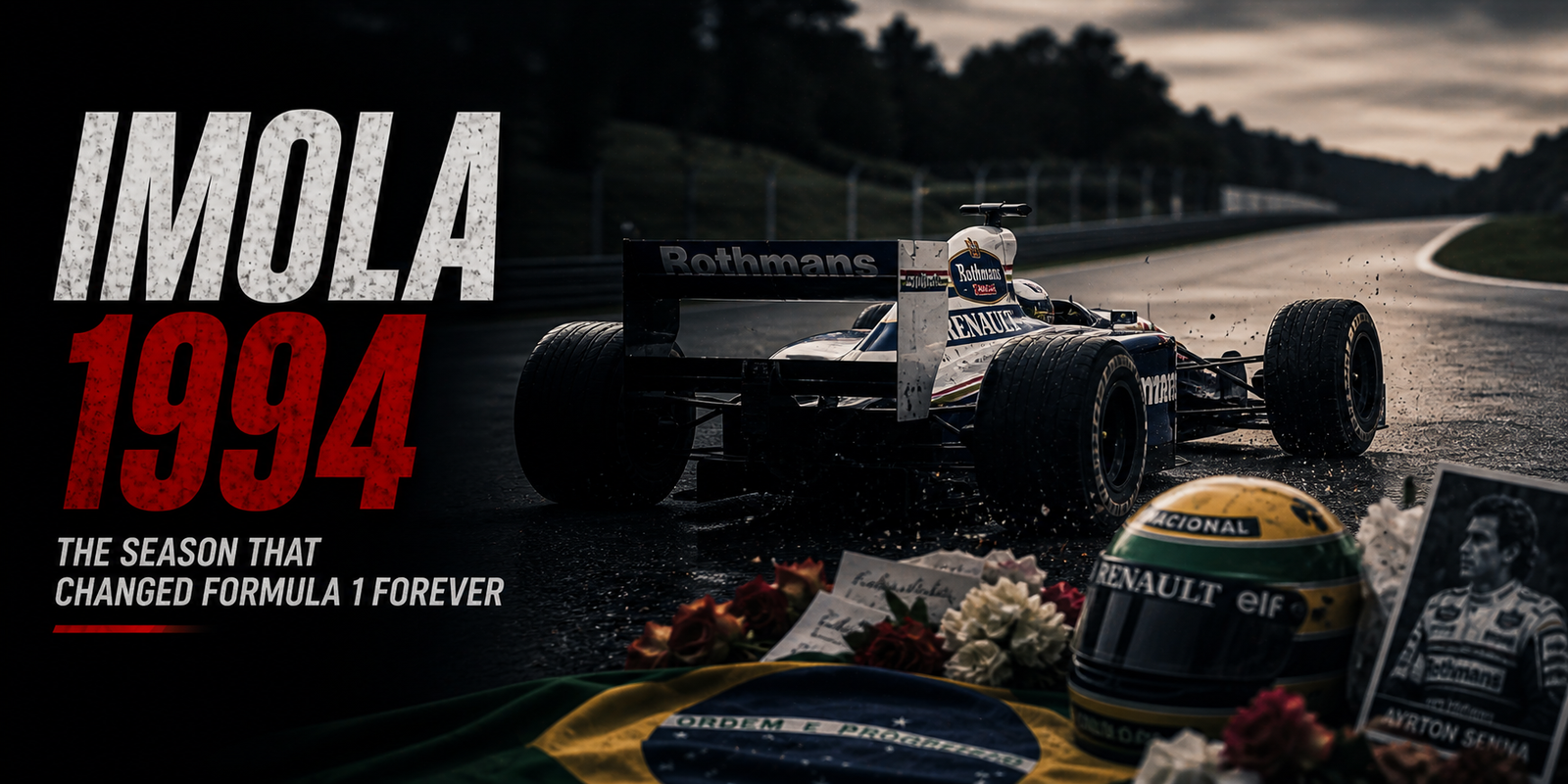

“If you no longer go for a gap that exists, you are no longer a racing driver.” – Ayrton Senna
The Last Chapter of the Greatest Story
There are seasons in Formula 1 that exist as data points. Results, championships, records and numbers that populate the history books and tell you who won and by how much.
And then there are seasons that exist as something else entirely – seasons that changed the sport, changed the people in it and left a mark that no amount of time has been able to fully erase.
1994 is that season.
Ayrton Senna‘s move to Williams for 1994 was supposed to be the beginning of the final chapter of the most compelling career Formula 1 had ever produced. The greatest driver of his generation, finally in the fastest car, with nothing left to prove and everything left to win – the narrative wrote itself.
What actually happened in 1994 did not follow the narrative. It followed something darker, more complicated and more permanent – and it changed Formula 1 forever.
Why Senna Went to Williams
By the end of 1993, Senna had won three world championships with McLaren and had established himself, in the eyes of most people who had watched him race, as the greatest driver the sport had seen.
But the McLaren was no longer the fastest car. The Williams-Renault combination had become the dominant force and Alain Prost, Senna’s great rival and the man he had shared a garage with at McLaren during the most combustible partnership in the sport’s history, had driven it to the 1993 championship.
When Prost announced his retirement at the end of 1993, the Williams seat became available – Senna took it without hesitation. The logic was straightforward: if you want to win championships, you drive the fastest car and Williams had the fastest car.
The expectation, shared by almost everyone in the paddock, was that the combination of the sport’s greatest driver and its most technically advanced team would produce something extraordinary. A fourth championship, perhaps a fifth. A dominance that would define the mid-1990s the way the McLaren of 1988 had defined its era.
The 1994 Season and What It Promised
The 1994 season began under a regulatory cloud that would come to define it.
The FIA had banned a series of driver aids, including active suspension and traction control, that had been central to the previous generation of car performance. The Williams, which had been built around these systems more than almost any rival, was more affected than most. The car that Senna drove into the 1994 season was not the same car, in terms of how it behaved and what it demanded from the driver, as the one that had dominated 1993.
Senna was on record expressing concerns about the car’s handling in the early part of the season. The feedback he provided to his engineers described a car that was not yet where it needed to be, one that he was managing rather than exploiting. For a driver of his ability, that was an unusual position to be in.
The first two races of 1994, in Brazil and in the Pacific Grand Prix in Japan, both ended in retirement. His great rival that season, Michael Schumacher in the Benetton, was winning. The championship was not going as planned.
He arrived at Imola for the San Marino Grand Prix third in the championship, already behind in a title fight he had expected to lead.
Imola, 1st May 1994
The San Marino Grand Prix weekend at Imola in 1994 is the most painful weekend in Formula 1 history.
Rubens Barrichello suffered a serious accident in practice. Roland Ratzenberger was killed during qualifying – the first driver fatality at a Formula 1 event since 1982. The weekend was already carrying a weight that no race weekend should carry before the lights went out on Sunday.
Senna had been deeply affected by Ratzenberger’s death. Those close to him described a man who was quieter than usual, more reflective. He had reportedly spoken to Professor Sid Watkins, the FIA’s medical delegate, about the possibility of stopping racing. Watkins, by his own account, told Senna to retire and go fishing – Senna said he could not.
On lap seven of the race, at the Tamburello corner, Senna’s Williams left the track at high speed and struck the concrete barrier. Extracted from the car and airlifted to hospital, he was pronounced dead that evening.
He was 34 years old.
What Changed
Formula 1 after Imola 1994 was a different sport from the one that existed before it.
The immediate response was a comprehensive safety review that transformed the physical environment in which the sport operated. Circuit barriers were redesigned, run-off areas expanded and car structures were reinforced. The HANS device, which restricts head movement in an impact, was eventually made mandatory. The FIA’s approach to safety, which had been incrementally improving throughout the sport’s history, was transformed into something more systematic, more urgent and more comprehensive.
The circuits that had defined the sport’s romantic, dangerous character were modified. Tamburello, the high-speed corner where Senna died, was changed. Circuits across the world were assessed and altered. The sport became physically safer at a rate that no previous period had matched.
The culture changed too – the acceptance of risk that had characterised Formula 1’s attitude to death and serious injury, the sense that danger was simply part of the sport’s identity, shifted toward something more serious about the obligation to protect the people competing in it.
The Legacy
Senna’s legacy in Formula 1 is so large and so thoroughly documented that it risks becoming abstract.
The three championships, 65 pole positions, 41 wins, the qualifying laps that engineers and drivers still discuss as benchmarks of what is possible when talent and commitment combine without limit, the rain driving, the Monaco performances, the 1984 Monaco Grand Prix where he was closing on Prost at two seconds a lap before the race was controversially stopped.
All of it is real and all of it is extraordinary.
But the season at Williams, the season that never fully happened, adds something to the legacy that the championships alone cannot.
It adds the question. The permanent, unanswerable question of what 1994 and the seasons that followed would have looked like with Senna in a competitive car for a full season. Whether he would have beaten Schumacher, whether he would have won a fourth championship or a fifth. Whether the rivalry that was just beginning would have produced the defining sporting contest of the decade.
Those questions have no answers – they never will. And that absence, that permanent incompleteness, is part of what makes the 1994 season at Williams the one that changed Formula 1 forever.
Not just because of what happened. But because of everything that didn’t.
Damon Hill and the Weight of What Came Next
One thing that often gets lost in the Senna story is what his death meant for the people left behind at Williams. Damon Hill was his team-mate. He’d been playing a supporting role up to that point, learning alongside a three-time world champion and suddenly he was the team’s only driver with a championship to fight.
Hill carried that season forward. He pushed Schumacher to the final lap of the final race in Adelaide, in one of the most controversial title finishes the sport has ever seen. Whether you think Schumacher drove into him deliberately or not, the fact remains: Hill was there. He gave Williams something to hold onto in the worst year the team had ever experienced.
His story that season is one of the most underrated in F1 history. If you want to understand just how much he had to carry, Damon Hill: The Champion Nobody Expected covers it properly.
The Helmet as a Symbol
Senna’s yellow helmet is one of the most recognisable objects in motorsport. It wasn’t just a piece of safety equipment. It was an identity. Fans knew it from a distance, on a television screen, in the rain at Donington or under the lights at Adelaide.
There’s a broader conversation to be had about what helmets mean in F1. They carry history, nationality, tribute and personality in a way that almost nothing else in the sport does. Helmets That Carry More Than A Driver’s Head gets into exactly that.
Senna’s yellow is the reason that conversation matters as much as it does.
Key Takeaways
- Senna joined Williams for 1994 because it was the fastest car. The logic was sound. The outcome was not what anyone imagined.
- The ban on driver aids hit Williams harder than most teams. Senna was managing a difficult car, not dominating with one.
- The Imola weekend was catastrophic before Senna’s accident. Ratzenberger’s death the day before had already changed the atmosphere entirely.
- The safety reforms that followed 1994 were the most significant in the sport’s history. Modern F1’s survival record owes a direct debt to what happened that weekend.
- The Senna-Schumacher rivalry had barely started. That’s the part that still stings. We saw the opening moves of something that might have defined a decade.
Frequently Asked Questions
Why did Senna leave McLaren for Williams ahead of the 1994 season?
McLaren had fallen behind Williams-Renault on outright pace by 1993. Prost won the championship that year in the Williams and when he retired, the seat opened up. Senna wanted to win more championships and the Williams was clearly the car to do it in. It was a straightforward decision based on where the performance was.
Was the Williams FW16 actually a bad car?
Not bad exactly. Difficult. The FIA banned active suspension and traction control before 1994 and Williams had relied on those systems more than most. The FW16 was aerodynamically aggressive but tricky to drive without the electronic aids. Senna said so himself. It needed development time that the season didn’t give him.
What safety changes came directly from Imola 1994?
The changes were sweeping. Circuits were redesigned with safer barriers and more run-off. Car cockpits were strengthened. The HANS device eventually became mandatory. The FIA created a more structured approach to circuit safety inspections. The sport’s attitude to acceptable risk shifted permanently after that weekend.
How did the 1994 championship end after Senna’s death?
Michael Schumacher won the title at the final race in Adelaide. Damon Hill, who took over as Williams’ lead driver after Senna died, pushed him all the way. The two collided in the closing laps. Schumacher’s car was damaged and he couldn’t continue. Hill’s car was also too damaged to finish. Schumacher took the title by a single point.
Would Senna have beaten Schumacher in 1994?
Nobody knows. Schumacher had won the first two races before Imola and the Benetton was fast. But Senna was still getting to grips with the Williams. Most people who watched both drivers believe Senna would have found the pace once the car was sorted. Whether that would have been enough is the question that F1 fans have been arguing about for thirty years.
