
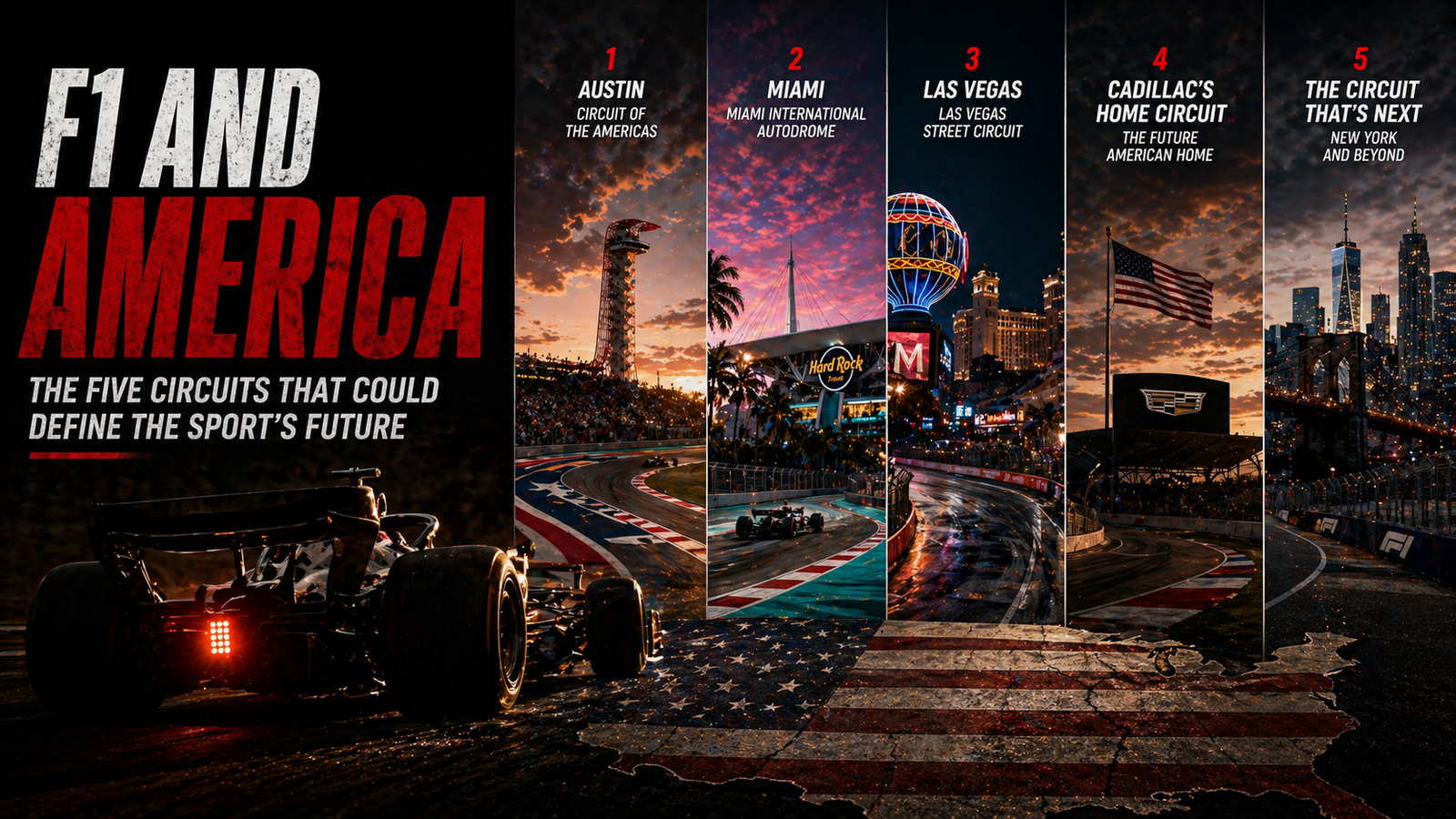

“America didn’t invent Formula 1, but it might just save it.” – Unknown
The Biggest Market in the World Has Finally Arrived
For most of Formula 1’s history, America was an afterthought.
The sport had its fans, it had its moments, it had the occasional race on American soil that generated interest before fading back into the wider landscape of a country where NASCAR, NFL, and basketball occupied the sporting consciousness in ways that left little room for a European racing series with complicated rules and no American team.
That has changed with a speed and completeness that nobody in the paddock fully predicted.
Drive to Survive on Netflix opened the door. The races that followed walked through it. The United States Grand Prix in Austin became one of the calendar’s most attended events. Las Vegas joined and immediately became one of its most watched. Miami arrived and sold out before the ink was dry.
Formula 1 in America is no longer a project. It is a phenomenon. And the circuits that host it are increasingly central to what the sport is becoming.
Here are the five that matter most.
1. Circuit of the Americas, Austin – The Spiritual Home
If any American circuit can claim to be Formula 1’s home in the United States, it is COTA.
Built specifically for Formula 1 and opened in 2012, the Circuit of the Americas was designed with the explicit purpose of producing great racing. The elevation changes, the flowing sector two, the long straight that produces genuine overtaking opportunities, all of it was constructed with the sport’s demands in mind rather than adapted from an existing facility.
Austin has delivered consistently. The crowd that fills it annually is among the most knowledgeable and passionate in the American calendar, a genuine mix of long-term F1 fans and the newer audience that the sport’s recent growth has produced. The racing has matched the setting more often than not.
COTA is where America’s relationship with Formula 1 was formalised. Everything that came after built on the foundation it laid.
2. Miami International Autodrome – The Spectacle
Miami is Formula 1 as cultural event first, racing second, and it makes no apologies for that.
The circuit around the Hard Rock Stadium is not the most technically demanding on the calendar. The racing is variable. The facilities and the atmosphere, however, are unlike anything else the sport produces. Miami has understood immediately what Formula 1’s American expansion is actually about, which is not purely the sport itself but the ecosystem around it, the celebrities, the music, the fashion, the sense that being at the Miami Grand Prix is a statement about who you are as much as a sporting attendance.
That might sound like a criticism. It is not. Formula 1 needs both the COTA and the Miami ends of the spectrum to sustain the growth it has achieved. The purists have Austin. The spectacle seekers have Miami. Both serve the sport.
3. Las Vegas Street Circuit – The Gamble That Paid Off
Formula 1 went to Las Vegas in 2023 and the reaction was, to put it generously, mixed.
The logistics were complicated. The racing was processional in the first edition. The Strip circuit, running past the casinos and hotels that define the city’s skyline, produced images that were spectacular in isolation but did not always translate into the wheel-to-wheel action that makes a grand prix memorable.
By the second and third editions, the event had found its rhythm. The night race format, the backdrop, the sheer visual scale of a Formula 1 car running past the Bellagio fountains at two in the morning, created something that no other sport could replicate. Las Vegas understood that it was selling an experience as much as a race, and once the circuit product improved, the combination became genuinely compelling.
It remains a work in progress. It is also here to stay.
4. Cadillac’s Home Circuit – The Wildcard
With Cadillac’s entry into Formula 1 as a full constructor from 2026, the conversation about American circuits takes on a new dimension.
An American team needs an American home race in the way that Ferrari needs Monza and Red Bull needs the energy of a European crowd that has followed them since the Vettel years. Whether that eventually means a street circuit in New York, a purpose-built facility somewhere in the midwest, or the elevation of an existing American round into something that feels specifically like Cadillac’s backyard remains to be seen.
What is certain is that the commercial logic of an American team competing in front of American crowds is too powerful to ignore for long. The circuit that eventually becomes Cadillac’s de facto home race will be one of the calendar’s most significant additions whenever it arrives.
5. The Circuit That Has Not Been Built Yet
The most important American circuit in Formula 1’s future may not exist yet.
There are credible conversations about a New York area race, a street circuit that would place Formula 1 in the world’s most famous city in the world’s most commercially valuable media market. The logistics are significant. The appetite, based on every attendance and viewing figure the American races have produced, is clearly there.
A New York Grand Prix would not just be another race on the calendar. It would be a statement that Formula 1 had completed its American transformation, moving from a sport that occasionally visited the United States to one that treated it as a core market with the same priority as Monaco, Silverstone, and Monza.
That transformation is already underway. The circuit that completes it will be one of the sport’s defining moments.
Why It Matters Beyond the Racing
Formula 1’s American expansion is not just a commercial story, though the commercial dimension is significant. It is a story about what the sport is becoming.
The audience that has arrived in America over the past five years is younger, more diverse, and more digitally engaged than the traditional European fanbase. It has brought with it different expectations, different ways of consuming content, and a different relationship with the drivers as personalities rather than purely as athletes.
The circuits that host the American races are the physical manifestation of that shift. They’re where the sport’s future is being built, one grand prix at a time.
Austin started it, Miami amplified it, and Las Vegas spectacularised it. What comes next will define whether the growth is sustained or whether it peaks and recedes.
Based on everything the data shows, the smart money is on sustained.
