
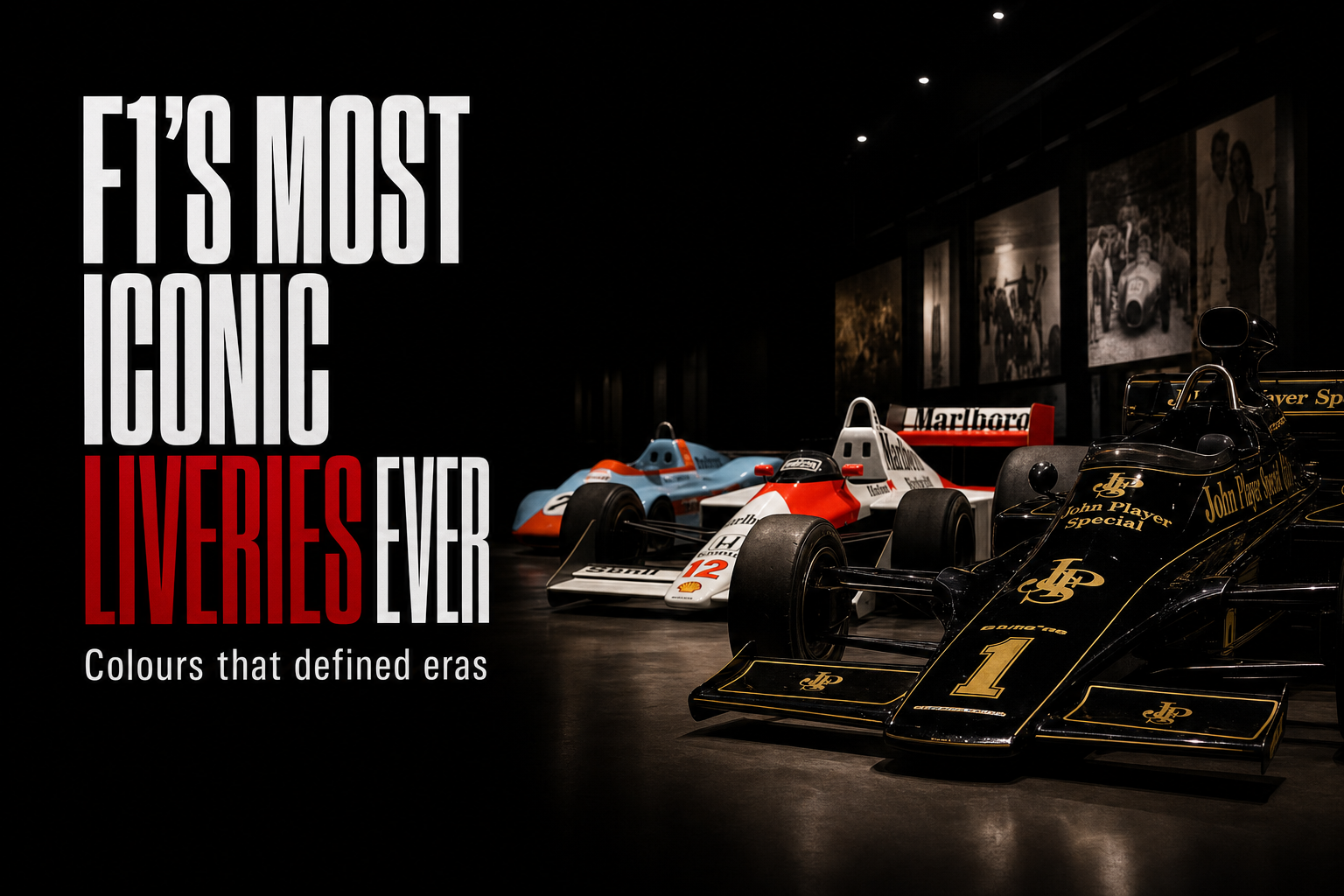

“A livery is the first thing people fall in love with before they even know what the car can do.
More Than Paint
A Formula 1 livery is never just a colour scheme.
It is identity, history, and emotion compressed into a few square metres of carbon fibre. The cars that fans recognise from across a paddock, from a single photograph, from a blurred image on a television screen, are recognisable because of choices made decades ago that became inseparable from what the team represents.
Some liveries were sponsor-driven, dictated by tobacco money or energy drink branding. Others were the product of national identity, technical heritage, or pure aesthetic instinct. What unites the liveries that have become genuinely iconic is that they outlasted the cars they were painted on and became symbols of something larger.
Here are the liveries that defined eras, and why they still matter.
Gulf Blue and Orange
The Gulf Oil livery, the pale blue and bright orange combination most associated with Ford GT40s and Porsche 917s at Le Mans, made its way into Formula 1 through several teams over the decades and remains one of the most universally recognised colour combinations in all of motorsport.
What makes Gulf livery enduring is its simplicity?
Two colours, applied with confidence, on cars whose shapes already commanded attention. When a modern team, such as Williams in recent seasons, has run a Gulf-inspired livery for sponsorship reasons, the reaction from fans has been disproportionate to what a simple paint scheme would normally generate – that reaction is the legacy talking.
Marlboro McLaren Red and White
The red and white McLaren livery of the late 1980s and early 1990s, carried by Senna and Prost during the most dominant period in the team’s history, is inseparable from the MP4/4 and the era it represents.
The livery itself was relatively understated by modern standards, but its association with the most successful season any constructor has produced gives it a weight that transcends its visual simplicity. When people picture peak McLaren, peak Senna, peak Formula 1 dominance, this is the image that comes to mind.
Ferrari Red
No discussion of iconic liveries can avoid Ferrari red, not because of any single specific shade or design but because of what red on a Formula 1 car has come to represent globally.
Rosso Corsa, the Italian racing red that Ferrari has carried since the team’s earliest days, is not merely a colour. It is shorthand for an entire philosophy of motorsport, for passion, for history, for the Tifosi and everything they represent. Other teams have used red – none of them mean what Ferrari red means.
Red Bull’s Dark Blue and Yellow
Red Bull’s livery, dark blue with the distinctive yellow, red and silver bull logo, represents something different from the historic liveries above. It is a brand identity translated directly into a racing colour scheme, energetic, modern, and instantly recognisable even to people with no interest in Formula 1.
The livery’s evolution across the Vettel and Verstappen championship eras has been remarkably consistent, which is itself notable. Teams that win consistently often resist changing what works, and Red Bull’s visual identity has become as associated with winning as any technical specification of their cars.
JPS Black and Gold
The black and gold livery carried by Lotus during the John Player Special sponsorship era of the 1970s and early 1980s remains one of the most striking designs the sport has produced.
It worked because black and gold is a combination that suggests luxury and menace simultaneously, and on a car driven by Mario Andretti or Ronnie Peterson, both qualities felt entirely appropriate. The livery has been referenced and revived by various teams in tribute liveries over the years, evidence that its visual power has not diminished with time.
Why Liveries Matter
In an era where Formula 1’s commercial structure changes constantly, where sponsors arrive and depart and teams rebrand with a frequency that can be difficult to follow, the liveries that endure in memory are the ones that became inseparable from genuine sporting achievement.
A livery on a losing car is just paint – a livery on a car that won a championship, that carried a legendary driver, that defined an era, becomes something else entirely.
It becomes the visual shorthand for a story that fans will tell for decades after the car itself has been retired to a museum.
That is the real power of a Formula 1 livery – not the colours themselves, but everything they come to represent once the racing is done.
How F1 Livery Design Actually Works
Designing an F1 livery is considerably more complicated than slapping a sponsor’s logo onto a paint template. Teams work with specialist automotive design agencies, and the process typically begins eight to twelve weeks before a car’s launch date. Designers must account for the car’s complex aerodynamic surfaces, meaning a colour or graphic that looks bold on a flat screen can appear fractured or distorted across sidepods, bargeboards and the curved nose cone. Most modern teams use 3D rendering software to simulate how a livery will read at speed, under television lighting and from grandstand distances.
The physical application has shifted dramatically over the decades. Early cars were painted using conventional automotive lacquer, which added measurable weight and could crack under the thermal stress of racing. Contemporary teams use vinyl wrapping for large colour areas, combined with direct paint for surfaces where vinyl adhesion is unreliable. Some teams apply a full base coat and then layer vinyl graphics on top. The total weight of a finished livery, including protective clear coat, is carefully logged because every gram matters against the FIA’s minimum weight regulations. Sponsor placement is negotiated separately from the design itself, with certain zones on the car commanding significantly higher fees based on television camera exposure data gathered from previous seasons. The halo, introduced in 2018, created an entirely new premium advertising surface that teams were initially uncertain how to incorporate aesthetically.
The Regulations That Govern What Teams Can and Cannot Display
F1 liveries are not entirely at a team’s creative discretion. The FIA’s Sporting and Technical Regulations place firm restrictions on what can appear on a car, and those rules have evolved substantially since the sport’s early decades. Tobacco advertising, once the financial backbone of the entire paddock, was effectively banned across the European Union by 2005 and phased out globally by most teams shortly after. Some constructors found creative workarounds, using abstract geometric patterns or barcode designs that were alleged to subliminally evoke cigarette branding, which prompted the FIA to tighten its guidelines further.
Beyond advertising content, teams must submit their livery designs to the FIA for approval before each season and before any mid-season changes. Regulations require that car numbers remain legible and positioned in specified zones, and that the driver’s name appears on the cockpit surround in a standardised format. There are also rules governing the use of national flags and symbols, particularly relevant for cars running under a constructor’s national identity. Colour itself can become a regulatory matter: two cars on the same grid cannot run liveries so similar that they create confusion for marshals or officials during an incident. This rule has occasionally forced minor palette adjustments when a new team’s chosen colours have been deemed too close to an existing constructor’s. Teams wishing to run a one-off special livery for a specific Grand Prix must submit revised documentation and receive clearance well in advance of the event.
