
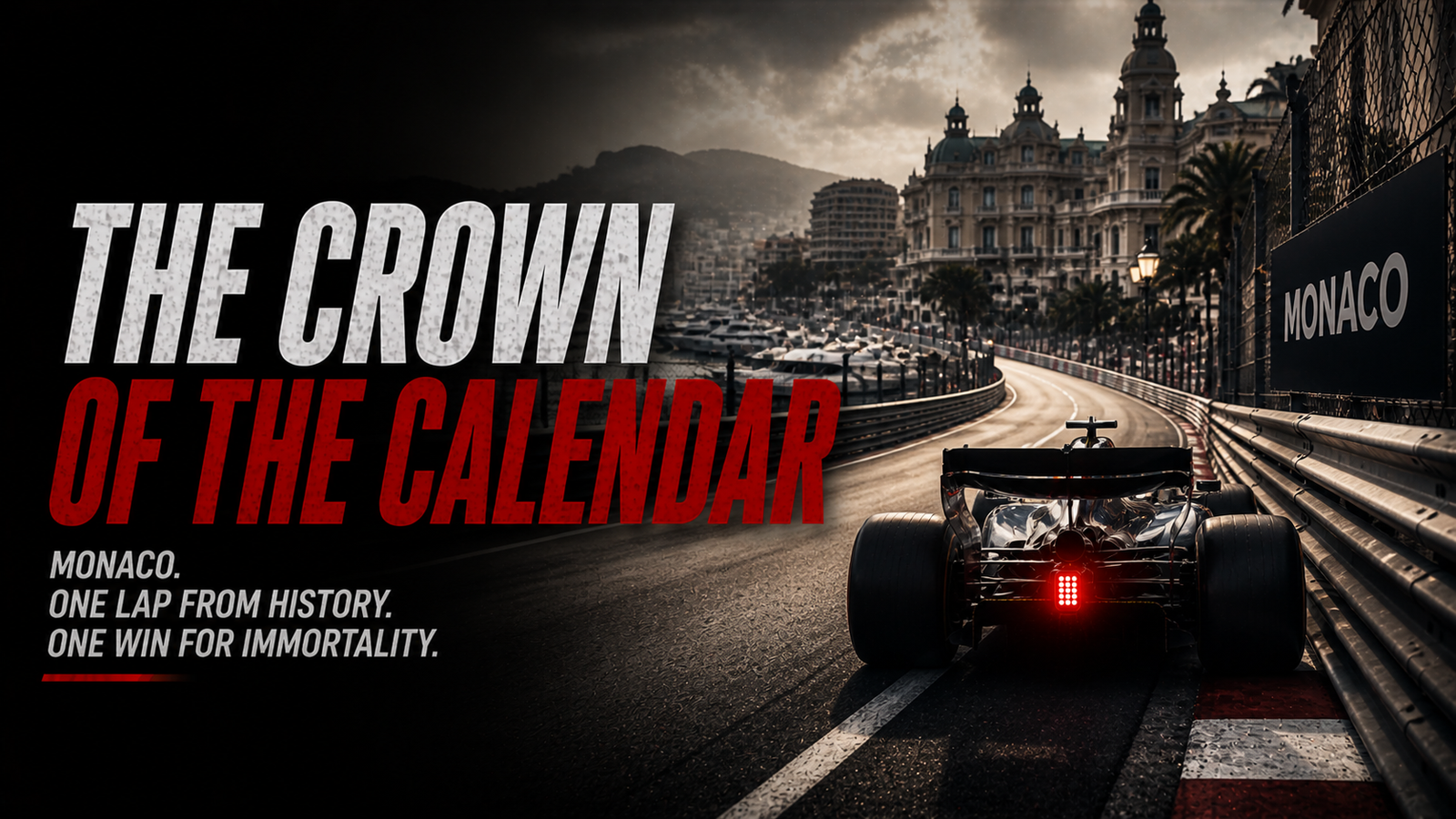

“To win in Monaco, you must be at one with the barriers.” – Graham Hill
The Race That Shouldn’t Work
By almost every objective measure of what makes a good Formula 1 race, Monaco should not be on the calendar.
The circuit is too narrow for overtaking, the barriers are too close for modern cars to race wheel to wheel with any real freedom and the safety car appears with a regularity that disrupts whatever strategic variety the race might otherwise produce.
Qualifying decides the outcome more reliably here than anywhere else on the calendar, and the procession that follows pole position can test the patience of even the most devoted fan.
And yet Monaco is not just on the calendar – it is the calendar, the race that every driver dreams of winning, the event that defines a career in a way that victories elsewhere simply do not, and the weekend that Formula 1 would sooner cancel Christmas than remove. The contradiction at the heart of Monaco is real, and so is the reason why it does not matter.
What Monaco Is
Monaco is not primarily a racing event, and it has not been primarily a racing event for decades, if it ever was. It is a spectacle, a cultural institution, a collision of the sport’s history, its glamour, its romance and its most extreme technical demands in a setting that no other race on earth can replicate.
The streets of Monte Carlo, the harbour, the tunnel, the Casino Square, the swimming pool section, these are not just corners and straights but places that carry the weight of everything that has happened there since the Monaco Grand Prix began in 1929, where every barrier has been hit by someone famous and every section of Armco has a story attached to it that predates the grandstands currently watching.
When a Formula 1 car goes through the tunnel at Monaco at 280 kilometres per hour with barriers inches from the bodywork, it is doing something that exists nowhere else in the sport, with a margin for error that is essentially zero and consequences for any mistake that are immediate and severe.
The skill required to do it consistently, lap after lap, in traffic, under pressure, is of a different character from anything demanded at a conventional circuit. Call it what you want, but it is something more interesting than good racing.
What Winning at Monaco Means
Ask any Formula 1 driver what victory they most want and Monaco will be near the top of the list for almost all of them, for reasons that are not complicated. Monaco rewards a specific and rare combination of qualities: absolute precision, psychological composure under sustained pressure, the ability to manage a car at the absolute limit of adhesion for two hours without a single significant error, and the racecraft to navigate traffic in conditions where any contact ends your race immediately. A driver who wins here has demonstrated something that a victory at a conventional circuit does not require in the same way, proving they can perform at the limit, for the duration, on the least forgiving surface in the sport.
Senna won Monaco six times, and on each occasion he started from a position of extraordinary qualifying pace, managed the race with a precision that left his engineers with little to add, and arrived at the chequered flag having produced something that felt less like a race win and more like a masterclass in controlled excellence.
His 1984 Monaco Grand Prix, where he drove a Toleman to within striking distance of Alain Prost’s McLaren before the race was controversially stopped in wet conditions, remains one of the most discussed performances in the sport’s history, a drive that produced no victory and left one of the decade’s defining moments permanently unfinished.
The Track That Has Not Changed
Part of what makes Monaco significant in the modern era is precisely its resistance to change, at a time when every other circuit on the Formula 1 calendar has been modified, resurfaced, redesigned or entirely rebuilt in the decades since the sport began. Safety requirements, commercial pressures and the changing demands of modern cars have transformed the circuits that host Formula 1 into facilities that would be unrecognisable to the drivers of the 1970s and 1980s – but Monaco, remains recognisable.
The layout that Senna raced on is substantially the same layout that exists today, the tunnel unchanged, the swimming pool section, added in 1973 – untouched since.
This is not purely a romantic observation – it means that Monaco is the one place on the calendar where historical comparisons have genuine meaning, where a lap time from 1990 and a lap time from 2026 are measuring performances over the same surface, through the same corners, under the same fundamental constraints, and that continuity is rare enough in modern sport to be worth something.
The Argument Against and Why It Misses the Point
The case against Monaco’s place on the modern Formula 1 calendar is not without merit – the racing is processional, the strategic variety is limited, and the circuit does not reward the technical capabilities of the current generation of cars in the way that a Silverstone or a Spa does.
If you were designing the perfect Formula 1 calendar from scratch today, with no history attached to any venue, Monaco would not make it on racing merit alone, but calendars are not designed from scratch and they are the product of history, identity and the accumulated meaning, that certain events carry beyond their sporting content.
Monaco carries more of that meaning than any other event in the sport – it is the race where Graham Hill won five times and became known as Mr Monaco, where Senna built his legend, where Schumacher somehow managed to crash into a barrier while apparently driving slowly enough to create a strategic advantage, where Verstappen has produced drives of extraordinary precision, and where careers are made and occasionally unravel in the most public way possible.
The racing may not always be good enough, but the event always is.
Why It Will Never Leave the Calendar
Formula 1 without Monaco would be a sport that had chosen efficiency over identity, and that choice would cost it more than any improvement in the quality of racing could recover, because the drivers know it, the teams know it, the commercial rights holders know it, and the fans know it too, even the ones who spend race Sunday watching cars follow each other around in a queue.
They watch because Monaco is Monaco, because the history is there in every barrier and every kerb, and because the driver who wins on Sunday afternoon has achieved something that winning elsewhere in the season does not quite replicate.
The racing may not always justify the hype – but the event always earns it.
