

“In Formula 1, every point is a battle. Every battle is a war.” – Bernie Ecclestone
It’s Not Just About Winning
Most casual Formula 1 fans understand the basics. First place gets the most points, last place gets nothing, and whoever has the most points at the end of the season wins the championship.
That understanding is correct. It is also incomplete in ways that matter enormously when a championship is close, when strategy is being made at the pitwall, and when a team has to decide whether to race for a win or protect a points position.
The F1 points system is deceptively simple on the surface and surprisingly complex underneath. Understanding it properly changes how you watch a race, how you read a championship, and how you appreciate decisions that can look strange from the outside but make complete sense when the numbers are applied.
How the Current System Works
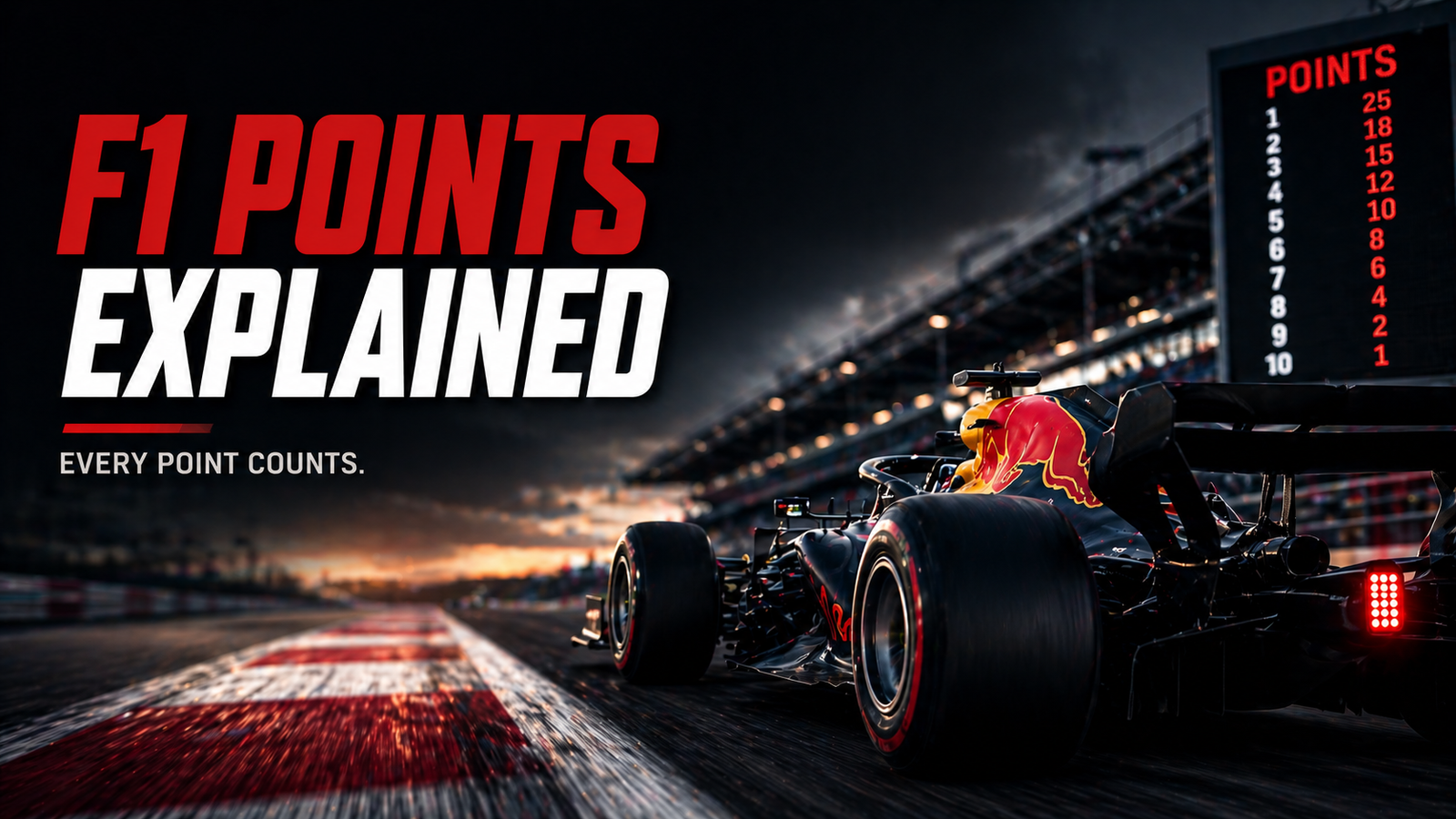
The current points system awards points to the top ten finishers in each grand prix, as follows:
1st: 25 points 2nd: 18 points 3rd: 15 points 4th: 12 points 5th: 10 points 6th: 8 points 7th: 6 points 8th: 4 points 9th: 2 points 10th: 1 point
An additional point is awarded for the fastest lap of the race, provided the driver recording it finishes in the top ten. Sprint races, held at selected rounds across the calendar, offer a smaller points allocation for the top eight finishers.
The Constructors’ Championship adds together the points scored by both drivers at each team, meaning that a team with two consistent points scorers can accumulate a significant advantage over a team that relies on one driver to carry the load.
Why the Gap Between First and Second Matters So Much
The seven point gap between first and second place is the single most important number in the championship mathematics.
Consider what it means across a season. A driver who finishes second in every race of a 24 race season scores 432 points. A driver who wins every race scores 600 points. The gap between a perfect season and a nearly perfect season is 168 points, which is the equivalent of almost seven race wins.
This is why teams and drivers will sometimes sacrifice a likely second place finish to attempt a win that carries significant risk. The points gap justifies the gamble in a way that a smaller differential would not. Equally, it is why a driver who is comfortably ahead in the championship will sometimes accept second place rather than risk a retirement, because the seven point swing between first and second is far less damaging than the 25 point swing between first and a non-finish.
The Fastest Lap Point
The additional point for fastest lap was reintroduced in 2019 after a long absence, and its effect on race strategy is more significant than its single point value might suggest.
In a close championship, one point can be the difference between winning and losing. The 2021 championship, decided by the final race of the season, was so tight that individual fastest lap points accrued across the season were part of the conversation about what might have changed the outcome.
The fastest lap point also creates strategic decisions in the closing stages of races that would not otherwise exist. A driver running in fourth who fits fresh tyres in the final laps to chase the fastest lap is accepting a small risk in exchange for a point that might matter more than it appears in November.
Sprint Races and the Points Complexity
The introduction of sprint races at selected rounds has added a layer of complexity to the points system that some fans find confusing and others find compelling.
Sprint races are shorter events, typically around 100 kilometres, held on Saturdays at selected grands prix. They award points to the top eight finishers on a descending scale from eight points for first down to one point for eighth.
The effect on the championship mathematics is modest at any individual event but meaningful across a full season. A driver who consistently performs well in sprint races can accumulate a points cushion that influences championship decisions later in the year. A driver who struggles in sprints while excelling in grands prix faces a structural deficit that their race performances have to compensate for.
How Points Shape Strategy
The points system is not just a way of recording results. It is a framework that actively shapes the decisions teams and drivers make throughout a race weekend.
A team that is 30 points ahead in the championship with five races remaining will approach those races differently from a team that is 30 points behind. The leader protects. The chaser attacks. Those different postures produce different strategies, different risk tolerances, and different racing.
This is why championship context is essential to understanding individual race decisions. A driver who appears to be racing conservatively in the closing laps is not necessarily lacking ambition. They may be protecting a points position that is mathematically more valuable than the additional points available by pushing harder and risking a mechanical failure or an incident.
The Championships That Came Down to Points Mathematics
The 2008 championship, decided on the final corner of the final race when Hamilton passed Timo Glock to claim fifth place and the single point he needed to beat Felipe Massa by a single point, is the most famous example of championship mathematics producing a moment of almost unbearable tension.
Hamilton needed fifth. He had fourth going into the final lap. He dropped to sixth when the rain hit. Then he passed Glock in the final corner. One point. One championship.
The 2021 championship between Hamilton and Verstappen was similarly shaped by points accumulation across the season, with penalties, retirements, and strategic decisions at individual races all feeding into a final day calculation that came down to a single race result.
These moments are not accidents. They are the inevitable product of a points system that keeps championships alive deep into the season and rewards consistency as well as outright pace.
Why It Matters for 2026
The 2026 season, with its new regulations and genuinely uncertain performance hierarchy, makes the points system more relevant than ever.
In a season where the fastest car changes from circuit to circuit, where teams are still learning their machinery, and where reliability is less certain than it is in a mature regulatory era, consistent points accumulation becomes more valuable than it is when one team is dominant.
A team that scores reliably in the eight to twelve point range every weekend while their rivals chase wins and occasionally retire will find themselves competitive in both championships by the summer. The points system rewards that approach, and in 2026 the approach may prove more effective than anyone predicts in March.
Understanding the mathematics is not just an academic exercise, it’s the key to understanding why Formula 1 is as strategically rich as it is, and why the championship is almost never as simple as whoever crosses the line first.
