
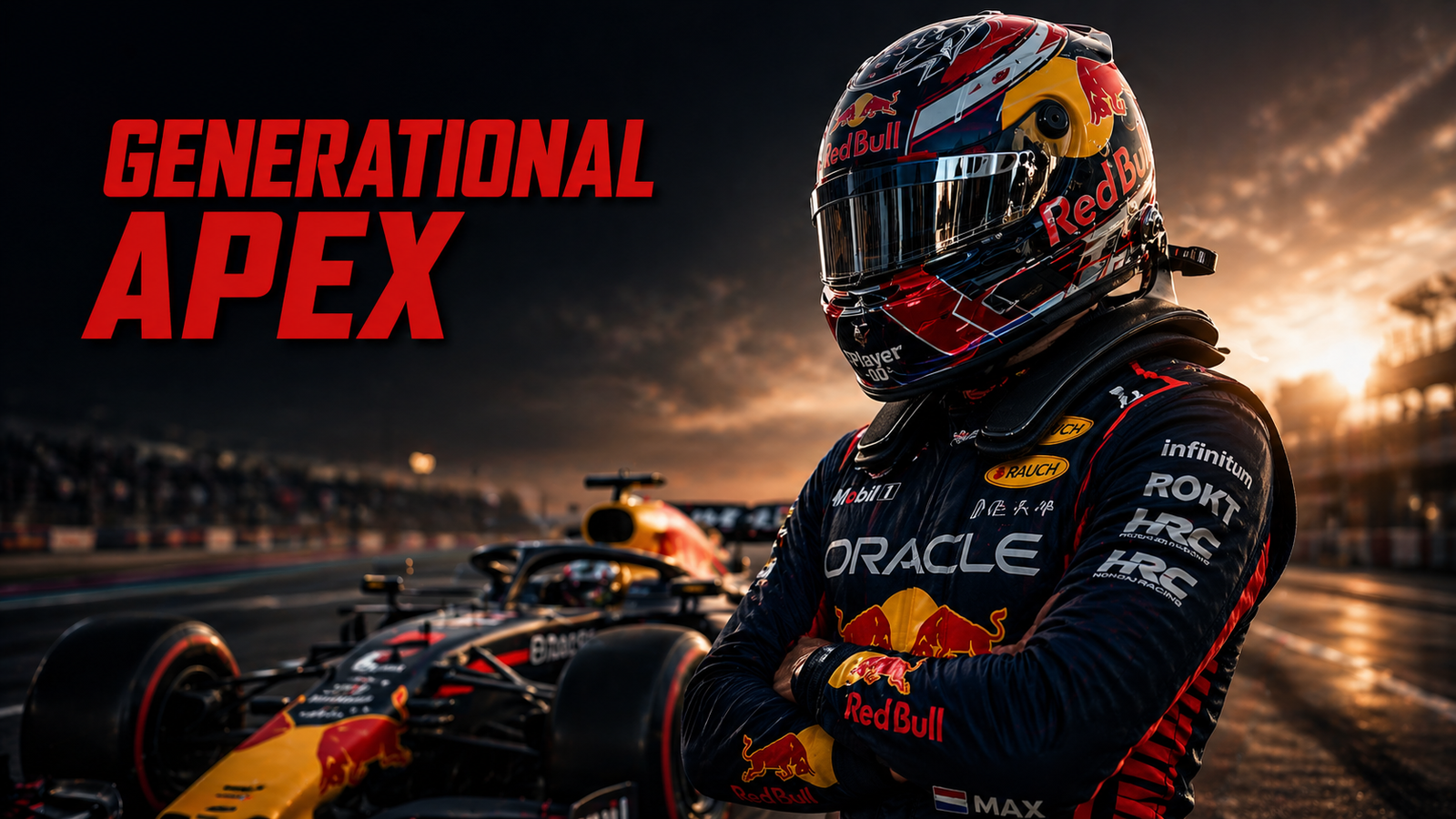

Why Verstappen Is Already the Greatest of His Generation
“I don’t think about records. I just want to win every race.” – Max Verstappen
The Argument Is Already Over
There is a version of this debate that requires more time to settle. More seasons, more championships, more data points before a conclusion can be drawn with any confidence.
That version does not apply to Max Verstappen’s place among his generation.
The argument is already over. It was probably over by the end of 2023. What remains is the formality of time confirming what the evidence already shows clearly.
Verstappen is 28 years old. He has four Formula 1 world championships. He has more race wins than drivers who spent entire careers being considered all-time greats. He has produced individual performances, in the wet, under pressure, in cars that did not deserve the results he extracted from them, that belong in the same conversation as anything the sport has ever seen.
The question is not whether he is the greatest of his generation. The question is how far beyond his generation the conversation should extend.
What Makes Him Different
The easiest way to assess a driver’s ability is lap times and championship results. By those measures, Verstappen’s case is already conclusive.
But the more interesting assessment is qualitative. What does he do that others cannot, and how consistently does he do it?
The wet-weather performances stand out first. Verstappen in the rain operates at a level that separates him from every contemporary on the grid. His 2021 Brazilian Grand Prix drive from the back of the field, his performance in Brazil in 2016 as a teenager in a car that had no right to be where he put it, his qualifying laps in conditions that caused multiple drivers to go off the road while he went faster than anyone. Rain removes the car’s advantage and reveals the driver. In the rain, Verstappen is in a category of one.
His ability to manage tyres over a race distance while maintaining qualifying-level pace in the closing laps is another quality that engineers across the grid describe in terms that approach disbelief. The conventional expectation is that pushing hard destroys tyres. Verstappen routinely pushes hard and destroys the competition instead.
And then there is the racecraft. The instinct for the moment, the commitment in wheel-to-wheel situations, the ability to read a race two or three moves ahead and position himself accordingly. These are learnable skills to a point, but the ceiling on them is innate, and Verstappen’s ceiling appears to be significantly higher than anyone currently sharing a grid with him.
The Championship Record in Context
Four championships is the number that defines the legacy in the record books, but the context around those championships matters.
The 2021 title was contested against Lewis Hamilton in perhaps the most equal fight the sport had seen in a decade. The outcome was controversial, but the season itself, the genuine back-and-forth between two drivers at the absolute peak of their abilities, was a demonstration that Verstappen could match the greatest of the previous generation on equal machinery.
The 2022, 2023 and 2024 titles were different in character. The Red Bull was dominant, particularly in 2023, and dominant machinery produces dominant champions as a matter of course. The question those seasons raise is how much of the achievement was Verstappen and how much was the car.
The answer, supported by the specific performances that stand out within those seasons, is that the car was a multiplier rather than the cause. In the races where the Red Bull was not fastest, Verstappen still found results. In the moments where the championship could have been lost through misfortune or error, it wasn’t. The consistency of excellence across varied conditions, varied circuits, and varied levels of competitive pressure is not something a car alone produces.
The Comparisons
Inevitably, the conversation extends to Schumacher and Hamilton.
Schumacher’s seven championships and Hamilton’s seven championships remain the record Verstappen is chasing. At 28, with years of competitive racing ahead of him, the arithmetic is straightforward. If he continues at anything approaching his current level, the record is reachable.
What is more interesting than the numbers is the nature of the comparison. Each of the three dominated their era with a completeness that made the championship feel almost predetermined in their peak seasons. Each extracted results from machinery that, on specific weekends, should not have produced those results. Each had a relationship with winning that went beyond professional ambition into something that looks, from the outside, closer to compulsion.
Verstappen is different from both in ways that are worth noting. He is more openly emotional than Schumacher, more willing to express frustration and joy in the moment. He is less political than Hamilton, less interested in the sport’s wider cultural narrative and more purely focused on what happens between lights out and the chequered flag.
Whether those differences matter to the historical assessment is a question for another decade. Right now, the relevant comparison is with his contemporaries, and that comparison is not close.
The Generation He Has Defined
Norris is exceptional. Leclerc is exceptional. Russell is excellent. Hamilton, in the closing years of a career that will never be adequately summarised, remains formidable.
None of them have beaten Verstappen in a championship fight when the machinery was comparable. Some have come close. None have crossed the line first.
That is the definition of the greatest of a generation. Not the absence of worthy rivals, but the consistent ability to be better than them when it matters most.
Verstappen has done, and continues to do it. The generation that came through with him will be remembered as genuinely talented, genuinely competitive, and definitively second.
That’s not a criticism of them, it’s is a measure of him.
