
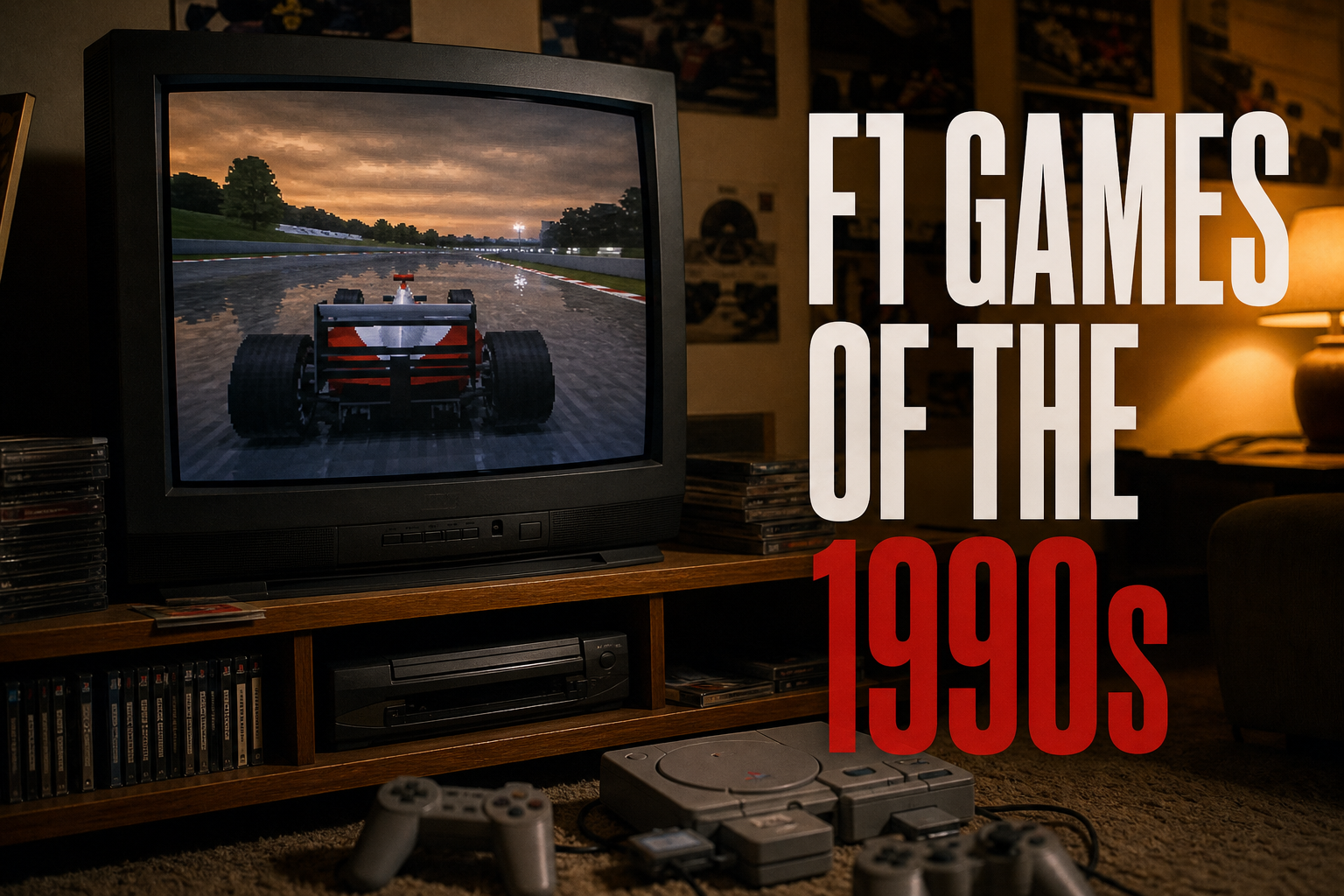

The Decade F1 Games Grew Up
Formula 1 video games exist today in a very particular shape. One annual release, console first, built on an official licence that covers every team and every driver on the current grid. That template did not fall out of the sky. It was built, slowly, across the 1990s, in a licensing environment that nobody had figured out yet and on hardware that changed every eighteen months. The result is a decade of F1 games that reads like a long, tangled argument about what a Formula 1 game should be, and which companies were allowed to call themselves one.
If you have landed on this page looking for a clean list of officially licensed Formula 1 games from the 1990s, by platform, the answer is further down. If you want the story of why the list is as short as it is, start here.
The Licensing Picture Before 1996
The first half of the 1990s was dominated by games that looked like Formula 1 without quite being Formula 1. The commercial reason was simple. The Formula One Administration, the holder of the sport’s commercial rights, did not run a predictable, straightforward licensing programme in the early part of the decade. The teams had their own name and image rights, Bernie Ecclestone’s FOA controlled the collective sporting rights, and the FIA sat on top of the regulatory structure. A developer who wanted to build a Formula 1 game had to negotiate with each of those parties separately. Most did not try.
The games that filled the gap worked around it in different ways. Some bought the rights to a single star driver and built the brand around him. Gremlin’s Nigel Mansell’s World Championship, released in 1992 across every major home platform of the era from MS-DOS to the Mega Drive, held a Mansell licence and ran with it. Sega’s Ayrton Senna’s Super Monaco GP II, also 1992, carried a Senna endorsement and ran the circuits and lap times he had actually driven, but the surrounding grid used placeholder names. These were not Formula 1 games in the modern sense. They were F1 games the way an unauthorised biography is a biography of its subject: close enough to count, legally arranged around the single piece of permission the publisher could actually afford.
At the simulation end of the market, Geoff Crammond’s Grand Prix shipped in 1992 for MS-DOS, Amiga and Atari ST. It was an extraordinary technical achievement, considered by sim veterans even now as the beginning of the modern racing simulation. The teams and circuits were real. The drivers, in the base release, were not. A later patch inserted the real names once the licence situation shifted. Crammond’s game was a lesson in what a serious F1 game could look like once the technology caught up with the ambition, and it set the sim-focused audience up for the sequel that would, four years later, change everything.
1995: F1 Challenge Breaks the Seal on Console
The first fully officially licensed Formula 1 game of the decade on a modern console was F1 Challenge, released in 1995 for the Sega Saturn and published by Virgin Interactive. It carried the FOCA licence for the 1995 season, meaning every team, every driver, every circuit and the correct liveries were in place from the start. The game itself was received as competent rather than exceptional, but its historical importance is hard to overstate. It demonstrated to Formula One Administration that there was a serious market for console-based licensed games, and it opened the door that Bizarre Creations and Psygnosis would walk through the following year.
The Breakthrough: Formula 1 (1996)
The 1996 Psygnosis release of Formula 1, developed by Bizarre Creations in Liverpool and published on PlayStation and Windows, is the game that defined the entire modern template. It carried a full FOCA licence covering the 1995 season. Every team was in. Every driver was in. Every circuit was in, modelled with the level of detail that the first PlayStation hardware could reasonably render. Murray Walker and Martin Brundle commentated the races, in character, recording lines that still get quoted on sim-racing forums thirty years later.
The commercial numbers tell the story. Formula 1 sold more than three million copies worldwide, making it one of the fastest-selling PlayStation titles of its generation. For a huge cohort of fans in the UK and Europe, Formula 1 on PlayStation was the Formula 1 game, the one they played before they ever watched a race in full. Its template, meaning an annual release, console-first, licensed, voiced by the ITV commentary team, became the industry’s expectation of what an F1 game should look like. Codemasters would eventually inherit that template in the 2010s, but the pattern was Psygnosis’s.
Formula 1 97, 98 and 99: The Murray Walker Years
The three Psygnosis sequels followed in annual succession. Formula 1 97, released at the end of 1997 for PlayStation and Windows, upgraded the physics model and the handling, kept Murray Walker and Martin Brundle in the booth and expanded the career mode. Formula 1 98, released in 1998 for PlayStation only, moved to the Visual Sciences development team and brought a notably improved visual presentation. Formula 1 99, released in 1999 for PlayStation and Windows, closed the decade with the final Psygnosis title before Sony’s internal reorganisation moved the series.
Alongside the mainline series, Psygnosis published Official Formula One Racing in 1998 for Windows, developed by Visual Sciences. It carried the same FOCA licence as the PlayStation line and functioned as the PC audience’s entry into the Psygnosis stable. Separately, the Nintendo 64 received F1 Pole Position 64, also from Bizarre Creations, which brought a version of the Psygnosis template to Nintendo’s platform in 1997.
Grand Prix 2 (1996): The Simulation Flag-Bearer
Four years after the original, Geoff Crammond and MicroProse delivered Grand Prix 2 for MS-DOS. It carried the FOCA licence for the 1994 Formula 1 season, which meant real teams, real drivers (bar the Senna substitution noted below) and real liveries throughout. The physics model was deeper than anything on the console side. The AI opponents, famously, raced with distinct personalities, taking different lines through the same corners. Players could set up the car in a level of mechanical detail that would not become routine on consoles for another decade.
Grand Prix 2 was a 1996 release in Europe and the United States but shipped with the 1994 season because the licensing deal had been locked years earlier. The San Marino weekend was included with Ayrton Senna replaced by a fictional driver, in a decision taken out of respect following the events of that race. For sim enthusiasts, Grand Prix 2 remains the high-water mark of 1990s PC Formula 1 games, and the title that most sim veterans will name first when the decade is discussed.
Nintendo 64 Joins In: F-1 World Grand Prix (1998)
Not every important F1 release of the 1990s was officially licensed. Ubisoft’s F-1 World Grand Prix, released in 1998 for the Nintendo 64 and later ported to Dreamcast and Game Boy Color, was the N64 generation’s standout Formula 1 title. It did not hold a FOCA licence. Teams and drivers were present under modified names and liveries, close enough that any viewer of the 1997 season would recognise what the game was depicting but legally distinct from what Psygnosis was shipping on PlayStation. For N64 owners it was the only serious F1 option available on the platform during the console’s commercial peak, and it sold accordingly.
The 1990s Officially Licensed F1 Games, By Year and Platform
Partially Licensed and Unlicensed Standouts
Three further 1990s titles deserve mention because their quality or their cultural footprint earned them a place in the decade’s F1 game story, even without a full grid licence.
Nigel Mansell’s World Championship (1992). Gremlin’s game held a single-driver licence covering Mansell. Teams and the rest of the grid used fictional names. Released across MS-DOS, Mega Drive, SNES, NES, Game Boy and Amiga, it was the first serious attempt to build a mass-market F1 game around a specific driver’s championship campaign.
Ayrton Senna’s Super Monaco GP II (1992). Sega’s follow-up to the 1989 Super Monaco GP brought Senna in as collaborator and face of the game. It released for Mega Drive, Master System and Game Gear. The licence covered Senna’s name and image only, with the surrounding grid rendered under placeholder teams.
F-1 World Grand Prix (1998). Ubisoft’s N64 release did not carry a FOCA licence but was for most of the console’s lifespan the only credible Formula 1 game available on Nintendo 64. Later ports to Dreamcast and Game Boy Color extended its reach into 1999 and 2000.
What the 1990s Gave the Modern F1 Game
The format that EA Sports now ships every July (annual release, console-first, licensed across the full current grid, broadcaster-voiced commentary) is the Psygnosis template. The decision to anchor the brand to the PlayStation audience rather than the PC audience, to prioritise the arrival of each season over the long tail of a given game, to treat the real commentary team as part of the product, those were all decisions made in Liverpool between 1996 and 1999. The Codemasters era that ran from 2009 to 2022 inherited them. The EA Sports era that began in 2023 inherited them again.
The sim community’s own template, descending from Grand Prix 2, has had a more fragmented inheritance. The deep physics modelling, the mechanical setup granularity, the driver-personality AI model have all survived in modern sim platforms like iRacing and rFactor 2. The lineage from Crammond’s work to modern sim racing is direct, even where no specific line of code carried over.
What was lost in the transition from Psygnosis to Codemasters, and arguably from Codemasters to EA Sports, is less tangible. The 1990s games were made by small teams that cared about F1 the way their audience did. The modern games are made by huge teams for a market that includes casual players, broadcast tie-in watchers and competitive esports entrants. The reach is bigger. The specific texture of a Bizarre Creations product, the Liverpudlian wit of the menu voice-overs, the quirks that made Formula 1 97 feel personal, those have not come back.
If the modern F1 game canon interests you, we have a wider survey in F1 video games through the years, which covers every era from Pole Position in 1982 to the current F1 series. For the drivers who defined the 1990s era that these games depicted, our pages on Michael Schumacher, Damon Hill and Mika Häkkinen cover the careers you probably played through in your PlayStation years.
Officially Licensed 1990s F1 Games — Frequently Asked
What was the first fully officially licensed F1 game of the 1990s?
F1 Challenge, released in 1995 for the Sega Saturn and published by Virgin Interactive. It carried a full FOCA licence for the 1995 Formula 1 season, with every team, driver, circuit and livery present.
Which 1990s F1 game is considered the most influential?
The 1996 Psygnosis Formula 1, developed by Bizarre Creations. It sold more than three million copies on PlayStation and Windows and established the annual, console-first, fully licensed template that EA Sports still uses today.
Was Grand Prix 2 officially licensed?
Yes. Geoff Crammond’s Grand Prix 2, released in 1996 by MicroProse for MS-DOS, carried a FOCA licence for the 1994 Formula 1 season, which is why it ran that season rather than the current year of release.
What 1990s F1 games were released on Nintendo 64?
Three main titles: Psygnosis’s F1 Pole Position 64 in 1997 (officially licensed), Ubisoft’s F-1 World Grand Prix in 1998 (not FOCA licensed) and its sequel F-1 World Grand Prix II in 1999, also unlicensed in the FOCA sense.
Was Nigel Mansell’s World Championship officially licensed?
Only partially. The 1992 Gremlin release held a licence covering Mansell’s name and likeness. The rest of the grid used fictional driver names, so the game is best described as single-driver licensed rather than fully FOCA licensed.
Did Sony hold an exclusive Formula 1 licence in the 1990s?
No. Sony’s exclusive Formula One licence period began in the 2000s. In the 1990s Sony’s involvement was through its Psygnosis subsidiary, which published four officially licensed F1 titles on PlayStation across the decade alongside parallel sim titles from MicroProse and Virgin that also held FOCA licences in their own right.
Related picks on Amazon
A few things worth a look if this review got you curious. Links are affiliate: buying through them supports the site at no extra cost to you.
- Grand Prix 2 (MicroProse, 1996) PC CD-ROM: shop on Amazon
- Grand Prix 3 (MicroProse, 1999) PC CD-ROM: shop on Amazon
- Formula 1 (1996) PlayStation, Psygnosis: shop on Amazon
- Formula 1 97 PlayStation disc + case: shop on Amazon
- Formula 1 98 PlayStation: shop on Amazon
- Formula 1 99 PlayStation: shop on Amazon
- Nigel Mansell’s World Championship Racing (1992): shop on Amazon
- Ayrton Senna’s Super Monaco GP II (1992) Sega: shop on Amazon
- F-1 World Grand Prix (1998) Nintendo 64: shop on Amazon
- F1 Pole Position 64 (1997) Nintendo 64: shop on Amazon
- Original PlayStation console (grey) refurbished: shop on Amazon
- Murray Walker: Unless I’m Very Much Mistaken (autobiography): shop on Amazon
- F1 25 (EA Sports / Codemasters) PlayStation 5: shop on Amazon
- F1 25 (EA Sports / Codemasters) Xbox Series X|S: shop on Amazon
- F1 25 (EA Sports / Codemasters) PC Steam key: shop on Amazon
- Logitech G923 TRUEFORCE racing wheel + pedals (PS/PC): shop on Amazon
- Logitech G29 Driving Force racing wheel (PS, entry-level): shop on Amazon
- Playseat Challenge foldable sim racing cockpit: shop on Amazon
- Next Level Racing GTtrack sim racing cockpit: shop on Amazon
