
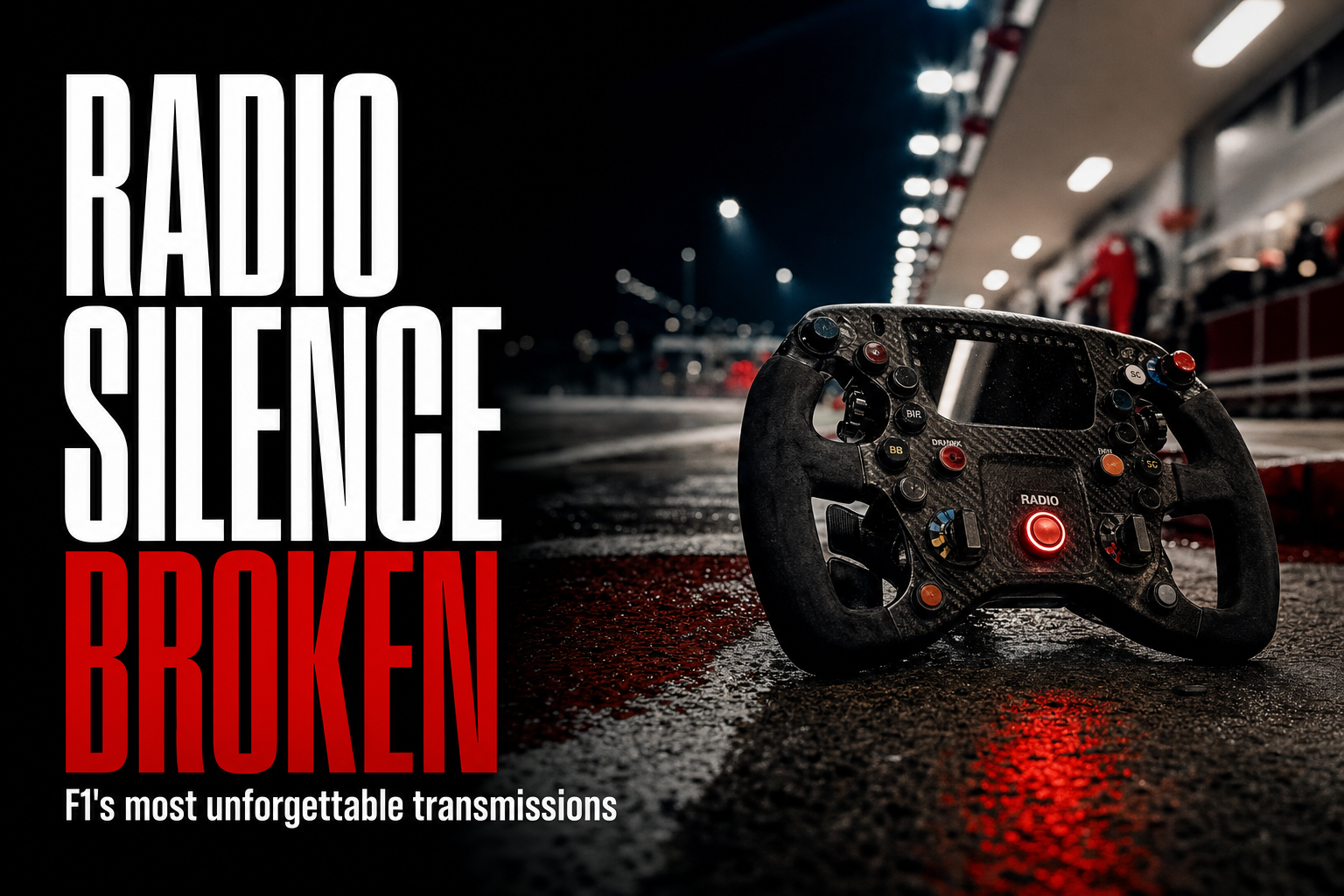

“In Formula 1, the radio is where the truth comes out.
What the Radio Reveals
For most of Formula 1’s history, the conversations between drivers and their engineers were private, conducted through radio systems that the broadcast audience never heard and that were considered an internal operational matter rather than entertainment.
That changed as broadcasts became more sophisticated and as the sport recognised that the radio exchanges, in the heat of a race, under pressure, between a driver at the absolute limit and the engineer trying to help them perform, produced moments of genuine human drama that no scripted content could replicate.
The team radio has given Formula 1 some of its most memorable moments, from the technical to the emotional to the occasionally very funny.
Here are the exchanges that have stayed with the sport long after the races that produced them.
“Multi 21, Seb” – Malaysia 2013
Perhaps the most famous team radio moment in the sport’s recent history, this exchange between Red Bull and Sebastian Vettel during the 2013 Malaysian Grand Prix exposed a team orders situation with a directness that the sport rarely sees in public.
Multi 21 was a coded instruction telling Vettel to hold position behind his teammate Mark Webber, who was leading the race. Vettel ignored the instruction, overtook Webber, and won the race. The radio exchanges that followed, from both Vettel and Webber, captured the raw frustration of a team order situation gone wrong with a clarity that made the incident one of the most discussed of that season.
Vettel’s subsequent apology on the podium and in the media was the formal response.
The radio told the real story.
Kimi Raikkonen: “Leave Me Alone, I Know What I’m Doing”
Raikkonen’s radio communications were a category unto themselves throughout his career, combining technical brevity with a directness that occasionally crossed into exchanges that became genuinely famous beyond the paddock.
His response during the 2012 Abu Dhabi Grand Prix, when his engineer’s attempts to provide information were met with the instruction to leave him alone because he knew what he was doing, captured the essence of The Iceman’s relationship with conventional team communication so precisely that it became one of the sport’s most shared audio clips.
The delivery, flat and final without a trace of irritation or humour, was somehow funnier than any more expressive response would have been.
Fernando Alonso: “GP2 Engine, GP2”
Alonso‘s radio message during the 2015 Malaysian Grand Prix, commenting on the Honda engine powering his McLaren with a comparison to the lower formula’s specification, was a moment of extraordinary candour from a driver who was rarely less than completely managed in his public communications.
The message was heard by the broadcast audience and became immediately famous, not because of the frustration it expressed, which was understandable given the Honda engine’s difficulties that season, but because of the directness with which Alonso expressed it whilst the race was still happening around him.
It became shorthand for the entire McLaren-Honda period’s difficulties, and its continued reference years after the partnership ended demonstrates how effectively a single radio message can encapsulate a situation that technical analysis alone cannot fully communicate.
James Hunt: Various
The radio era of modern Formula 1 means that the most memorable exchanges are predominantly from the last two decades, but Hunt’s commentary from his television career produced observations about drivers and situations that operated in a similar register, spontaneous, honest, and occasionally startling in their directness.
His influence on how the sport communicates with its audience, the precedent he set for saying what was actually true rather than what was diplomatically appropriate, runs through the broadcast culture that eventually made team radio a feature rather than a private operational tool.
Nico Rosberg and Lewis Hamilton: Singapore 2017
The radio exchanges between Nico Rosberg and Lewis Hamilton during their championship years at Mercedes produced moments of tension that the broadcast audience was occasionally allowed to hear, carefully selected by the production team to convey the dynamic between two drivers in the same team fighting for the same championship.
The 2017 exchanges, by which point their relationship had deteriorated to a point where direct communication was limited, captured something about the specific tension of intra-team rivalry that the race footage alone could not convey.
Why the Radio Matters
Team radio transformed Formula 1 from a purely visual spectacle into something with an audio dimension that adds genuine understanding of what is happening behind the wheel.
When a driver reports that the car feels wrong, that a tyre has gone, that another driver has done something that has compromised their race, the listener is given access to the race as the driver experiences it rather than as the cameras capture it.
Those are different things, and the gap between them is where much of Formula 1’s real story lives.
The most memorable radio moments are the ones where that gap closes completely, where the driver’s unfiltered reaction to what is happening becomes the most honest account of the race available.
Those moments are unpredictable, unscripted, and irreplaceable, which is exactly why they stay in the memory long after the results have been filed in the history books.
How Team Radio Actually Works in Formula 1
Every word exchanged between a driver and their pit wall travels through a surprisingly complex system before it reaches the public. Teams use encrypted digital radio on dedicated frequencies allocated by the FIA, meaning rival outfits cannot simply tune in and listen. The signal passes through a series of trackside repeaters positioned around the circuit, because the sheer volume of barriers, grandstands and infrastructure would otherwise cause dead spots where communication drops entirely. Engineers on the pit wall wear noise-cancelling headsets and speak through throat microphones in some cases, helping to cut out the wall of engine and crowd noise that would otherwise make conversation almost impossible.
Broadcast teams receive a separate, delayed feed from the FIA, which acts as a gatekeeper for what goes to air. There is typically a short delay applied specifically to allow for the removal of commercially sensitive or genuinely offensive content before transmission. Drivers wear a push-to-talk button, usually mounted on the steering wheel, though some teams configure voice-activated systems during specific phases of a race. The onboard microphone quality has improved dramatically since the early 1990s, when crackling AM-style transmissions made messages difficult to decipher even at close range. Today, the audio clarity is good enough that tone, frustration and humour all come through cleanly, which is a large part of why these exchanges resonate so strongly with fans watching at home.
The Regulations That Govern What Drivers Can and Cannot Say
Formula 1’s Sporting Regulations place clear boundaries on how teams may use radio communications during a race weekend. Since 2016, the FIA has enforced strict rules limiting the technical guidance engineers are permitted to give drivers while the car is moving. The intent was to push more of the cognitive workload back onto the driver rather than allowing engineers to essentially co-pilot the car through complex tyre management or fuel-saving instructions. Specific phrases relating to driving lines, braking points and throttle application are prohibited, and stewards can review radio transcripts when investigating potential breaches.
Beyond technical coaching, the regulations also address conduct. Bringing the sport into disrepute through radio transmissions is treated as a disciplinary matter, and the FIA has issued warnings and fines to both drivers and team personnel for language deemed inappropriate for broadcast. Teams are required to make their radio logs available to the FIA on request, and the governing body retains recordings from every session across a full race weekend. There is also a commercial dimension: teams cannot use radio to pass information that would constitute insider trading under the financial regulations governing the sport. What sounds like a spontaneous, unfiltered conversation between a driver and their engineer is therefore operating within a fairly detailed legal and regulatory framework, even if the emotion in those exchanges is entirely genuine.
Additional Insights
The race engineer on the other end of those transmissions rarely gets much credit. When Vettel ignored the Multi 21 call in Malaysia, it was his engineer Rocky (Guillaume Rocquelin) who had to manage the fallout in real time, relaying messages between a furious Mark Webber and a team principal who was watching from the pit wall. The radio captures the driver’s voice but the engineer’s job in those moments is almost impossibly difficult. If you want a clearer picture of what that role actually involves, Inside the Role of an F1 Race Engineer covers the full scope of it.
Raikkonen’s Abu Dhabi moment works partly because of how unusual it was to hear a driver speak to his engineer that way on a live broadcast. Most drivers, even the outspoken ones, keep a professional filter running. Alonso’s GP2 engine comment was different again because it wasn’t directed at his engineer at all. It was a verdict delivered to the air, almost to nobody. That’s what made it land so hard. He wasn’t complaining to someone. He was just stating a fact he couldn’t keep inside any longer.
It’s also worth thinking about how the sport’s relationship with team radio has shifted across generations. Hunt’s era had no broadcast radio at all. By the Schumacher years at Ferrari there were famous coded messages and strategic calls that only made sense in retrospect. The current grid operates knowing every word might end up clipped and shared within minutes. That awareness hasn’t killed the spontaneous moments but it has changed the texture of them. Drivers like Hamilton have occasionally used the radio almost rhetorically, knowing the audience is listening. Whether that makes the moments less authentic is a genuine debate among fans.
The dynamic between teammates produces the sharpest radio moments almost every time. The Rosberg-Hamilton tension across their championship battles generated exchanges that were carefully worded but unmistakably loaded. That same pattern shows up across F1’s family and partnership histories too. Proximity breeds friction and the radio catches it raw before anyone has had time to compose a press conference answer.
