

“A racing circuit is the closest thing to a living creature that man has ever built.
Watching a Formula 1 car through a corner at 300 kilometres per hour tells you one thing. Driving that same corner yourself tells you something else entirely. The camber you never noticed from the grandstand. The blind entry that looked straightforward on the broadcast. The braking zone that arrives faster than you expected. The circuit makes sense from the driver’s seat in a way that watching never quite manages.
The good news is that several circuits associated with Formula 1 open their gates to the public. Some offer full track days where you bring your own car. Others run organised experiences in purpose-built road cars. All of them give you something that no television screen can.
Silverstone, Great Britain
Silverstone is the most accessible major Formula 1 circuit in the world for public driving. The programme runs throughout the year and covers everything from hot hatchback sessions to supercar experiences, with instruction available for anyone who wants guidance on the circuit’s specific demands.
The Maggotts, Becketts and Chapel sequence is the one that gets people. It looks flowing and almost gentle from above. From the driver’s seat it’s a completely different proposition. The direction changes come faster than your brain expects and the commitment required to carry real speed through the combination produces an instant and lasting respect for the drivers who take it flat at racing pace.
Track days at Silverstone are available through multiple operators and can be booked directly through the circuit’s website. If you’re only going to drive one F1 venue in your life, this is the most practical choice for most fans.
Circuit de Spa-Francorchamps, Belgium
Spa offers track days through its own programme and through a wide range of third-party operators. It’s one of the most celebrated circuits in the world and also one of the most demanding.
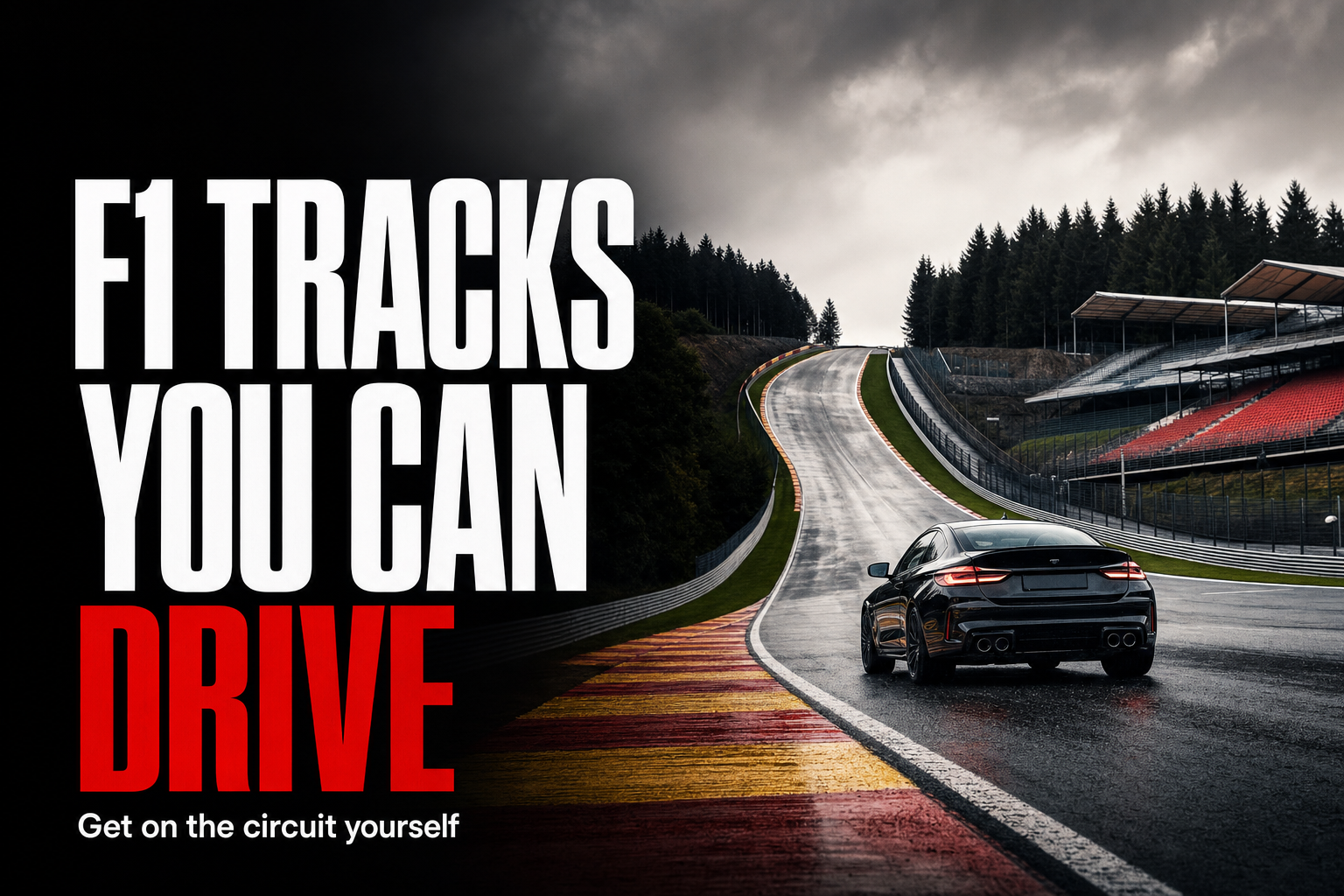
Eau Rouge and Raidillon is the moment every driver talks about. The compression at the bottom, the blind crest, the commitment required to carry speed up the hill. At road car speeds it’s manageable. At anything approaching a real pace it becomes a genuine examination of everything you have as a driver. Every F1 fan who has driven it describes the experience the same way: you come out the other side with a completely different understanding of what the professionals are doing.
The Ardennes weather adds something extra. It can change from dry to wet within a single lap at certain times of year, which is precisely the kind of condition that defines the Belgian Grand Prix. Driving in those conditions yourself makes the race coverage feel much more real.
Autodromo Nazionale Monza, Italy
The Autodromo Nazionale Monza opens to the public through track days and organised experiences across the year. It’s the fastest circuit on the F1 calendar and even in a road car the long straights produce speeds that feel genuinely quick.
The chicanes that replaced the old banking break up the straight-line sections but the slipstreaming opportunities that define the Italian Grand Prix are present even at road car pace. The straight-line nature of large portions of the circuit rewards positioning and drafting in a way that most other venues simply don’t. It’s a different kind of driving lesson compared to Spa or Silverstone, but an equally valuable one.
Circuit de Barcelona-Catalunya, Spain
Circuit de Barcelona-Catalunya is no longer on the 2026 Formula 1 calendar — that slot now belongs to the new Madring circuit — but it remains fully operational and continues to run track experiences throughout the year. The number of driving experience operators based in and around Barcelona who use it as their primary venue means availability tends to be good, and the circuit’s layout covers a wide range of demands across a single lap.
The first sector is medium-to-high speed corners that reward smoothness. The middle and final sectors are more technical. The long Turn 3 right-hander produces significant lateral g-force even in a road car and is the corner most visitors remember longest. For anyone who wants to understand the varied demands of a full F1-style lap, Barcelona is one of the better places to experience that variety in a single session.
The Nordschleife, Nurburgring, Germany
Strictly speaking the Nordschleife isn’t the Formula 1 circuit. The shorter Grand Prix layout sits adjacent to it. But no list of circuits that fans can actually drive would be complete without the 20.8 kilometre Nordschleife.
It opens to the public on Tourist Days throughout the year. Anyone with a road car and a ticket can drive it. Over 150 corners. Significant elevation changes. A history in motorsport so dense that driving it produces a connection to the sport’s past that no other circuit can offer.
It also produces accidents among inexperienced visitors with some regularity. The conventional advice is clear: attend a track day run by an operator who provides instruction rather than turning up on a public session without previous circuit experience. The circuit demands respect and preparation. Arrive without either and it will find you out quickly.
For any F1 fan who wants to understand what circuit driving actually demands at its most extreme, the Nordschleife is the most complete answer available anywhere in the world.
What These Experiences Actually Give You
None of these experiences will show you what it feels like to drive a Formula 1 car. Nothing available to the public can do that. The speeds, the downforce, the braking forces and the physical demands of an F1 car are simply not replicable in anything a fan can access.
What they give you is the circuits themselves. The actual tarmac. The actual corners. The actual braking zones and cambers and blind crests that drivers like Max Verstappen and Lewis Hamilton have navigated at three times the speed you’ll manage.
Once you’ve been through Eau Rouge under your own power or navigated Maggotts and Becketts with your own hands on the wheel, you watch the professionals do it differently. The appreciation isn’t abstract anymore. It’s grounded in something you’ve actually felt. That’s what makes these experiences worth doing. Not the speed. The understanding.
If you want to go deeper on the circuits and the vocabulary of the sport before you book anything, the F1 glossary on this site covers the terminology you’ll encounter at any track day briefing.
Further reading
- Silverstone Circuit official site — The official source for booking Silverstone driving experiences, directly relevant to the article’s main recommendation.
- Nurburgring official Touristenfahrten information — The primary source for Nordschleife Tourist Day information, directly relevant to the article’s section on public driving at the Nurburgring.
Related picks on Amazon
A few things worth a look if this article got you curious. Links are affiliate: buying through them supports the site at no extra cost to you.
- Driving a Formula 1 Car by Mark Hughes — shop on Amazon
- Motorsport driving gloves for track days — shop on Amazon
- Helmet for track days and circuit driving — shop on Amazon
- Nurburgring Nordschleife circuit guide book — shop on Amazon
