Physical Address
304 North Cardinal St.
Dorchester Center, MA 02124
Physical Address
304 North Cardinal St.
Dorchester Center, MA 02124

“I just want to win.”
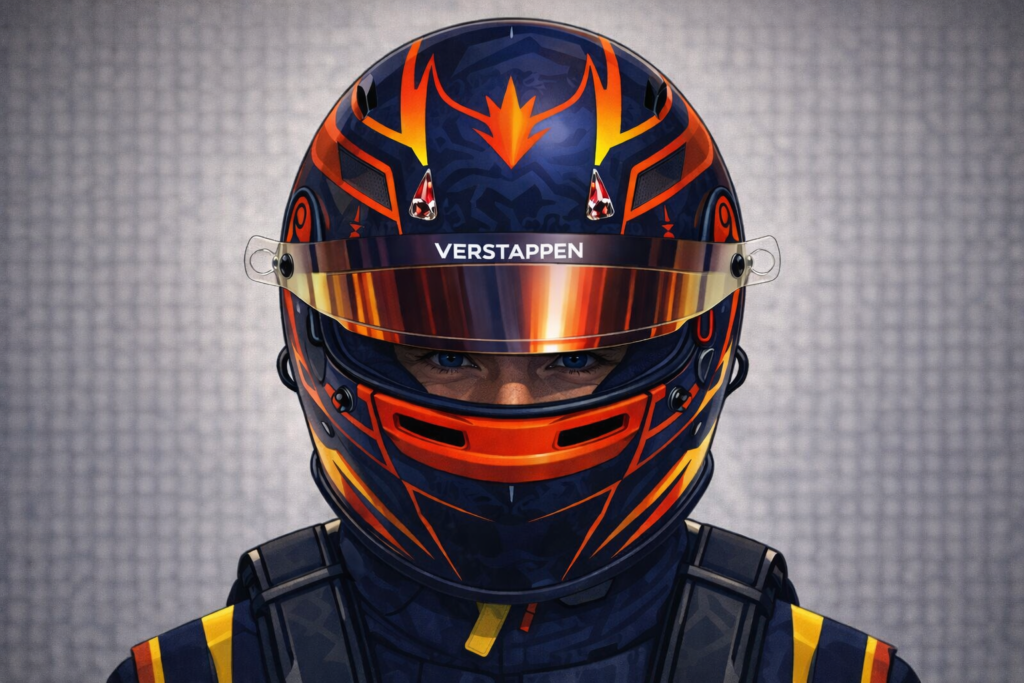
Max Verstappen has never been subtle about what he’s here to do. From the moment he arrived in Formula 1 as a teenager, it was obvious he wasn’t interested in learning patiently or waiting his turn. He raced like someone who assumed he belonged at the front – and expected everyone else to move accordingly.
What began as raw aggression has evolved into something far more dangerous. Verstappen is no longer just fast or fearless. He’s controlled. Complete. Relentless. He isn’t chasing history – he’s rewriting it.
Verstappen has reshaped what dominance looks like in modern Formula 1.
This isn’t the measured, clinical supremacy of past eras. It’s loud, unapologetic, and radically precise. He wins races from pole, from the back, in the dry, in the wet, under pressure, without pressure, and often without looking like he’s even reached his limit.
More importantly, he’s forced the entire grid to recalibrate expectations. Drivers don’t just aim to beat him anymore. They aim to survive weekends where he exists.
When Verstappen is on the grid, the reference point moves – for strategy, for pace, and for what everyone else considers possible.
Verstappen’s early years were anything but smooth.
He was fast – spectacularly so – but also reckless. Late lunges. Aggressive defending. Incidents that divided opinion almost weekly. Critics questioned his maturity, his judgment, and whether raw talent alone was enough at this level.
Then Red Bull handed him a race seat mid-season in 2016.
He won immediately.
That moment didn’t just silence doubts. It confirmed something deeper. Verstappen didn’t need time.
He needed trust.
What followed was a gradual sharpening rather than a reinvention. The mistakes lessened. The racecraft matured. The decision-making became colder. The speed never left.
What changed was how efficiently it was deployed.
When Verstappen is in control, the race feels closed.
He controls races from the front with metronomic precision, managing pace, tyres, and gaps with an air of inevitability. When attacking, he commits fully. When defending, he leaves no ambiguity.
There’s a clarity to his driving that’s almost unsettling. No wasted motion. No emotional fluctuation. No visible doubt.
Even when conditions are chaotic, Verstappen looks anchored – like everything else is moving around him.
It isn’t flashy dominance – it’s absolute control.
Away from the circuit, Verstappen is famously uninterested in the celebrity side of Formula 1.
There’s no obsession with image. No desire to play the media game. He treats racing as a job – a serious one – and everything else as background noise.
He doesn’t romanticise the sport. He doesn’t mythologise himself. He turns up, does the work, and expects results.
Interestingly, Verstappen has openly said he would walk away from Formula 1 the moment it stops being enjoyable or competitive for him, showing little interest in longevity for its own sake.
That mindset explains a lot.
He races like someone with nothing to protect and nothing to prove – making him extremely hard to beat.
At Oracle Red Bull Racing, Verstappen is the centre of gravity.
The team is built around him – technically, strategically, emotionally. Car philosophy, development direction, and race execution all flow outward from his feedback and preferences.
It works because the relationship is unflinchingly honest. Red Bull backs him completely.
Verstappen delivers without compromise.
Together, they’ve created one of the most efficient winning operations the sport has ever seen.
And there’s little sign they’re finished.
The debate around Verstappen has shifted.
It’s no longer about whether he’s the best driver on the grid. That conversation is effectively over. The question now is where he fits historically – and how far he actually wants to push it.
Will he chase records endlessly? Will he leave early? Will motivation ever fade?
No one knows. Possibly not even him.
What is certain is this: while Max Verstappen is racing at this level, Formula 1 revolves around his pace.
Everyone else is reacting.
As of the 2026 Formula 1 season, Max Verstappen drives for Red Bull Racing.
As of 2026, Max Verstappen is a multiple-time Formula 1 world champion, with his first title coming in 2021.
Max Verstappen is 28 years old for most of the 2026 season.
Max Verstappen is Dutch.
Max Verstappen races with number 1 as the reigning champion, and he has also used number 33 earlier in his career.
Driver line-ups can change year to year; check Red Bull’s official 2026 driver announcement for Verstappen’s confirmed team mate.
As of 2026, Verstappen is widely reported to be on a long-term contract with Red Bull extending into the late 2020s, subject to any clauses.
He is known for elite racecraft, high consistency, and strong pace in changing conditions, including wet-weather performance.
He rose quickly through karting and single-seaters and debuted in Formula 1 as a teenager, becoming the youngest driver to start an F1 race.
Yes. Verstappen is heavily involved in sim racing and often uses it for practice and competition outside of Formula 1 weekends.