Physical Address
304 North Cardinal St.
Dorchester Center, MA 02124
Physical Address
304 North Cardinal St.
Dorchester Center, MA 02124

“I’m stupidly competitive.”
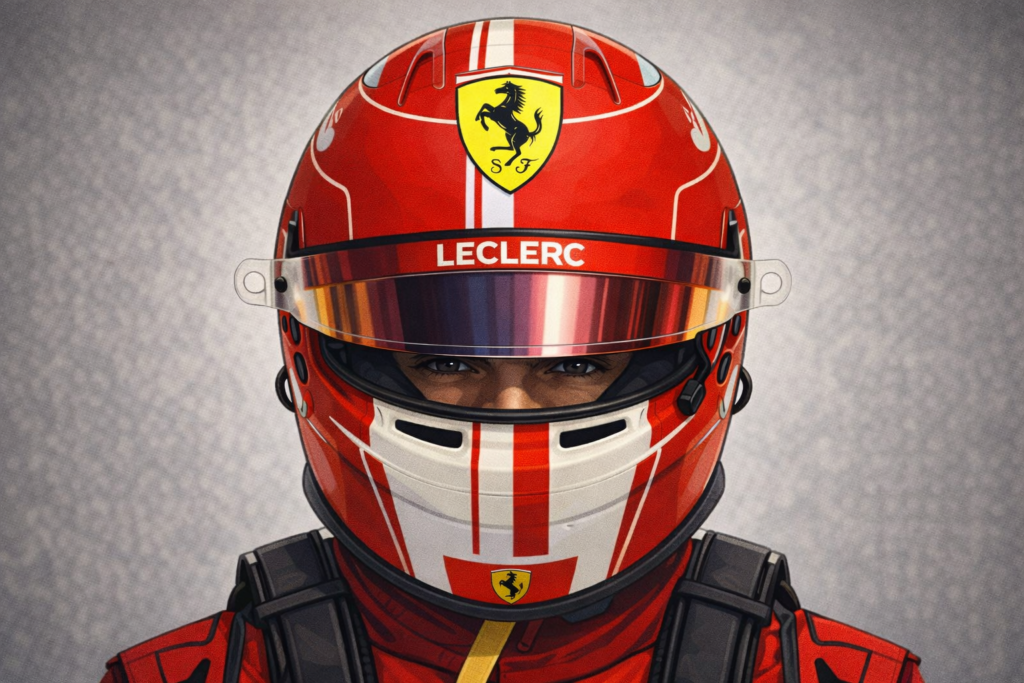
Charles Leclerc doesn’t shout for attention. He doesn’t need to. From the outside, he looks almost too polished for Formula 1: calm voice, movie-star looks, impeccably media-trained. But underneath that surface is one of the most emotionally driven, obsessively competitive drivers on the grid. A Ferrari driver in the most Ferrari way possible – fast, passionate, occasionally brilliant, occasionally heartbreaking.
Leclerc has been part of the sport’s conversation since his teens. A Monaco prodigy. A junior-category standout. Fast-tracked to Ferrari before most drivers have even figured themselves out. And since then, he’s lived under the heaviest spotlight Formula 1 can offer. Not because he demanded it – but because Ferrari did.
Simply put, Leclerc matters because he represents Ferrari’s future – and their constant dilemma. He is fast enough to win championships. Everyone in the paddock knows it. On raw pace alone, few drivers can touch him over a single lap. When the car is good, he can make it look sensational. When it isn’t, he can still drag it somewhere it probably doesn’t belong.
But Ferrari isn’t just a team. It’s a pressure cooker. And Leclerc has been living inside it since his early twenties. He’s carried expectations that break most drivers – especially in Italy, where Ferrari drivers aren’t just athletes, they’re symbols. The fact that he’s survived that pressure, matured through it, and still comes back fighting every season says a lot about his resilience.
Leclerc hasn’t just endured Ferrari.
He’s grown up within it.
Leclerc’s rise wasn’t long – it was sharp. After dominating GP3 and Formula 2 in back-to-back rookie seasons, he arrived in Formula 1 in 2018 with Sauber and immediately looked like he didn’t belong there. Because he was already too good for it.
Ferrari moved quickly. One season later, he was wearing red. Wins came early. Poles came often. The trajectory looked obvious. The narrative wrote itself.
And then Formula 1 did what Formula 1 does. Car performance fluctuated. Strategies went sideways. Championships slipped away before they really began. Leclerc became known not just for speed, but for what could have been. It’s an unfair label – but it’s also part of the story he’s still trying to rewrite.
Over a single lap, Leclerc is pure precision. He’s clinical in qualifying. He commits early, trusts the front end completely, and extracts lap time in places other drivers hesitate. When he’s hooked up, the car looks light, balanced, and alive.
In races, he’s aggressive but clean. He’ll fight when it matters – and sometimes when it doesn’t. That intensity has cost him before, but it’s also what makes him dangerous when momentum is on his side.
Emotionally, he’s transparent. You hear it on the radio. The frustration. The disappointment. The belief that it should have been more.
You never wonder how Charles Leclerc feels.
He tells you – even when he probably shouldn’t.
Leclerc is intensely private by Formula 1 standards. Away from the circuit, he keeps a low profile, stays close to his family, and avoids the celebrity side of the sport whenever possible. Personal loss early in life shaped much of his outlook – giving him a seriousness and focus that runs deeper than his public persona suggests.
Music, particularly piano, has become a way for him to switch off. It’s a contrast to the intensity he carries into the cockpit, and a reminder that much of his processing happens quietly, away from cameras. Interestingly, Leclerc composes music on piano in his downtime, often using it to process difficult race weekends – a creative outlet that sits in stark contrast to the precision he demands from himself on track. That perfectionism fuels his speed – and aptly explains the pressure he places on himself.
Charles Leclerc’s career is still being written – but one question continues to linger.. Will Ferrari finally give him the car, the strategy, and the consistency needed to convert talent into titles? Or will he become another chapter in Ferrari’s long history of ‘almosts’?
What’s clear is this: Leclerc hasn’t plateaued. He’s smarter now. More controlled. Less reckless with his emotions. Still brutally fast.
If Ferrari ever gets it right, he’ll be ready.
And if they don’t?
Formula 1 may one day have to reckon with just how much of Charles Leclerc’s potential it never truly saw.
As of 2026, Charles Leclerc drives for Scuderia Ferrari in Formula 1.
As of the 2026 season, Charles Leclerc is 28 years old for most of the year.
Charles Leclerc is Monégasque (from Monaco).
Charles Leclerc races with number 16.
As of 2026, Charles Leclerc’s Ferrari team mate is Lewis Hamilton.
As of 2026, Charles Leclerc has not won a Formula 1 world championship.
He progressed through karting and the FIA junior ladder, winning the GP3 Series (2016) and FIA Formula 2 (2017) before reaching Formula 1.
Charles Leclerc joined Ferrari for the 2019 Formula 1 season.
He is known for strong qualifying pace, precise car control, and assertive wheel-to-wheel racing.
He is known for a relatively low-key public profile and a strong connection to Monaco, and he has spoken publicly about his interest in music and piano.