
“It’s been a long time coming, hasn’t it? I always knew we have it in us, and I have it in me somewhere.” – Nico Hülkenberg
More Than a Ceremony
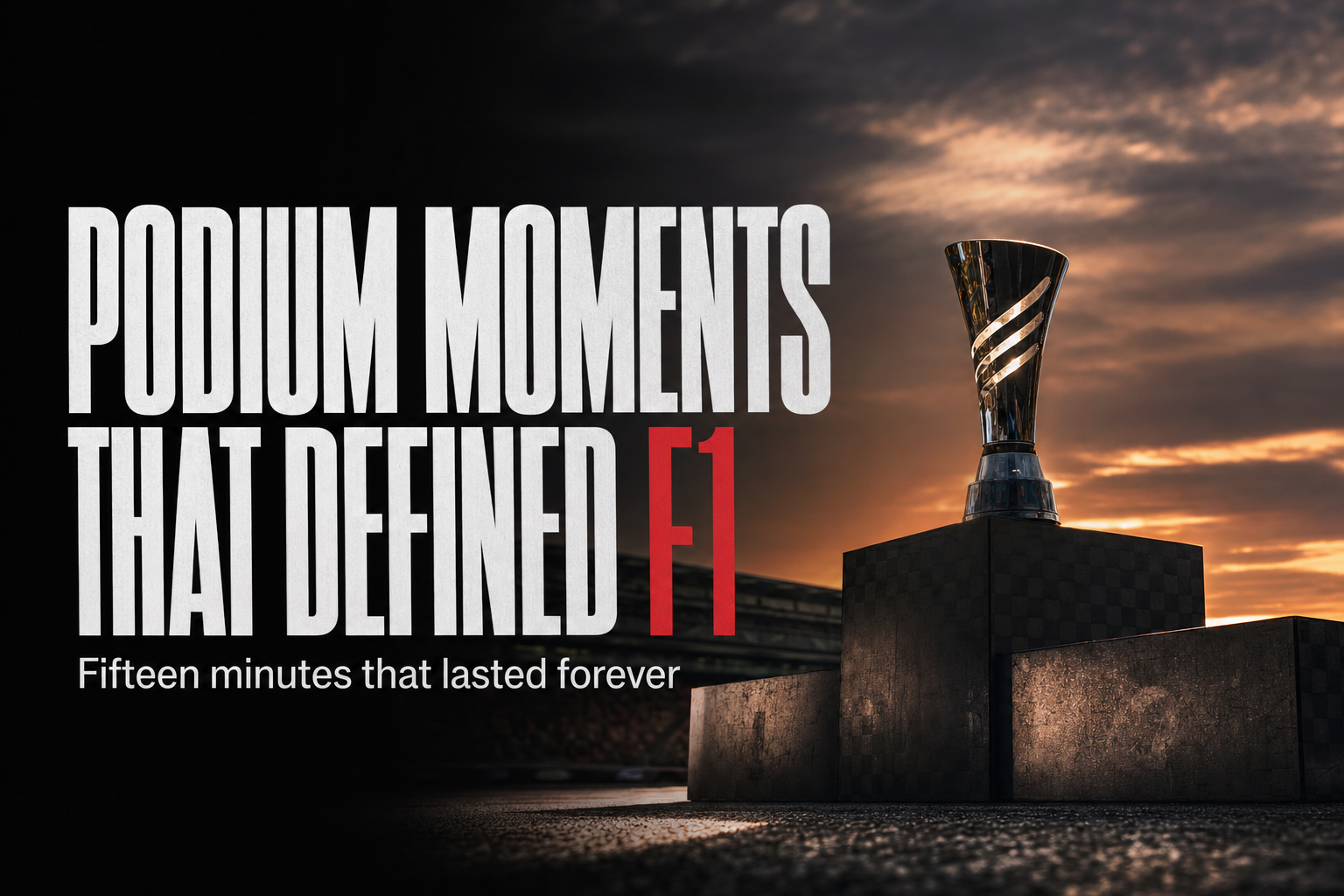
The Formula 1 podium is a three-step structure at the end of a race weekend. It holds three drivers, plays three national anthems, and distributes three trophies. By the time the champagne has been sprayed and the crowd has begun to disperse, it has been standing for less than fifteen minutes.
And yet some of the sport’s most enduring images come from those fifteen minutes, moments that have been photographed, broadcast, and replayed so many times that they exist in the collective memory of Formula 1 fans independent of any context beyond the image itself.
The podiums that matter are not necessarily the ones where the most significant championship points were distributed. They are the ones where something human happened on those three steps, something that went beyond the result and became a moment.
Schumacher and Barrichello, United States 2002
The 2002 United States Grand Prix at Indianapolis produced one of the most discussed finishing moments in Formula 1 history, when Michael Schumacher attempted to have his teammate Rubens Barrichello cross the finish line ahead of him as a gesture of recognition for Barrichello’s loyal service through what had been a season of team orders controversies.
The attempt, executed at the last possible moment before the finish line, produced a margin of victory measured in fractions of a second that made it appear, to some observers, as though Schumacher had almost lost the race rather than chosen to gift it. The gesture was real but its execution was awkward enough to generate a reaction that was more complicated than the intention had been.
On the podium, both drivers’ emotions were visible in a way that the controlled press conference environment rarely allows. The moment captured something true about the dynamic between a dominant driver and a loyal teammate that the season’s official narrative had not fully expressed.
Senna’s Final Victory
Ayrton Senna’s final Formula 1 victory came at the 1993 Australian Grand Prix in Adelaide, the last race of the season and the final time he stood on the top step of a Formula 1 podium. The image of Senna embracing Alain Prost after years of fierce rivalry became one of the defining moments of the sport, symbolising the mutual respect that ultimately developed between two of Formula 1’s greatest rivals. In hindsight, knowing it would be Senna’s final victory before his death the following year, the podium has taken on an emotional significance that nobody present could have anticipated at the time.
Villeneuve’s Championship Podium, 1997
Jacques Villeneuve’s championship clinching podium at the 1997 European Grand Prix in Jerez was preceded by one of the most controversial incidents in Formula 1 history, Schumacher’s collision with him that the FIA subsequently judged to be a deliberate attempt to end the championship fight.
Villeneuve continued after the collision, finished third, and took the championship. His podium celebration, conducted against a backdrop of the most significant regulatory consequence the sport had imposed in years, Schumacher’s disqualification from the entire 1997 season, produced images of a driver who had been through something extraordinary and was processing it in real time.
The champagne spray was the same as every other podium, though everything else about those fifteen minutes was specific to that moment and that season.
Hamilton’s Record-Equalling 91st Win
When Lewis Hamilton won the 2020 Eifel Grand Prix at the Nurburgring to equal Michael Schumacher’s all-time record of 91 Formula 1 victories, the podium ceremony included a moment that neither driver had scripted.
Schumacher’s son Mick, present at the circuit in his capacity as a junior driver, brought Hamilton a cap that had belonged to his father, presented as a gesture of acknowledgment from the Schumacher family that the record had been equalled by someone worthy of the comparison.
Hamilton‘s reaction on the podium, visibly moved in a way that his controlled public persona does not always permit, produced one of the most genuine moments of sporting emotion that Formula 1 has captured in recent years. The image of Hamilton holding Schumacher’s cap on the podium where he had just equalled Schumacher’s record is one that requires no caption for anyone who follows the sport.
Brawn GP, Australia 2009
The podium at the 2009 Australian Grand Prix, where Jenson Button stood on the top step for a team that had been given away for a nominal sum three months earlier and had been expected by many observers to not even make the grid, produced a reaction from Ross Brawn and the team’s personnel that captured the specific character of the Brawn GP story more completely than any subsequent interview or documentary.
Button’s podium celebration was restrained by the standards of a driver who had just won his first race of the season in a car that had no right to be as fast as it was. The celebrations in the garage and from the team around him were not restrained at all, and the footage of Brawn, characteristically composed throughout a career of extraordinary achievement, allowing himself a moment of visible emotion on the wall of the garage, has become one of the season’s defining images.
Vettel’s First Championship Podium, Abu Dhabi 2010
The 2010 championship was decided in Abu Dhabi in circumstances that required Sebastian Vettel to win the race whilst both of his title rivals, Fernando Alonso and Mark Webber, failed to score sufficient points. When the result became clear, the podium that followed was one of the sport’s more extraordinary emotional spectacles, a young German driver processing the realisation that he had become world champion for the first time in a manner that produced visible disbelief alongside the celebration.
Vettel’s youth at the time, twenty-three years old and the youngest champion in the sport’s history at that point, meant that the magnitude of what had happened was arriving in real time rather than being processed with the composure that older champions tend to bring to the moment.
The podium images from Abu Dhabi 2010 capture something about what it feels like to win a Formula 1 championship for the first time that more composed celebrations cannot contain.
Why Podiums Matter
The podium is where Formula 1 allows itself to be human for a few minutes.
The controlled environment of the race weekend, the press conferences, the team communications, the management of information and image that modern Formula 1 demands from everyone involved, is briefly suspended on those three steps, where the drivers have just finished something that demanded everything they had and are processing the result with cameras pointed at their faces.
The moments that endure from Formula 1 podiums are the ones where the processing is visible, where the emotion of what has just happened breaks through the professional composure and produces something that feels true rather than performed.
Those moments are rare.
The podiums where they occur are the ones that define the sport’s human story as much as any lap time or championship points total.
How the Formula 1 Podium Ceremony Evolved Over the Decades
The podium ritual that fans recognise today, complete with national anthems, trophy presentations and champagne spraying, is a surprisingly modern construction. In the early decades of the world championship, which began in 1950, there was no standardised ceremony at all. Winners were often congratulated informally on the pit straight, trophies handed over in makeshift presentations and photographers left to scramble for position. The sport’s commercial explosion in the 1970s changed everything. Bernie Ecclestone’s grip on television rights from 1981 onwards meant broadcasters needed a clean, repeatable visual moment that could anchor race coverage globally.
The champagne tradition itself predates that era, tracing back to Dan Gurney spontaneously spraying a bottle at Le Mans in 1967, a gesture that filtered into Formula 1 shortly after. The FIA gradually formalised podium procedures through the 1980s and 1990s, standardising the raised platform, the order of trophy presentations and the timing of the anthem. Today the ceremony is governed by strict protocols in the Sporting Regulations, including which officials may attend, how long the anthem runs and where the constructors’ trophy is handed over. Some circuits use regional variations, such as non-alcoholic sparkling wine at events held in countries with restrictions on alcohol promotion. What looks spontaneous is, in practice, one of the most choreographed three minutes in motorsport.
The Points and Positions: What a Podium Finish Actually Means Statistically
Finishing on the podium in Formula 1 carries weight far beyond the trophy. Under the current points system, introduced in 2010, a race winner collects 25 points, second place earns 18 and third place takes 15. That gap between first and third, just ten points, can look modest across a single race but compounds dramatically over a season. Drivers who consistently convert front-row starts into podiums rather than victories can still mount serious championship challenges, as the points structure rewards reliability and consistency alongside outright pace.
Statistically, podium finishes are one of the most commonly cited benchmarks when comparing drivers across different eras, precisely because the metric exists across the entire history of the championship even when points systems changed. Michael Schumacher held the all-time podium record for years before Lewis Hamilton surpassed it, with Hamilton accumulating well over 190 podium finishes by the mid-2020s. For constructors, podium ratios per season are used internally to measure car competitiveness relative to rivals. A team finishing on the podium at more than half of the season’s rounds is generally considered to have a front-running package. For drivers outside the top teams, a single podium in a season can define contract negotiations, sponsorship conversations and their entire public profile for the following year.
